
Keepers of the Royal Genealogy
Carved into a stone slab four feet high, three and a half feet wide, and just six inches thick, the Batu Tarsilah records the genealogy of Brunei's sultans from 1363 to 1804 in elegant Jawi script. The original stands near the Royal Mausoleum in Bandar Seri Begawan, but a careful replica occupies a gallery inside the Brunei History Centre on Jalan Stoney -- a quiet government building where researchers have spent four decades piecing together the story of one of Southeast Asia's oldest continuous monarchies. UNESCO's "Memory of the World" program has identified the Batu Tarsilah as one of Brunei's most important documentary legacies. The institution charged with studying and safeguarding that legacy opened its doors on 25 January 1982, created by royal decree so that the history of the sultanate would belong not just to the palace but to the people.
A Sultan's Mandate
The Brunei History Centre owes its existence to a single memorandum. On 26 January 1982, Sultan Hassanal Bolkiah approved the establishment of a dedicated research institution -- Memorandum Number SUK.06/84/92, issued by the Menteri Besar of Brunei. The previous day, the Centre's building at Jalan Stoney in Bandar Seri Begawan had been officially opened. Its mandate was straightforward: conduct research, gather documents, and disseminate historical knowledge about Brunei for the benefit of the people. Initially, the Centre shared space with the Dewan Bahasa dan Pustaka Library at Jalan Elizabeth II before moving to its own purpose-built facility. The timing was deliberate. Brunei would declare independence from Britain less than two years later, on 1 January 1984, and a nation stepping onto the world stage needed an institution that could articulate who it had been before it could say who it intended to become.
The Archives Within
The Centre's library, founded alongside the institution in 1982, began as part of the Archives Division before growing into its own division. A senior library officer was appointed in 1984 to formalize cataloging and organization, and by July 1987 the collection had moved to a dedicated ground-floor facility. The holdings are focused and deep: books, journals, pamphlets, newspapers, and manuscripts covering Brunei's national, cultural, and economic history, with particular strength in Southeast Asian regional history. Materials are organized into categories -- Brunei Reference, Southeast Asia Reference, and General Reference -- and the collection has expanded through purchases of literature published both domestically and abroad. Access is primarily internal; outside scholars require prior permission from the Centre's principal. The restriction is not about secrecy but about preservation. Many of the manuscripts are fragile, and the institution's first obligation is to the documents themselves.
Galleries of the Sultanate
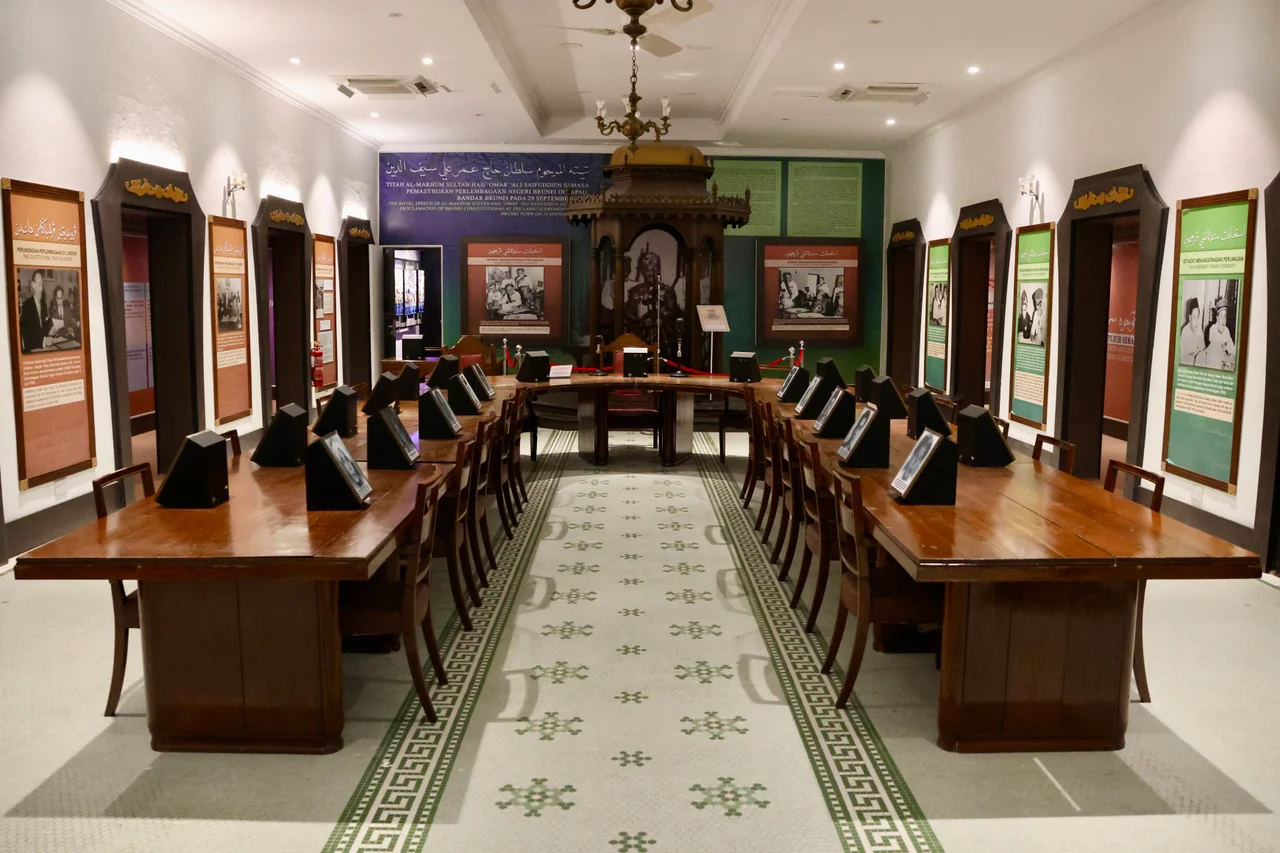
Visitors to the Centre encounter a series of galleries that bring Brunei's deep past into physical form. The Borneo Manuscript Collection Gallery displays handwritten texts that document centuries of governance, trade, and diplomacy across the island. A replica of the tomb of Sultan Bolkiah -- the fifth sultan, who ruled during the empire's golden age in the late 15th and early 16th centuries -- anchors one room. The 1959 Brunei Constitution Gallery traces the country's path from protectorate to self-governance, presenting the legal framework that preceded full independence. The Genealogy Gallery returns visitors to the Batu Tarsilah and the royal lineage it preserves, inscribed in khat styles including Nash, Thuluth, and Parsi. There is also the Hundred Spices Room, a gallery that explores the trade networks that once made Brunei a crossroads of the spice routes linking the Malay Archipelago to China, India, and beyond.
Quiet Work, Long Memory
The Brunei History Centre operates under the Ministry of Culture, Youth, and Sports, led since March 2021 by Dr. Hadi Melayong, a historian who served for years as the Centre's deputy and acting principal. The institution does not attract the tourist crowds that fill the nearby Omar Ali Saifuddien Mosque or the Royal Regalia Museum. Its work is quieter: archival research, publication, and the careful maintenance of a documentary record that stretches back centuries. Government documents, historical photographs, official publications, and local newspapers all pass through its archives. In a nation whose modern wealth rests on oil discovered less than a century ago, the Centre serves as a reminder that Brunei's story is far older -- older than petroleum, older than colonialism, older than the European explorers who arrived to find a sophisticated maritime kingdom already flourishing on the waters of the Brunei River.
From the Air
Located at 4.892°N, 114.942°E on Jalan Stoney in Bandar Seri Begawan. The Centre is near the Royal Mausoleum and within walking distance of the Omar Ali Saifuddien Mosque, whose golden dome serves as a key landmark. Brunei International Airport (WBSB) is approximately 11 km to the northeast. The building is a low-rise government structure not individually visible from altitude, but the Jalan Stoney area is identifiable by its proximity to the Brunei River waterfront.
Nearby Stories
- From Residency to Memory 28 km away
- Twenty Years on the Seattle Run 30 km away
- The Abode of Peace on Borrowed Coastline 31 km away
- USS Salute: The Minesweeper That Found the Last Mine 33 km away
- The Ants of Borneo 50 km away
- Sabah State Railway 55 km away
- Starcevich Monument 74 km away
- Luconia Shoals 209 km away