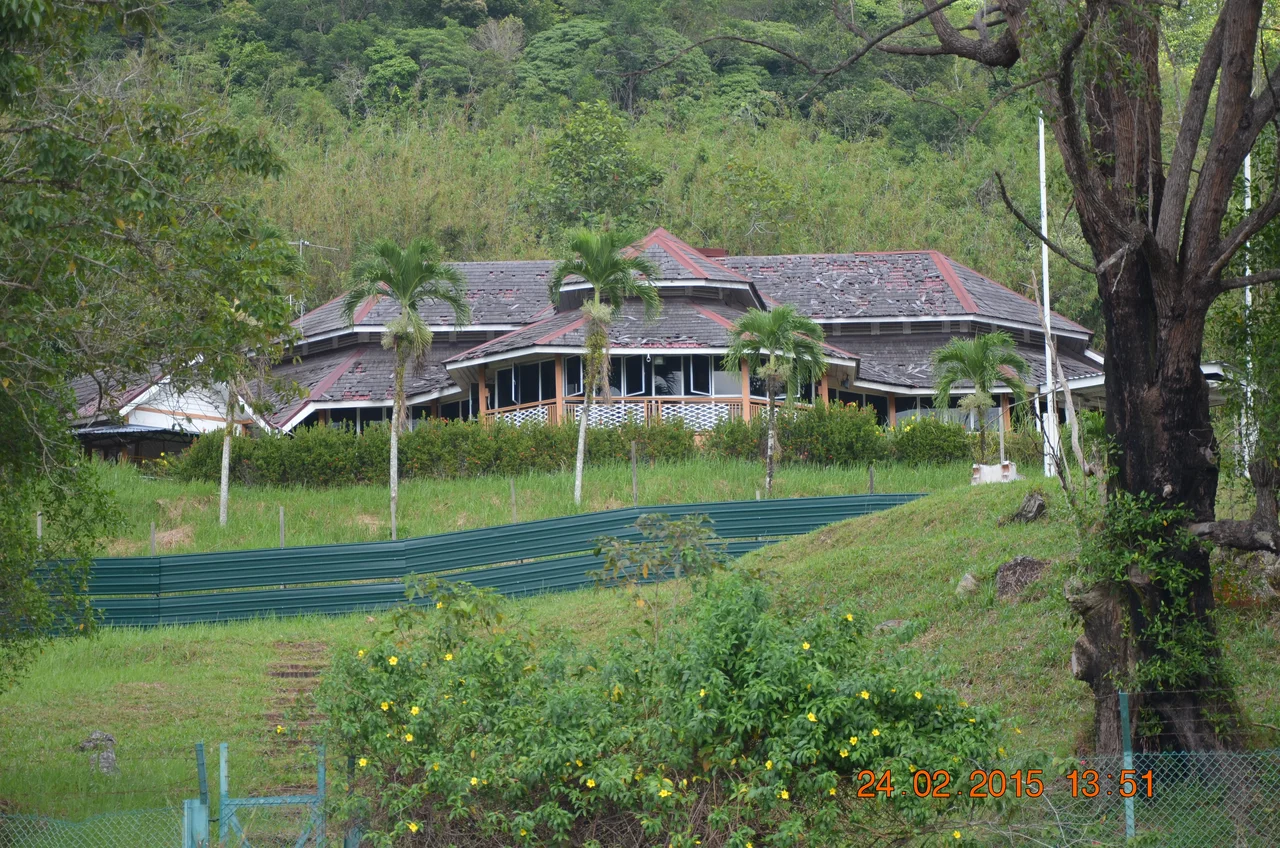

The House of Twelve Roofs
Count the roofs and you get twelve, though nobody can say with certainty why. The Bubungan Dua Belas -- the House of Twelve Roofs -- sits atop Residency Hill, three kilometers south of Bandar Seri Begawan, where it has watched over the floating villages of Kampong Ayer since 1907. Built from imported Sandakan timber on raised pillars, with Kapur wood floors and hand-cut wooden shingles, the building is a hybrid that belongs fully to neither tradition: British colonial in its verandas and billiard rooms, Malay vernacular in its casement windows, ornate porch railings, and relationship to the tropical air. Twenty-five British Residents and High Commissioners called it home. Japanese officers commandeered it during the war. Queen Elizabeth II held court here. Through it all, the house endured -- not because anyone planned for it to last this long, but because each generation found it worth preserving.
A Consul's Makeshift Home
The site's history predates the building by half a century. British Consul General Spenser St. John constructed a makeshift dwelling here in 1856 under Sultan Abdul Momin's rule, upgrading it to a permanent structure two years later. That building stood for nearly thirty years before it decayed beyond repair. When the current residency was commissioned, a loan of 20,000 pounds from the Federated Malay States financed the construction, though total costs would reach only $8,000 by 1916. Whether the old building's brick foundations were incorporated into the new one remains debated -- historical accounts suggest debris from St. John's home was likely compacted into the foundation rather than preserved structurally. What is clear is that the hilltop was chosen deliberately, offering commanding views of the Brunei River and the sprawling water village below.
Billiard Tables and Brass Cannons
The residency's early decades reveal as much about colonial priorities as about architecture. In 1911, Sultan Hashim Jalilul Alam Aqamaddin gifted four brass cannons salvaged from old Malay forts for display on the grounds. Acting Resident Harvey Chevalier, who served four years without ever securing the substantive appointment, oversaw upgrades in 1914 that included a new flagstaff, furniture, painting -- and a billiard table with an unexpected $1,000 budget. A tennis court materialized on leveled ground once occupied by police barracks, though its current state suggests it was abandoned decades ago. Lightning damaged the roof in 1924; a complete replacement followed in 1926. By 1929, the residency's jetty had been refurbished, brick steps descending through the garden to the water's edge -- steps that still mark the spot where boats once docked, even though the jetty itself was removed in the 1960s.
War and Return
When Japanese forces occupied Brunei in December 1941, they made the residency their headquarters. Allied aircraft strafed Brunei Town in 1944, and the roof took a few machine-gun rounds, but the building survived largely intact while much of the town around it burned. After Australian forces landed at Muara Beach in June 1945, Sultan Ahmad Tajuddin returned to find the residency in military hands. The Australian 9th Division commander greeted him with a Guard of Honour and served tea -- diplomacy conducted in a bullet-scarred drawing room. When Resident Eric Pretty came back in 1948 after a twenty-year absence, he found the house and town in rough shape. His wife cataloged the work needed: re-roofing, re-flooring, interior renovation. There was no electricity beyond a small, unreliable Japanese generator, and weekly supplies had to arrive by boat from Seria. The Merbau wood floors installed during the 1949 restoration, shipped from Singapore, remain underfoot today.
Royal Preparations
From the 1950s onward, the residency's renovations tracked the calendar of royal visits. For the Duke of Edinburgh's 1959 stay, a bedroom was paneled in stained wood to resemble a ship's cabin and fitted with air conditioning, soft board ceilings, and enlarged plumbing. Prince Philip attended a water pageant and opened the Edinburgh Bridge during his two-day visit. When Queen Elizabeth II came in 1972, the modifications were more sweeping: the kitchen moved to a former guest room, plywood paneling replaced the open latticework at the back, and central air conditioning was installed throughout. The property was repainted and entirely refurnished at a cost of $31,400. A raised deck appeared in the back courtyard for the royal reception. Since that visit, the structure has remained essentially unchanged -- frozen, architecturally, in its 1972 configuration.
From Residence to Relic
After Brunei gained independence in 1984, the residency's purpose shifted from diplomatic shelter to cultural landmark. In 1998, Queen Elizabeth II returned -- this time to inaugurate the building as an exhibition gallery housing five galleries celebrating Brunei's diplomatic history with Britain. The transformation felt fitting: a building constructed to project colonial authority had become a place where that relationship could be examined, reframed, and remembered on Brunei's own terms. The Brunei Postal Service commemorated the structure's centennial in 2007. Today, the Bubungan Dua Belas stands closed for renovations, its wooden shingles and Sandakan timber pillars awaiting another cycle of preservation. It is the oldest building in Brunei, and its survival is not accidental. Every generation since 1907 has decided, sometimes reluctantly, that twelve roofs are worth keeping.
From the Air
Located at 4.878N, 114.952E atop Residency Hill, approximately 3 km south of central Bandar Seri Begawan. The building overlooks Kampong Ayer, the famous water village on the Brunei River. Nearest airport is Brunei International Airport (WBSB), about 9 km to the northeast. The hilltop site is visible from low-altitude approaches over the river. Look for the distinctive tiered roof structure amid the surrounding tropical vegetation.
Nearby Stories
- From Residency to Memory 28 km away
- Twenty Years on the Seattle Run 30 km away
- The Abode of Peace on Borrowed Coastline 31 km away
- USS Salute: The Minesweeper That Found the Last Mine 33 km away
- The Ants of Borneo 50 km away
- Sabah State Railway 55 km away
- Starcevich Monument 74 km away
- Luconia Shoals 209 km away