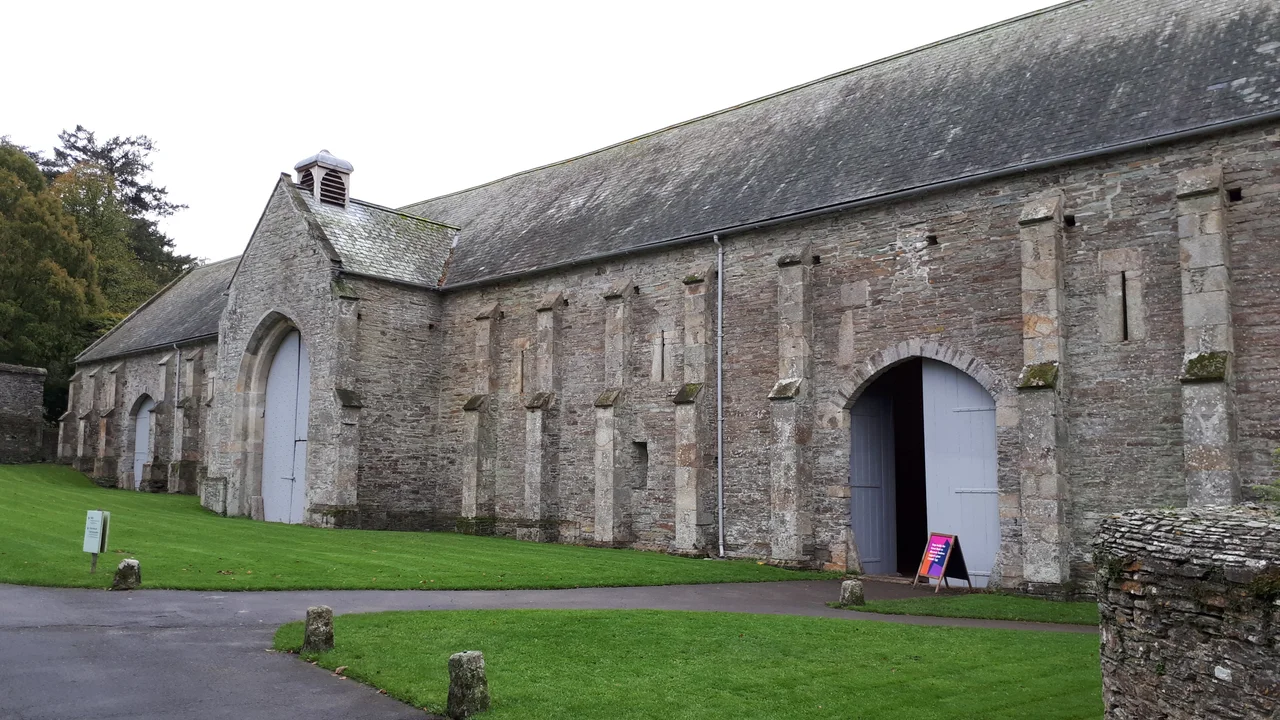

Buckland Abbey
In 1581, Sir Richard Grenville sold his ancestral home to two men he did not realise were working for Sir Francis Drake. Grenville and Drake despised each other. Both were privateers, both were heroes of Elizabethan England, and both were destined for legendary deaths at sea, but they could not stand to share a county, let alone a country house. Drake got Buckland Abbey for £3,400 through that quiet bit of subterfuge, and he held it until he died in 1596. The Cistercian abbey that had been founded in 1278 by Amicia, Countess of Devon, has been a monastery, a country house, a Drake family seat, and a National Trust property where in 2014 a portrait hanging quietly on the wall turned out to be a £30 million Rembrandt.
The Monks Who Sang Here
Amicia, Countess of Devon founded Buckland Abbey in 1278 as a Cistercian house, a daughter foundation of Quarr Abbey on the Isle of Wight. Some historians have suggested she meant it as a memorial to her late husband and her son, both named Baldwin de Redvers. For 261 years the white-robed Cistercians prayed and farmed here on the southwestern edge of Dartmoor. When Henry VIII suppressed the abbey in 1539, Abbot John Toker was pensioned off at £60 a year and the remaining twelve monks shared £54 between them. Until quite recently nobody knew much about the actual music those monks had sung. Then in 2025 researchers at the British Library examined the Buckland Book, a 15th-century customary acquired by the British Museum in 1753, and found within it an early 16th-century collection of plainchant. It would have been copied for use by Robert Derkeham, the abbey's choir master and organist. After nearly five hundred years of silence, the songs of Buckland's monks have been sung again.
From Holy House to Privateer's Hall
When Henry sold the suppressed abbey in 1541, the buyer was Sir Richard Grenville the Elder, soldier-poet and Sewer of the Chamber to Henry VIII, and the last English Earl Marshal of Calais. He and his son Sir Roger Grenville began converting the abbey nave into a residence, renaming it Buckland Greynvile. Sir Roger died young in 1545, drowned when the Mary Rose heeled over in a sudden squall during a battle with the French fleet off Portsmouth. He left a three-year-old son, also named Richard, who would grow up to complete the conversion in 1575-76 and to become one of Elizabeth I's most famous and most stubborn sea captains. This younger Richard Grenville was the one who, in 1591, fought his single ship the Revenge against fifty-three Spanish vessels off the Azores until he was mortally wounded and his ship captured. He had sold Buckland a decade earlier, in 1581, to Drake's intermediaries. Whether he ever knew where his old home had gone is uncertain. The story of the deception is, however, recorded.
Drake's Drum and the Lady
Sir Francis Drake lived at Buckland from 1581 until his death in 1596, returning from his circumnavigation of the world, his raids on Spanish ports, and finally his fatal expedition to the West Indies where he died of dysentery and was buried at sea in a lead coffin. His descendants held the abbey until the early twentieth century; in 1946 Captain Arthur Rodd purchased the house and estate and promptly gifted the property to the National Trust in 1947. A restoration between 1948 and 1951, largely funded by the Pilgrim Trust, prepared the house for public opening in 1951. The collection includes Drake's Drum, a tambour the admiral supposedly carried with him on his voyages and which by Devon legend will sound itself in time of national peril. The National Trust Costume Group at Buckland now creates authentic Elizabethan costumes using period methods, including a complete Sir Francis Drake costume based on the famous c. 1580 portrait in the National Portrait Gallery.
The Rembrandt That Almost Wasn't
In March 2013, the Rembrandt expert Ernst van de Wetering re-examined a small portrait at Buckland that had hung there for years, attributed only as a self-portrait by a follower of Rembrandt. Van de Wetering thought it was the real thing. The painting went to the Hamilton Kerr Institute in Cambridge for eight months of careful technical analysis. In June 2014 the authentication was confirmed: this was a genuine Rembrandt self-portrait from 1635, the artist at twenty-nine wearing the white-plumed bonnet that appears in several of his early works. The estimated value jumped from a few thousand pounds to £30 million. It still hangs at Buckland Abbey, in the converted nave where the Cistercians once sang their offices, where the Grenvilles raised their sons, and where Drake kept his drum. The house has worn many lives. The Rembrandt is just the latest of its surprises.
From the Air
Buckland Abbey sits at 50.48 N, 4.13 W, just west of Yelverton on the western edge of Dartmoor, about 9 miles north of Plymouth. From the air the abbey's medieval Great Barn and tower are visible amid wooded grounds on the upper Tavy valley. Dartmoor's high ground rises sharply to the east. Plymouth City Airport (EGHD) closed in 2011; nearest active fields are Exeter (EGTE) about 30 nm northeast and Newquay Cornwall (EGHQ) 42 nm west. Best low-level viewing is 1,500 to 2,500 feet AGL with morning sun lighting the abbey grounds and the Tavy valley below.
Nearby Stories
- Bodmin Moor 4.1 km away
- South Devon Railway sea wall 4.8 km away
- Tiverton Castle 12 km away
- Hope Cove Lifeboat Station 14 km away
- Caerhays Castle 20 km away
- Holsworthy 22 km away
- HMS Formidable (1898) 32 km away
- HMS Montagu 41 km away