
Buenos Aires Botanical Garden
Watch the cats first. They drape themselves over warm marble plinths, doze beneath the laurels, and trot between the cypresses as if they own the place. In a sense, they do. The Buenos Aires Botanical Garden has quietly become the city's most famous cat sanctuary, home to dozens of animals left here by owners who could not, or would not, keep them. The volunteers who feed and vaccinate them have made their peace with an arrival rate that, in summer, can reach one cat a day. But look past the cats and you find what the cats found: nearly seven hectares of curated wilderness, planted by a man who spent his life teaching a sprawling new metropolis how to breathe.
The Frenchman Who Planted a City
Carlos Thays arrived from France and stayed for the rest of his life, and Buenos Aires is greener for it. As the city's director of parks and walks, he laid out the avenues of trees and the broad public spaces that still soften the capital today. The garden was his laboratory and his home at once. Between 1892 and 1898 he and his family lived in an English-style mansion within the grounds, a house built in 1881 that now serves as the complex's main building. When the garden was inaugurated on September 7, 1898, it was not merely a collection of plants but the working studio of the man reshaping the city outside its gates. Argentina recognized this in 1996, declaring the garden a national monument.
Three Worlds in Seven Hectares
Thays built the garden as a conversation between landscapes. Three distinct styles unfold across the grounds: the symmetric, the mixed, and the picturesque, expressed as Roman, French, and Oriental gardens. The Roman section is a small act of historical imagination, holding the species that the first-century writer Pliny the Younger kept at his Apennine villa, cypresses and poplars and laurels among them. The French garden keeps the strict symmetry of the seventeenth and eighteenth centuries. Elsewhere the plantings are sorted by origin, so a short walk carries you from Asian ginkgo to Oceanian eucalyptus, from European oaks to African palms. Roughly 5,500 species of plants, trees, and shrubs grow here, a botanical map of the world folded into a triangle of land.
Glass, Bronze, and a Weather Machine
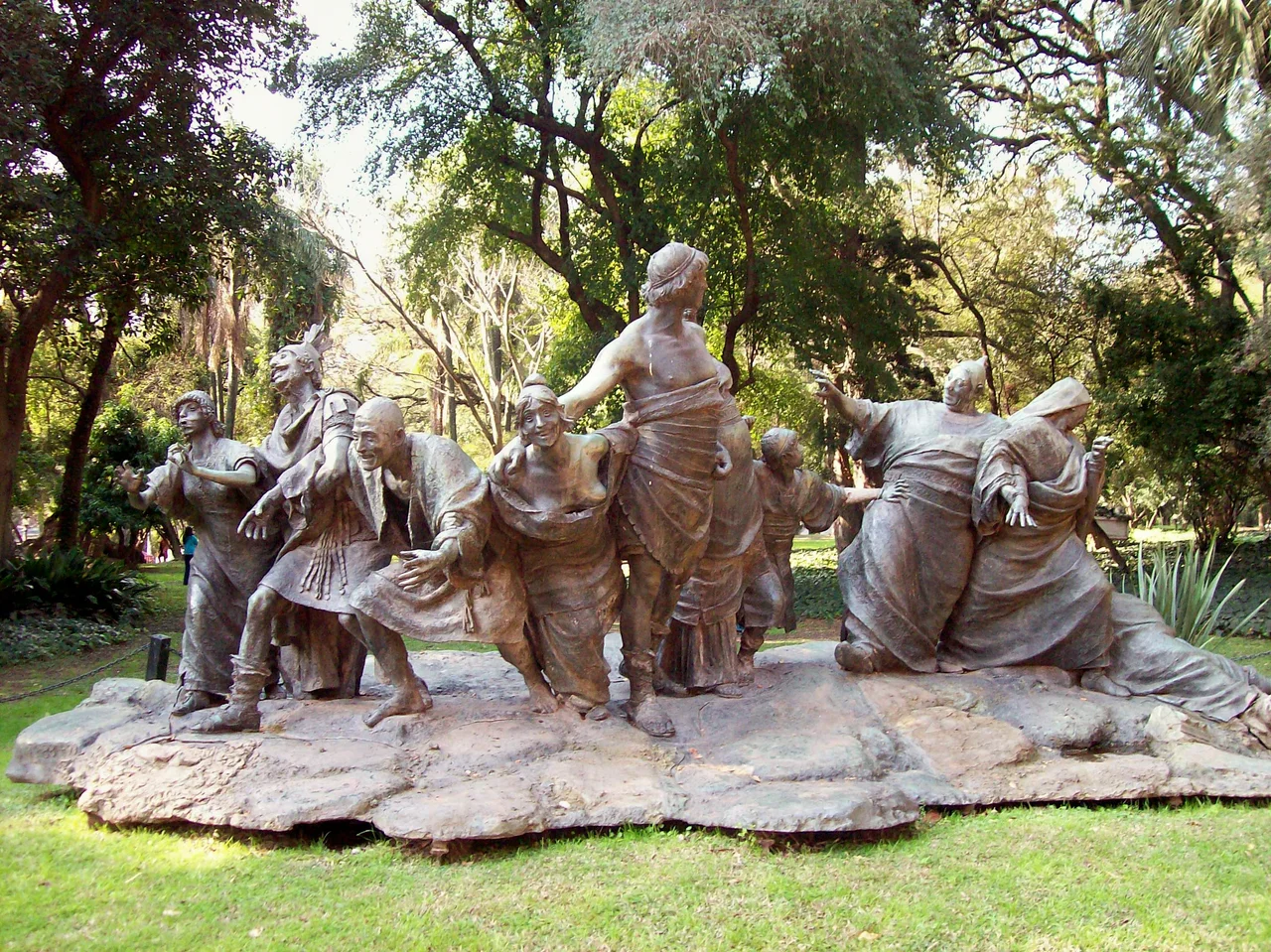
The garden is also a gallery without a roof. Thirty-three sculptures, busts, and monuments stand among the foliage, including Lola Mora's Figura de mujer and Ernesto Biondi's bronze Saturnalia. The crown jewel is glass: the largest of the garden's five winter-houses, an Art Nouveau greenhouse that won recognition at the 1889 Paris Universal Exhibition before being installed here. Thirty-five meters long and sheltering some 2,500 tropical plants, it is considered the only winter-house of its style still preserved anywhere in the world. Near it stands a stranger object, the Indicador Meteorológico, a weather indicator presented by the local Austro-Hungarian community for the centennial exposition of 1910, a gift from one immigrant community to a city built almost entirely by immigrants.
A Working Garden
For all its beauty, this was never meant to be only ornamental. The Municipal Gardening School, linked to the University of Buenos Aires faculty of agronomy, operates within the grounds, training the people who will tend the next century of the city's parks. A botanic library holds a thousand books and ten thousand publications open to any visitor, and a botanical museum keeps the records. Thays understood that a garden is a slow institution, planted by one generation for the benefit of those who will never meet the planter. More than a century after his trees first took root, students still learn here, the cats still sleep in the shade, and the city still comes to remember what quiet feels like.
From the Air
The Buenos Aires Botanical Garden sits in Palermo at 34.5825 degrees south, 58.4186 degrees west, a distinctive triangular wedge of dense green bounded by Santa Fe Avenue, Las Heras Avenue, and Republica Arabe Siria Street, immediately adjacent to the larger parks of Palermo. From the air the triangle of mature canopy stands out sharply against the surrounding grid of streets, with the glass winter-house catching light at its center. Best appreciated at low altitude in clear conditions. The garden lies barely 2 km from Aeroparque Jorge Newbery (ICAO SABE), the city's downtown airport on the Rio de la Plata, making it an easy visual reference on approach; the larger Ministro Pistarini (Ezeiza) International Airport (ICAO SAEZ) is roughly 35 km to the southwest. Buenos Aires sits near sea level on the estuary's western bank.
Nearby Stories
- Ezeiza Massacre 1.9 km away
- Luján, Buenos Aires 5.1 km away
- Curutchet House 13 km away
- Colonia del Sacramento 17 km away
- Martín García Island 28 km away
- Atucha Nuclear Power Plant 37 km away
- Lobos 43 km away
- Cry of Asencio 87 km away