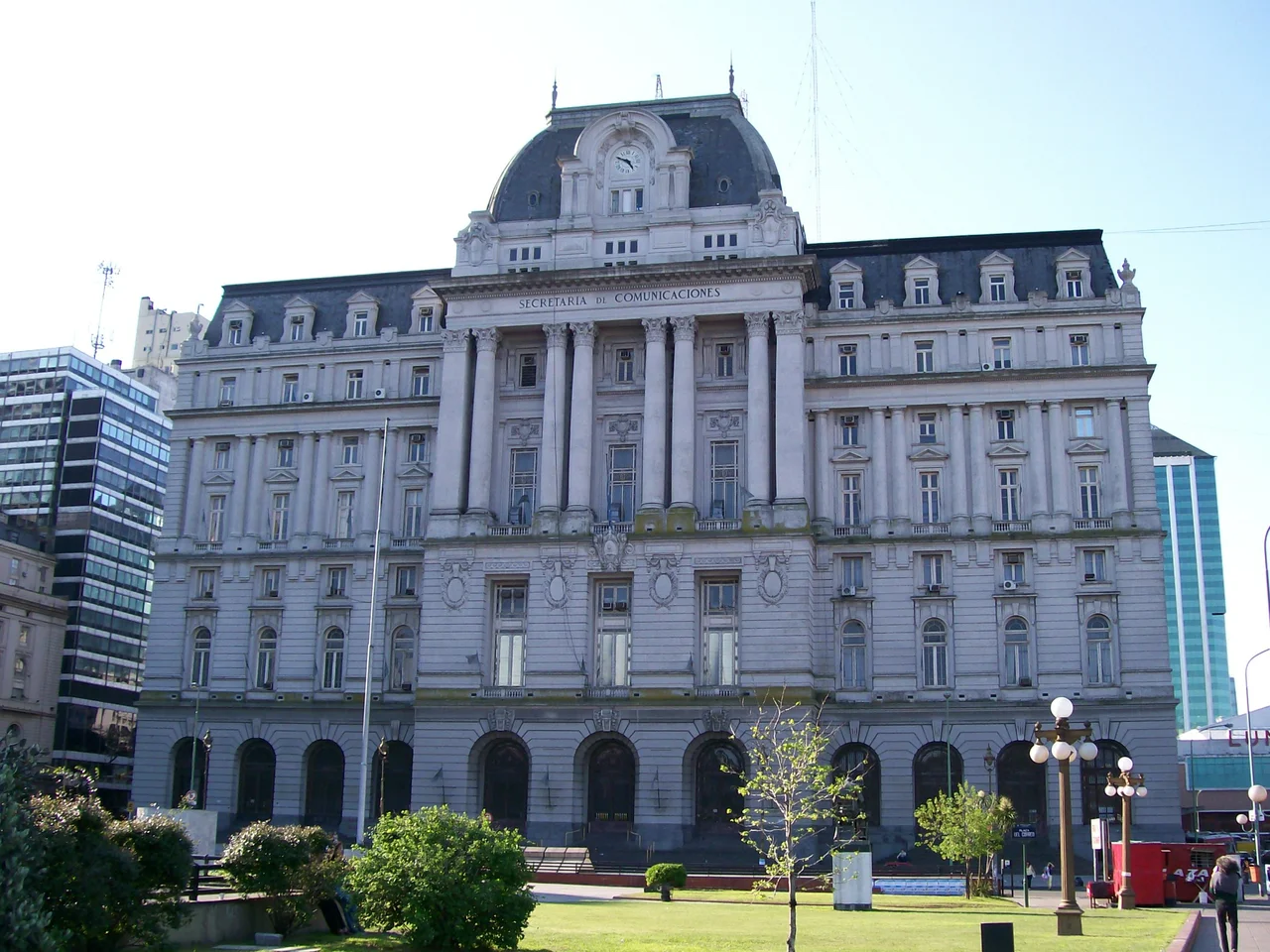

Buenos Aires Central Post Office
For seventy-four years, this colossus on the corner of Sarmiento Street did the most ordinary thing imaginable: it sorted letters. Then, in 2002, the mail stopped, and Argentina was left holding a Beaux-Arts behemoth the size of a city block with nothing to put inside it. The answer turned out to be one of the boldest cultural bets in Latin American history. The building that began as the Palacio de Correos, the Central Post Office, reopened in 2015 as the largest cultural center in Latin America and the fourth largest in the world, a place where you can wander from a symphony hall to an art gallery to a rooftop terrace, all free of charge, all inside a monument that once existed only to move paper.
A Palace That Took Thirty Years
Argentina wanted a post office worthy of an empire of correspondence, and the wanting nearly broke it. The French architect Norbert Maillart, modeling his design on New York's old City Hall Post Office, began work in 1889 on land granted near the riverfront. Then the project staggered through every crisis the era could produce. The economic crash of 1890 halted construction. Funds dried up again and again. Maillart redesigned the building larger in 1908, then quit in disagreement with the authorities in 1911. His Russian collaborator Jacques Spolsky took over and reworked the plans, adding a metal structure and pouring cement. Because the ground had been reclaimed from the Rio de la Plata, the foundations required 2,882 concrete piles, each ten meters long, sunk into the soft estuary soil. The First World War starved the project of materials. Funds ran out yet again in 1923. The building finally opened on September 28, 1928, four decades after the first proposals.
Perón's Address
When the doors finally opened, the palace quickly became more than a post office. During Juan Peron's first presidency, he and his wife Eva Peron kept their offices inside this building, and the Eva Peron Foundation, the charitable engine of her enormous popularity, used it as headquarters. For a stretch of the most consequential years in Argentine politics, the machinery of Peronism ran partly out of a building designed to handle the nation's letters. The address itself became a kind of power. In 1997 the country declared the Palacio de Correos a National Historic Monument, honoring both its architecture and the weight of the history it had absorbed.
The Largest Stage in Latin America
When the post office finally went silent in 2002, the government made an audacious decision: turn the palace into a gift to the public. The conversion was timed to the bicentennial of the May Revolution, the 1810 uprising that set Argentina on the road to independence. After years of renovation, the center opened in May 2015 as the Centro Cultural Kirchner, named for the late president Nestor Kirchner. The scale is staggering. Where clerks once franked envelopes, audiences now fill a major symphony hall; galleries, performance spaces, and terraces spread across the vast interior. Admission is free, a deliberate statement that culture is a public right rather than a private luxury.
A Building of Many Names
Few buildings have worn as many names as this one, and each name marks a chapter of Argentine history. It was the Palacio de Correos y Telecomunicaciones, the working heart of the postal service. When the conversion began it was to be the Centro Cultural del Bicentenario, then in 2012 it took the name of Nestor Kirchner. In 2024, under President Javier Milei, it was rechristened again, this time as the Palacio Libertad. The bricks have not moved, the great staircases remain, the river still presses against the foundations its builders fought so hard to stabilize. Only the name on the door keeps changing, each one a small monument to whoever held power when the paint was fresh.
From the Air
The former Central Post Office stands in the San Nicolas district of central Buenos Aires at 34.6033 degrees south, 58.3694 degrees west, near the riverfront edge of the old colonial grid, a block bounded by Leandro N. Alem Avenue, Corrientes Avenue, Bouchard, and Sarmiento streets. From the air its massive rectangular footprint and Second Empire roofline mark it as one of the largest single structures in the downtown core, set just inland from the Puerto Madero waterfront and the Rio de la Plata. Best viewed at low altitude in clear conditions, using the river's edge and the broad Avenida 9 de Julio nearby as orientation. The building lies roughly 4 km south of Aeroparque Jorge Newbery (ICAO SABE) on the riverfront, with Ministro Pistarini (Ezeiza) International Airport (ICAO SAEZ) about 30 km to the southwest. The city sits essentially at sea level on the estuary.
Nearby Stories
- Ezeiza Massacre 1.9 km away
- Luján, Buenos Aires 5.1 km away
- Curutchet House 13 km away
- Colonia del Sacramento 17 km away
- Martín García Island 28 km away
- Atucha Nuclear Power Plant 37 km away
- Lobos 43 km away
- Cry of Asencio 87 km away