
Bunhill Fields
Daniel Defoe died in poverty in April 1731 and was buried in Bunhill Fields with a simple headstone. In the winter of 1857-58, lightning struck the grave and broke the headstone. In 1869, the editor of a children's newspaper launched an appeal for a replacement — his readers could donate sixpence each, and he kept separate lists for boys and for girls to encourage competition. About 1,700 subscriptions were received, raising roughly £200. A marble obelisk was commissioned. When the foundations were dug, the crowd rushed for the disturbed bones as souvenirs; the police had to be called. Defoe's three great-granddaughters attended the unveiling ceremony. The author of Robinson Crusoe had, in death, become an adventure story.
The Ground That Church Refused
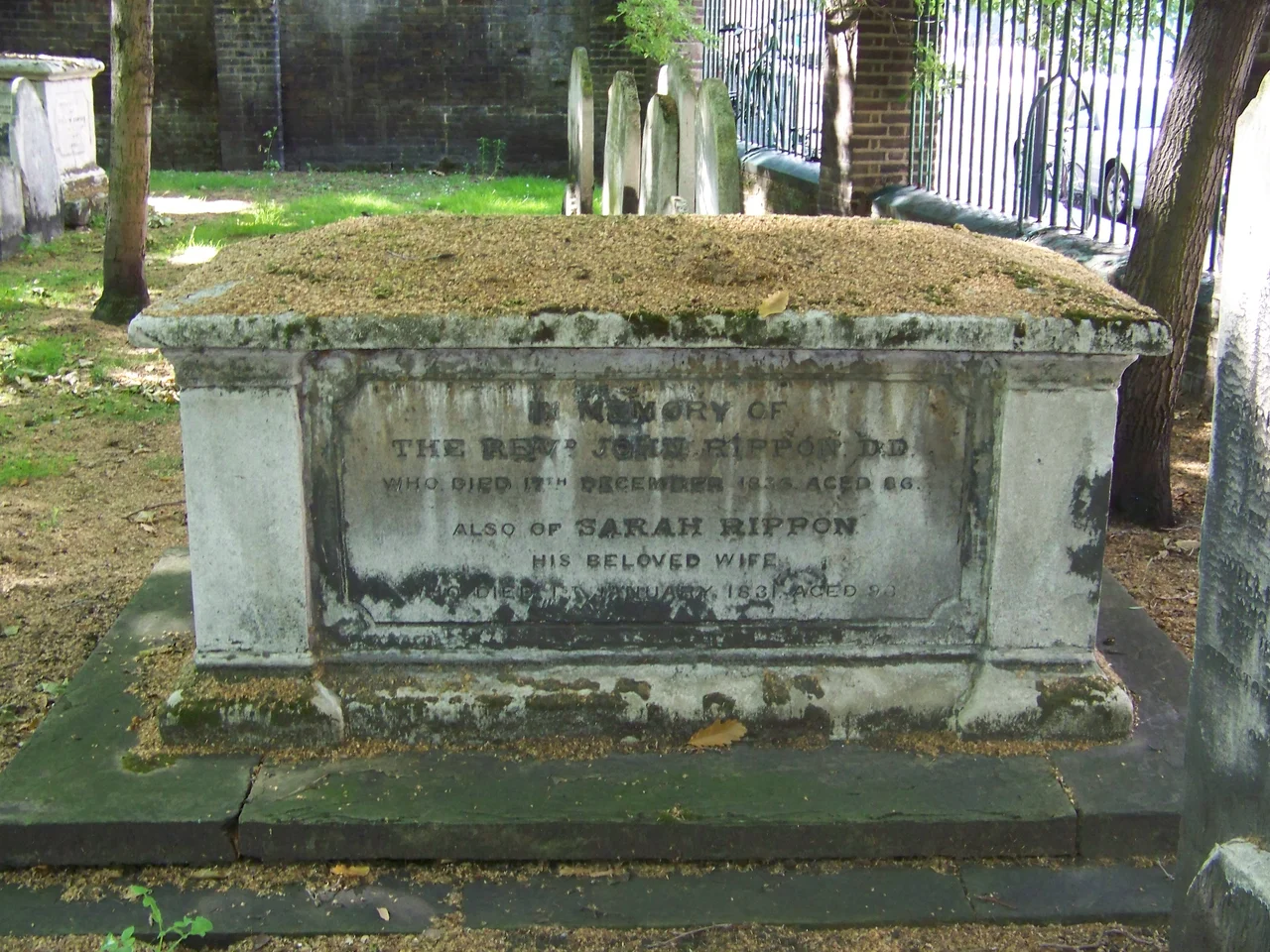
Bunhill Fields owes its existence to an act of religious exclusion. The land was prepared during the plague years of the 1660s as a potential emergency burial ground, but the Church of England never consecrated it. A Mr. Tindal took over the lease and allowed burials on the unconsecrated soil — a critical distinction. Those who worshipped outside the Church of England, the Protestant nonconformists who practised their faith without Church sanction, could not be buried in Anglican churchyards. Bunhill Fields — which appeared on Rocque's 1746 Map of London as 'Tindal's Burying Ground' — was open to anyone who could pay the fees, regardless of religious affiliation. Nonconformists chose it in such numbers that the nineteenth-century poet Robert Southey called it in 1830 the ground 'which the Dissenters regard as their Campo Santo.' By the time it closed in January 1854, approximately 123,000 people had been buried there.
Bunyan, Defoe, and Blake
Three graves draw most visitors down the central broadwalk created during the 1964-65 landscaping. John Bunyan, author of The Pilgrim's Progress, died in August 1688 and was buried here; his monument was fully reconstructed in 1862 and now features a recumbent effigy with relief panels depicting scenes from his book. Daniel Defoe, who died in April 1731, got his marble obelisk in 1870, funded by the newspaper readers' subscription campaign. William Blake, artist, poet, and mystic, died in August 1827. His grave fell into disrepair; a headstone was commissioned for the centenary of his death in 1927. When Bunhill Fields was relandscaped in the 1960s, Blake's headstone was moved about 20 meters from the actual grave site and repositioned next to Defoe's monument. In 2018, a new memorial stone — in the form of a ledger stone with lettering by Lida Cardozo Kindersley — was unveiled on the actual site of Blake's grave by Philip Pullman, President of the Blake Society.
A Remarkable Assembly
Beyond the three famous literary and artistic figures, Bunhill Fields contains an extraordinary concentration of people who shaped British religious, intellectual, and scientific history. Isaac Watts, who wrote 'Joy to the World' and 'When I Survey the Wondrous Cross' and is called the 'Father of English Hymnody,' is buried here. Susanna Wesley, mother of John Wesley the founder of Methodism and Charles Wesley the hymn writer, lies here — she died in 1742 and is described as the 'Mother of Methodism' for her role in educating her sons. Thomas Bayes, the eighteenth-century mathematician whose Bayes' theorem underpins modern statistics and probability theory, is here. Thomas Newcomen, the steam engine pioneer whose atmospheric engine was a crucial step toward the Industrial Revolution, was buried here in 1729 — though the exact site of his grave is unknown. Richard Price, who helped develop the principles underlying modern life insurance, is here. Eleanor Coade, entrepreneur and inventor of Coade stone — the artificial stone that allowed mass production of decorative architectural elements — is buried here. Over 2,000 monuments remain in concentrated blocks across the 1.6-hectare site.
Saving the Ground
After the burial ground closed in 1854, its future was uncertain. The City of London Corporation held the lease, which was expiring, and the Ecclesiastical Commissioners controlled the freehold. If the lease expired without action, the commissioners would take possession and likely redevelop the land. Charles Reed, son of a Congregational philanthropist and later the first MP for Hackney, led the effort to save it. A Preservation Committee was formed; Parliament was petitioned. The Bunhill Fields Burial Ground Act of 1867 gave the corporation authority to maintain the site as a public open space, provided it was laid out with seating, gardens, and restored monuments. The improvements cost an estimated £3,500. The new park was opened by the Lord Mayor of London on 14 October 1869. It is now Grade I listed on the Register of Historic Parks and Gardens, and remains a working open space used daily by City workers and local residents.
From the Air
Bunhill Fields sits at coordinates 51.5236°N, 0.0889°W in the London Borough of Islington, just north of the City of London's boundary. From altitude, look for the green rectangle of the burial ground adjacent to City Road, east of the Barbican development. London City Airport (EGLC) is 9km to the east; the City of London is immediately to the south.
Nearby Stories
- Stevenage 5.7 km away
- Malling Abbey 5.7 km away
- 1952 Farnborough Airshow Crash 7.7 km away
- Ingatestone Hall 8.2 km away
- Hellfire Caves 9.1 km away
- The Carrington Event: The Solar Storm That Could Happen Again 9.8 km away
- Bletchley Park 16 km away
- Castle Hedingham 23 km away