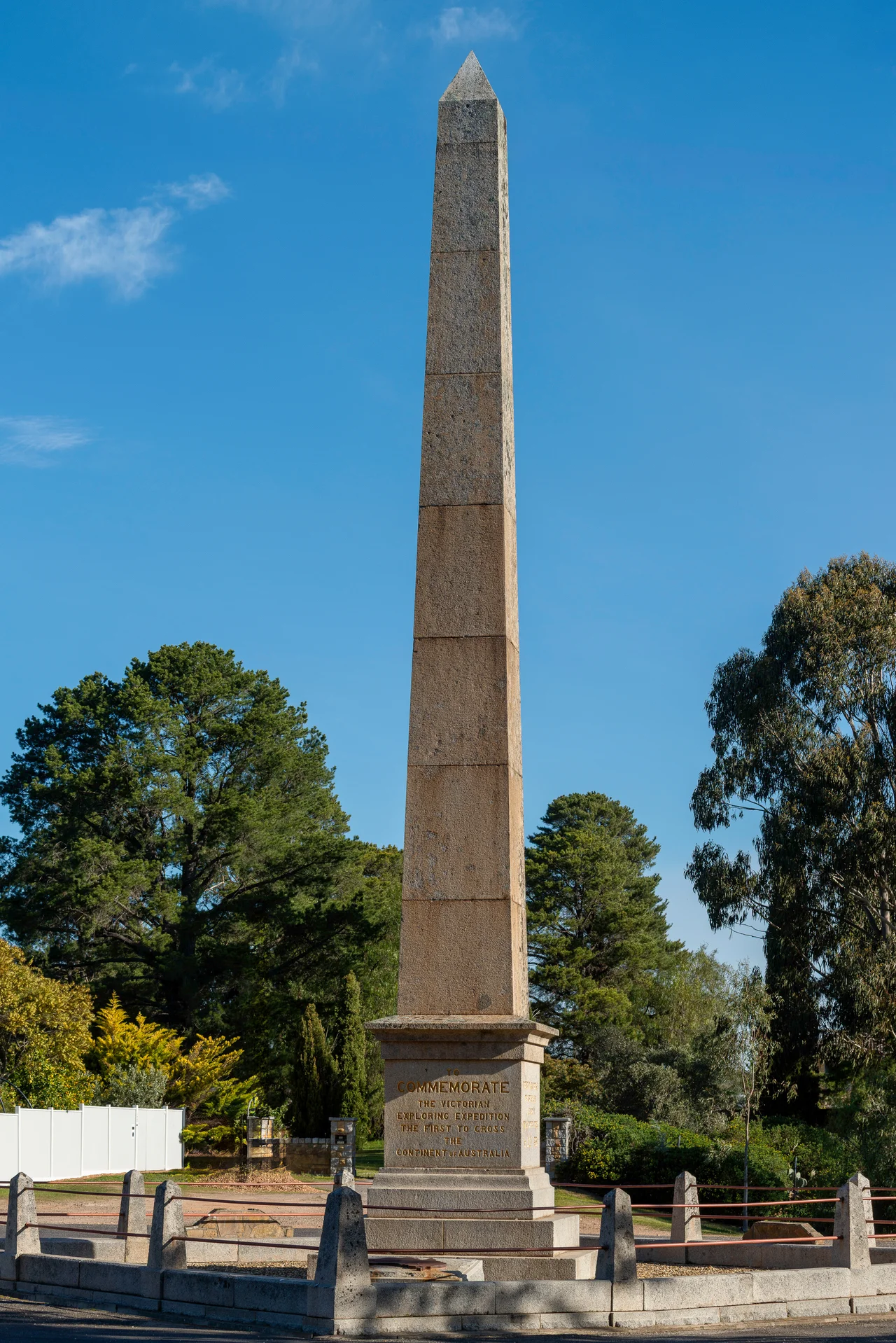

Burke and Wills expedition
On 20 August 1860, around fifteen thousand people gathered at Royal Park in Melbourne to watch nineteen men, twenty-six camels and a long train of wagons set off to cross a continent. The Victorian Exploring Expedition, led by police superintendent Robert O'Hara Burke, aimed to travel some 3,250 kilometres from Melbourne to the Gulf of Carpentaria, ground no European had crossed. It was lavishly funded and wildly celebrated. Within a year, Burke and his deputy William John Wills would be dead on the banks of Cooper Creek, and the only reason anyone survived at all would be the kindness of the very people the expedition's success would help dispossess.
The Race to the Gulf
Burke was a brave and impatient man, and many of his decisions were poor ones. Restless at the slow pace, he split his party again and again, pushing a small advance group ahead of his supplies. From a depot on Cooper Creek, he made his dash for the coast in December 1860 with Wills, John King and Charles Gray, leaving William Brahe to hold the depot. The four reached the mangrove swamps on the estuary of the Flinders River in February 1861, near where Normanton stands today. They had crossed Australia from south to north, the first Europeans to do so, but the dense mangroves blocked their path and they never actually glimpsed the open sea. Then, weakening and short of food, they turned back into the killing distance they had just covered.
The Cruelty of Cooper Creek
Gray died on the return march in April 1861. The three survivors reached the Cooper depot on the evening of 21 April to find it abandoned that very morning, missing Brahe by nine hours. They recovered the buried cache, but Burke made another fatal choice, striking out for distant Mount Hopeless instead of waiting. Their last camel died; they could carry almost nothing. Marooned on the creek, Burke and Wills slowly starved. The official date of their deaths was recorded as 28 June 1861, though both probably died a few days later, at the very end of June or beginning of July, at separate waterholes along the Cooper. Wills was left to die alone; Burke died near what is now called Burke's Waterhole, and King buried him wrapped in a Union Jack beneath a coolabah.
The Yandruwandha, Who Kept a Man Alive
John King lived because the Yandruwandha people chose to save him. This was their Country, and they read it fluently where the explorers could not. They had been courteous to the starving men from the first, sharing fish, beans they called padlu, and a kind of damper ground from the spores of the nardoo fern. The explorers had eaten nardoo too, but without the careful preparation the Yandruwandha used to draw out its poison, and the half-prepared plant slowly robbed their bodies of strength. After Burke and Wills were gone, a Yandruwandha group took King in entirely. He earned his keep by shooting birds for them and tending a skin sore on a woman named Carrawaw, and for roughly three months they fed and sheltered him as one of their own. When Alfred Howitt's relief party found King on 15 September 1861, he was alive only because of them.
Mourning, and the Reckoning After
Victoria turned its dead explorers into legends. Around a hundred thousand people filed past the coffins, and the state funeral of 1863 drew forty thousand to the streets of Melbourne, the funeral car modelled on the Duke of Wellington's. A Royal Commission picked over the blame, and monuments rose across the colony. The expedition did settle one question: there was no inland sea, and its scattered rescue parties filled in the map. But the deeper consequence fell on Cooper Creek. The reports of grazing land drew pastoralists within a decade, and the Yandruwandha, who had asked only sugar in return for saving a life, were pushed off their waterholes as cattle and fences arrived. Influenza and measles followed. By 1900 their numbers had fallen to around thirty, perhaps a tenth of what they had been. The story Australia chose to remember was one of heroic white explorers in an empty land. The truer story is that the land was never empty, and the people in it were the reason the legend had any survivor to tell it.
From the Air
The expedition's tragic final act unfolded along Cooper Creek in the far northeast of South Australia, near Innamincka at roughly 27.6 degrees S, 140.7 to 141.1 degrees E. The Dig Tree depot site sits just over the Queensland border at 27.62 degrees S, 141.08 degrees E. From the air, the story is written in the green channels of Cooper Creek snaking through pale Channel Country plains: Burke's Waterhole and Innamincka lie at the western end, the Dig Tree and Nappa Merrie to the east near the state line. Nearest airfields are Innamincka (YINN) and the Moomba airstrip (YOOM) to the southwest, with Thargomindah (YTGM) to the northeast. Recommended viewing altitude 2,000 to 5,000 feet AGL; the creek and its waterholes are the only reliable landmarks across otherwise featureless, heat-hazed terrain.
Nearby Stories
- Ballera gas plant 13 km away
- Strzelecki Desert 21 km away
- Malkumba-Coongie Lakes National Park 50 km away
- Wilson River (Queensland) 51 km away
- Arrabury 72 km away
- Dingo Fence 118 km away
- Sturt National Park 144 km away
- Strzelecki Creek 176 km away