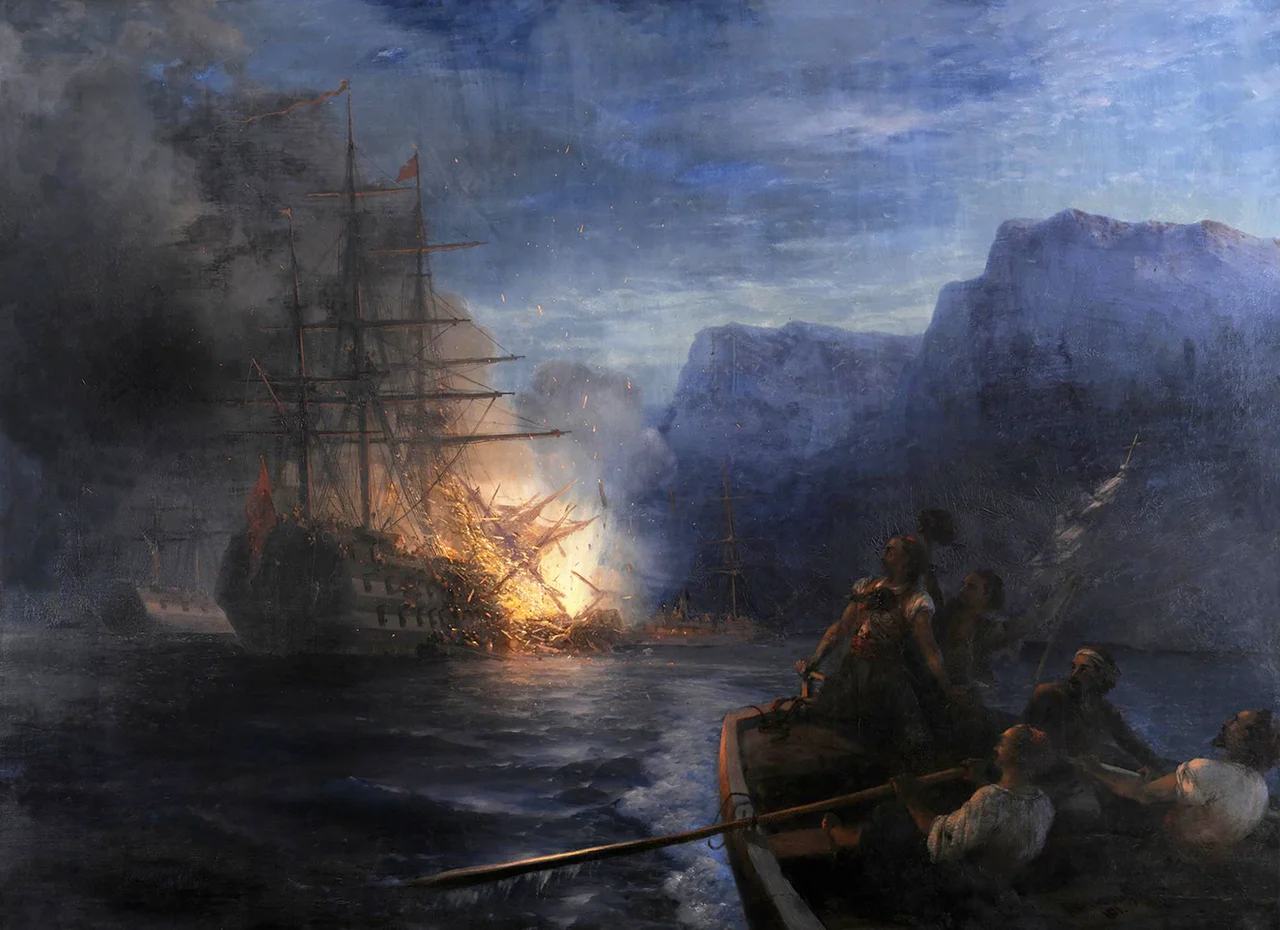

Burning of the Ottoman Flagship off Chios
Two months earlier, the same water had carried away the captives. Ottoman forces had landed on Chios in the spring of 1822 and turned the island into a charnel ground: tens of thousands of Greek inhabitants killed, tens of thousands more taken and sold into slavery in the markets of Smyrna and Istanbul. Now, on the night of 18 June, the bay was calm and the moon was hidden, and a small wooden boat drifted toward the great Ottoman flagship riding at anchor. Aboard her, packed with tar and gunpowder, the men of Psara waited for the wind.
After the Massacre
The Chios massacre was not a battle. When the Greek War of Independence reached the island in 1822, the Ottoman response was annihilation - by most accounts more than thirty thousand islanders killed and tens of thousands more enslaved, a community erased within weeks. News of it reached Europe and horrified it; Eugène Delacroix would paint the survivors into one of the nineteenth century's most famous canvases. The revolutionary government on the free islands of Psara and Hydra had little money and almost no navy that could face the Ottoman fleet head-on. What they had instead was the fireship: a doomed vessel filled with combustibles, sailed straight into an enemy hull and abandoned at the last instant. Vengeance, they decided, would come by fire.
The Night Attack
Two captains took the operation. Konstantinos Kanaris of Psara would target the flagship of the Ottoman admiral; Andreas Pipinos would strike the vice admiral's vessel. Four escort ships waited to pull the fireship crews from the sea once their work was done. The timing was deliberate. The Ottoman fleet was celebrating Ramadan Bayram, the night was dark, and the winds favored the attackers. Pipinos reached his target but the Ottoman crew saw the danger and shoved his fireship clear before it could finish the job. Kanaris was not turned away. He brought his fireship hard against the hull of the eighty-four-gun ship of the line Mansur al-liwa and made it fast.
The Explosion
The fire climbed the rigging and spread across the decks faster than the crew could fight it. When the flames reached the powder magazine, the flagship did not merely burn - it disintegrated, a single tremendous blast that lit the bay and was heard for miles. Roughly two thousand men aboard were killed or drowned, among them Nasuhzade Ali Pasha, the Kapudan Pasha who commanded the entire Ottoman navy, struck down by a falling spar as his ship came apart around him. They were sailors and officers, many of them conscripts far from home, and they died in the dark in moments. The historian Thomas Gordon, who chronicled the war, called the act one of the most astonishing feats in naval history and named Kanaris a hero of Greece. Both things can be true: a stunning act of seamanship, and a night of mass death born of an atrocity that came before it.
What the Water Remembers
Kanaris survived to repeat the tactic against the Ottoman fleet again, and lived long enough to serve as prime minister of the independent Greece he had helped win. The fireship attack entered Greek memory as a symbol of defiance against overwhelming odds, painted by Ivan Aivazovsky and carved into monuments. But the channel between Chios and the Anatolian coast holds more than one story. It remembers the islanders carried off in chains and the islanders killed where they stood. It remembers the conscript sailors who never saw the boat coming. History here is not a single hero against a single villain - it is reprisal answering atrocity, fire answering fire, on a stretch of water that has been contested for three thousand years.
From the Air
The action took place in the channel off Chios town, near 38.38°N, 26.07°E, between the Greek island of Chios and the Turkish Çeşme peninsula roughly seven nautical miles east. From altitude the narrow strait and the harbor of Chios town are clearly visible in clear Aegean weather. Nearest airport on the Greek side is Chios Island National Airport (LGHI), just south of Chios town; Izmir Adnan Menderes (LTBJ / ADB) lies about 40 nm east on the Turkish mainland. Best viewed from 4,000-8,000 feet to take in both coastlines and the bay where the flagship burned.
Nearby Stories
- Psara 18 km away
- Battle of the Oinousses Islands 28 km away
- St. Helena Church 35 km away
- Battle of Corycus 35 km away
- Greek Islands 60 km away
- Temple of Artemis at Ephesus 61 km away
- Adramyttium 94 km away
- Skyros 101 km away