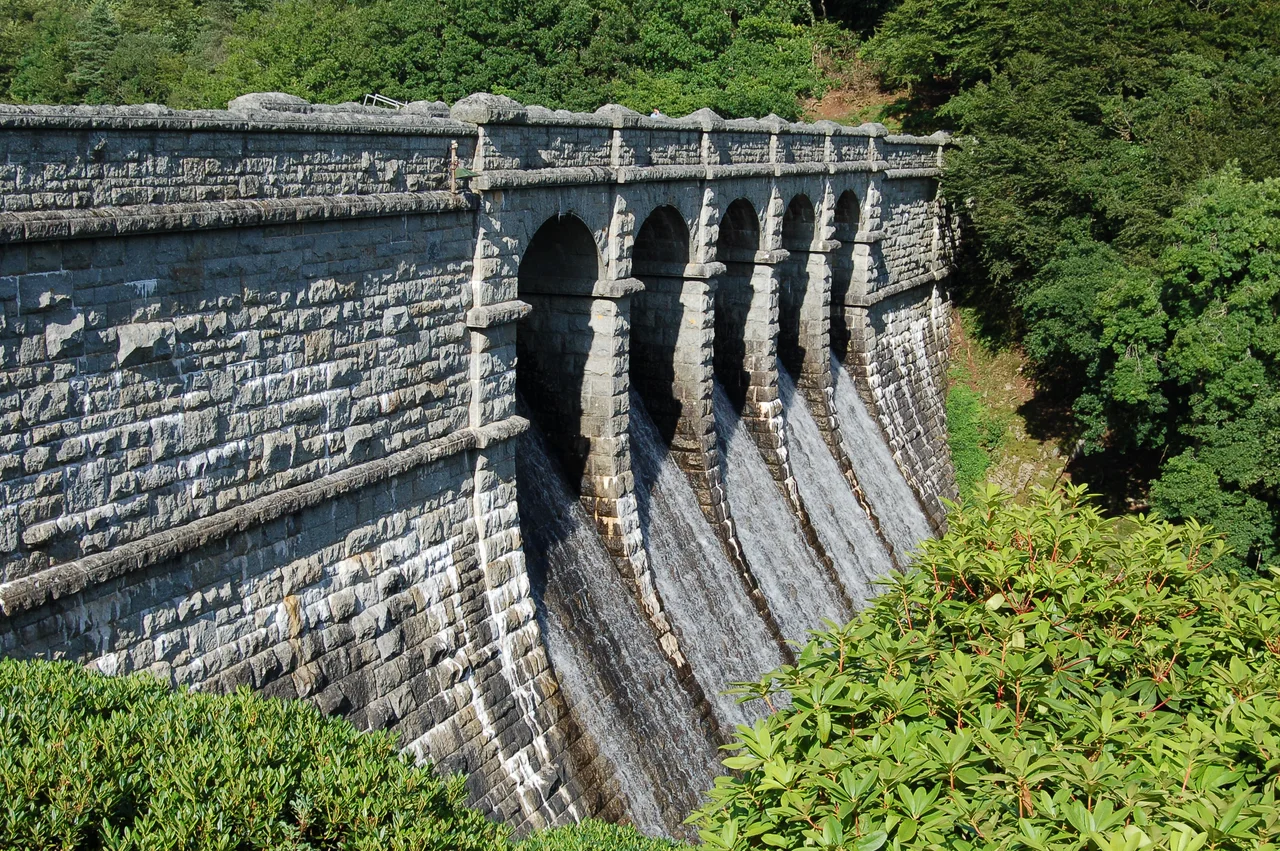

Burrator Reservoir
On 9 August 1893, on the southern slopes of Dartmoor where the River Meavy threads through a granite gorge, the first stones were laid for a dam that would change the lives of half a million people. Five years later, in September 1898, Burrator Reservoir filled and Plymouth's water troubles were over. The man behind it was Edward Sandeman, Plymouth's water engineer, whose name appears in the city's hydraulic history again and again. The result is one of the most photogenic engineering works on Dartmoor: a granite-faced concrete dam holding back a long, sinuous lake among heathland and tors, where Steven Spielberg later came to film War Horse.
Two Dams, One Reservoir
Burrator is unusual in having two dams. The Burrator Dam at the southwestern end is the more massive of the pair, built across the Meavy at Burrator Gorge in concrete faced with cut granite blocks. The Sheepstor Dam at the southeastern end, built in 1894, is an earth embankment with a puddled clay core wall above ground level and a concrete cut-off below. The reason for two dams is geography. The reservoir occupies a natural basin between the Meavy valley and a separate hollow drained by the Sheepstor Brook, and rather than building one enormous structure across both, Sandeman's engineers chose to plug each outlet with the appropriate type of barrier. When the reservoir opened on 21 September 1898 it held 668 million gallons. The watershed feeding it stretched across 5,360 acres of Dartmoor moorland.
Raising the Walls
Plymouth kept growing, and by 1923 the city wanted more water. The solution was elegant rather than expensive: raise both dams by ten feet. Work began in December 1923 and lasted nearly five years. Engineers built a temporary suspension bridge near Burrator Dam to keep traffic flowing during construction. When it was complete, the reservoir's capacity had grown from 668 million gallons to 1,026 million, a 54% increase achieved without rebuilding from scratch. The official reopening was on 12 September 1928. The reservoir today covers about 150 acres at overflow level, its edges planted with conifers that turn the basin into a green-and-grey amphitheatre. Burrator remains an operational water source for Plymouth, now managed alongside its leisure functions by the South West Lakes Trust.
Walking, Wheeling, Fishing
The reservoir's road follows the dam wall and threads through the conifer plantation, with frequent pull-offs where walkers and cyclists can leave their cars. Fishing here is for rainbow and brown trout, by permit from the Trust. In the right weather Burrator can feel almost Scandinavian, the granite-faced dam reflected in still water, but Dartmoor's mists move quickly across the southern moor, and the same view can vanish into grey within minutes. The villages of Sheepstor and Meavy lie nearby, each with their ancient parish churches. On the lower slopes you can find the ruined manor house of the Elfords on the shore, the family who married into the Coplestons of Tamerton Foliot and whose descendants eventually held the manor. The whole catchment is a working landscape, but it is also one of the most quietly beautiful corners of the southern moor.
On Screen and on the Page
The reservoir has had its turn in the cameras as well as the cameras of weekend visitors. In October 2011 it featured in the first episode of the second series of James May's Man Lab on BBC Two, when Oz Clarke and James May travelled along its edge while staging a mock escape from nearby HMP Dartmoor to the village of Meavy. The same year, Steven Spielberg used Burrator's slopes as a setting for his film War Horse, the adaptation of Michael Morpurgo's novel about a Devon farm boy and his horse caught up in the First World War. The film's Dartmoor scenes were partly shot here because the landscape, with its drystone walls and bracken-covered slopes rising to the granite tors, has changed remarkably little in a century. Burrator does what good water-supply reservoirs are supposed to do: it keeps Plymouth's taps running. It also happens to look magnificent doing it.
From the Air
Burrator Reservoir sits at 50.50 N, 4.04 W, on the southern flank of Dartmoor about 8 miles northeast of Plymouth. From the air the reservoir's distinctive long, curving shape stands out against the open moorland, with the village of Sheepstor visible to the east and Yelverton just to the south. Dartmoor's high ground rises north and east to peaks around 1,800 feet. Plymouth City Airport (EGHD) closed in 2011; nearest active airfields are Exeter (EGTE) about 28 nm northeast and Newquay Cornwall (EGHQ) 45 nm west. Best low-level viewing is 2,000 to 3,500 feet AGL on clear days, ideally with morning sun to highlight the granite-faced dam wall.
Nearby Stories
- Bodmin Moor 4.1 km away
- South Devon Railway sea wall 4.8 km away
- Tiverton Castle 12 km away
- Hope Cove Lifeboat Station 14 km away
- Caerhays Castle 20 km away
- Holsworthy 22 km away
- HMS Formidable (1898) 32 km away
- HMS Montagu 41 km away