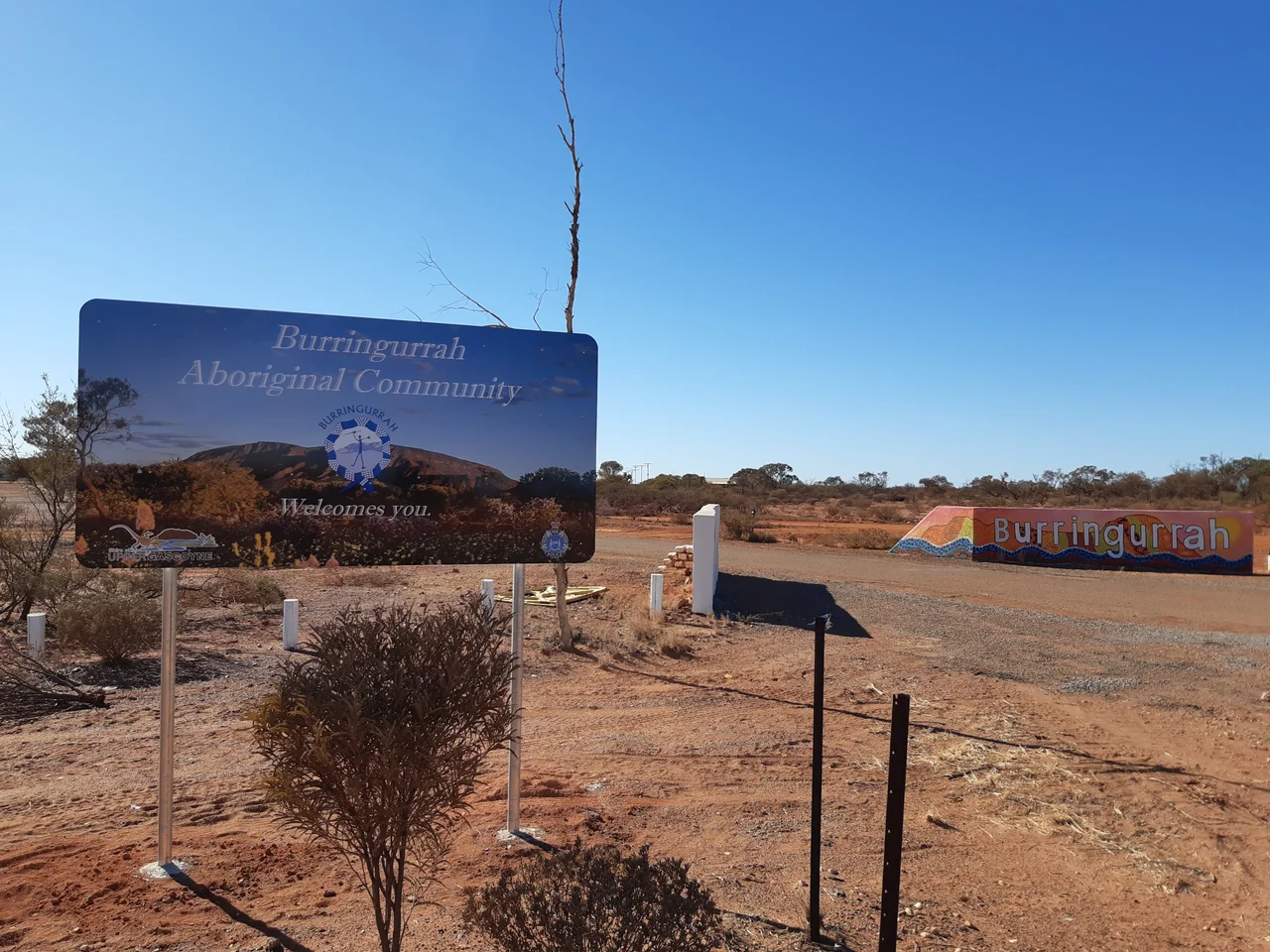

Burringurrah Aboriginal Community
The community and the mountain share a name, and the name carries a story far older than any map of Western Australia. In Wajarri tradition, Burringurrah was a boy who fled the hardship of his initiation. His own people pursued him, and when they caught him they speared him in the upper right leg; the spearhead broke off in the wound. He tried to crawl away and was struck down with a mulgurrah, a fighting stick. The great rock that rises behind the community is his body, lying on its belly with one leg bent - and the stump of the spear in his leg is the place known today as Edney's Lookout. To live here is to live beneath a story written into the land itself.
Country and Kin
Burringurrah is a Wajarri community in the Gascoyne region of Western Australia, in the Shire of Upper Gascoyne, on a reserve of about 45,000 hectares carved out of the old Mount James pastoral lease in 1999. It sits within the registered area of the Wajarri Yamaji native title claim - meaning this is recognised country, held by people whose connection to it long predates the fences and station leases that once divided it. The 2021 census counted around seventy Aboriginal and Torres Strait Islander residents. The numbers are small; the roots run deep.
The Tyranny of Distance
Remoteness shapes daily life here in ways city dwellers rarely have to imagine. For years the community had no reliable store of its own. The corner shop near the national park was prohibitively expensive, and the nearest real supermarket was in Carnarvon - roughly a five-hour drive away. Families would travel there to stock up, sometimes taking their children out of school for weeks at a time. With fresh food so hard to come by, diets leaned heavily on hunted meat, and the consequences were stark: cases of scurvy and boils, the signatures of malnutrition, in a country of plenty. It was a quiet, grinding hardship, and an unjust one.
A Store Comes Home
The story of the store is, in the end, a story of resilience. It closed in 2011, the operator citing a population too transient to sustain it, and that same year floodwaters cut the community off for weeks. Basic services did not fully return until early 2012. But in 2025, after years without one, the community store reopened its doors. The difference is measured in something simple and profound: children staying in school because their families no longer have to leave town for weeks just to buy groceries. A shop in a remote settlement is never only a shop. Here it is the difference between staying and going.
Governing Their Own
Burringurrah runs its own affairs through the Burringurrah Community (Aboriginal Corporation), formally incorporated in 1987. The community endorsed its own town-planning layout in 1999, later adopted by the state's planning commission. These are the unglamorous instruments of self-determination - corporations, layout plans, native title registrations - but they matter. They are the legal scaffolding by which a Wajarri community holds its country, manages its land, and decides its own future at the foot of Burringurrah, where the boy of the Dreaming still lies in stone.
From the Air
The Burringurrah community lies in the Gascoyne region of Western Australia at about 24.66 degrees S, 116.93 degrees E, on the south-eastern flank of Mount Augustus (Burringurrah). From the air the long ridge of the rock dominates the surrounding red mulga plains, with the small settlement at its foot. This is deeply remote country - the nearest sizeable town, Carnarvon (airport YCAR), is several hundred kilometres west by road; Meekatharra (YMEK) lies to the south-east. There are no scheduled services nearby; access is by small aircraft to local strips or by long unsealed road. Clearest flying is in the cooler dry months, roughly April to October.
Nearby Stories
- Mount Augustus National Park 13 km away
- Gascoyne Junction 117 km away
- Milly Milly 125 km away
- Kennedy Range National Park 134 km away
- Paraburdoo Mine 136 km away
- Peak Hill, Western Australia 150 km away
- Collier Range National Park 187 km away
- North West Coastal Highway 238 km away