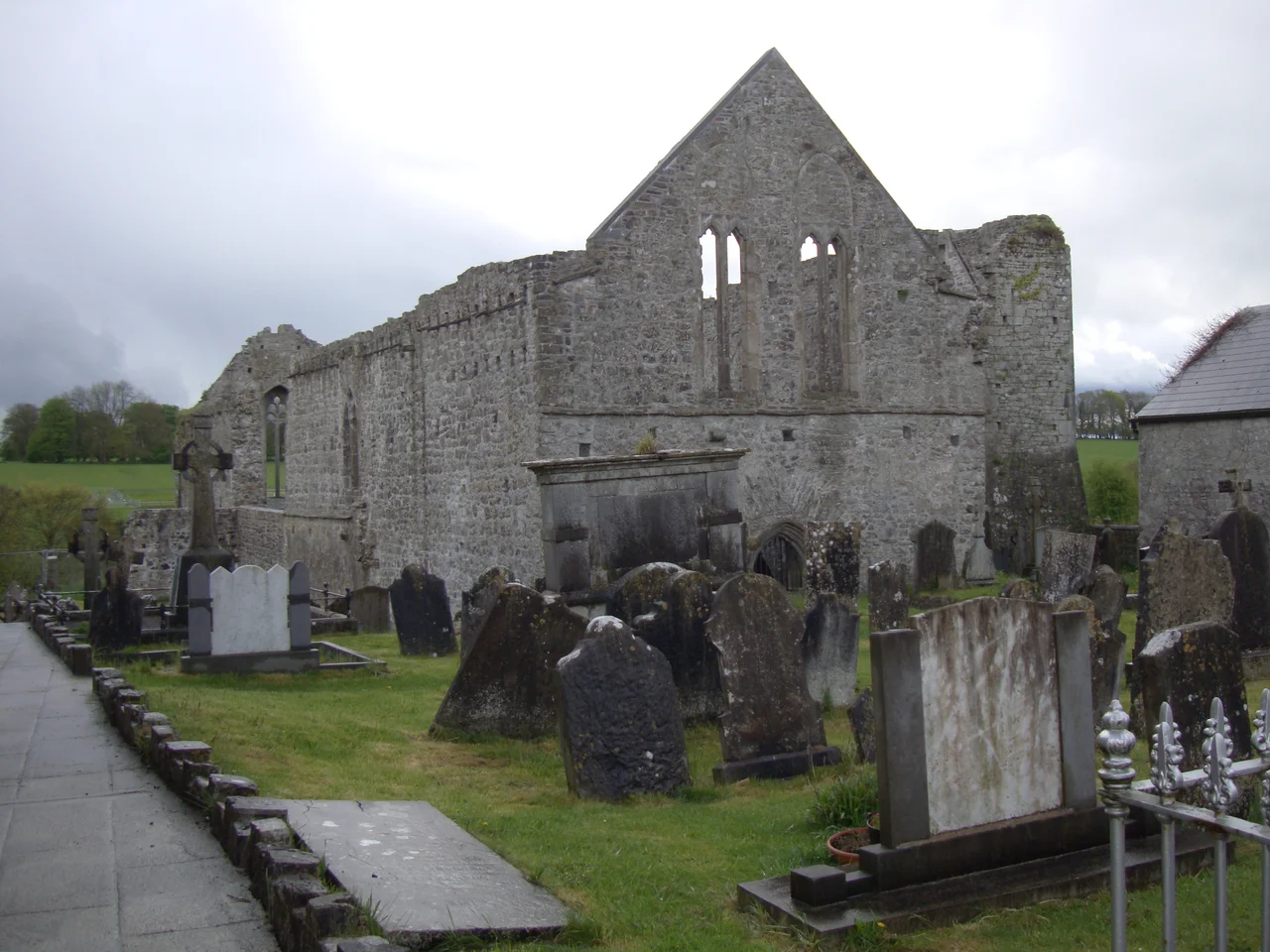

Buttevant Franciscan Friary
The last list of names is the saddest part of the story. Sometime around 1820, Bishop William Coppinger of Cloyne, working from memory, wrote down the four Franciscans who had been the final community at Buttevant. 'Pat Daly, a Friar of Buttevant died of gout and scurvy; Pat O'Neill, a Friar of Buttevant died of a fever in Cork; David Roche, a Friar of Buttevant, of exemplary conduct, died of a fever in Buttevant; and Daniel McAuliffe, a Friar of Buttevant, unemployed and turned horse jobber, died old.' That was the end of nearly six hundred years of Franciscan presence in this town. David Og de Barry had founded the friary in 1251, dedicated to Thomas Becket. Now the Franciscans were gone, and only their church was left, on the steep bank of the Awbeg in the middle of Buttevant.
Friars of Two Nations
By 1324, Buttevant was important enough to maintain a studium - a house of studies - and the community included both Irish and Anglo-Norman friars. The combination did not always sit easily. In 1327, a commission established by Pope John XXII to investigate the Irish Province of the Franciscans recommended that the Gaelic lector at Buttevant be transferred elsewhere. Two years earlier, the general chapter of the Order in Lyons had transferred Buttevant's obedience from Irish control to the new Anglo-Norman custody of Cork. The friars who lived through these years did so under tensions that ran through every Norman-founded religious house in Ireland. The friary porch, in the meantime, served the wider town: it was the place where leases were renewed each Lady Day and Michaelmas, where fealty was sworn, where homage was performed, and where marriages were contracted. The whole legal life of medieval Buttevant happened in front of the friars.
Edmund Spenser's Lease
The dissolution came around 1540. The examining jurors valued the entire complex - church, conventual buildings, garden, cemetery, a watermill - at 36 shillings and 8 pence. In 1570, James de Barry, the 4th Viscount Buttevant, took a twenty-one-year lease of the friary site at an annual rent of 16 shillings and 8 pence. When the Viscount joined the Desmond Rebellions a few years later and lost his estates, the friary passed in the Munster Plantation - one of the first colonial plantations in Ireland - to the poet Edmund Spenser, who lived nearby at Kilcolman and whose Faerie Queene is set partly along these rivers. The friars themselves did not entirely vanish. By 1607, the Protestant bishop of Cork, William Lyon, was complaining to the Lord Deputy that 'divers friars in their habits go up and down the country.' He named them: Conor M'Morice the warden, William Foy, Nicholas Sheynan, William Fer-something. The friary, he wrote, had 'continual and daily masses and assemblies and conventicles, little for the good of the King and the State.'
Murrough of the Burnings
When the Irish Rebellion broke out in 1641, the Buttevant Franciscans welcomed the Confederate Catholic army of Lord Mountgarret. The guardian, Father Boetius Egan, marched with the army and sat in the Confederate Parliament at Kilkenny in 1642. The Munster phase of the war that followed was led on the Parliamentarian side by Murrough O'Brien, Earl of Inchiquin, who assembled his English army in Buttevant and burned the friary church. His conduct in the war earned him the Irish nickname Murchadh na dToitean - Murrough of the Burnings. A large quantity of bones from the nearby Battle of Knocknanuss in 1647 are said to have been placed in the crypt under the church choir. Yet the friars came back. A 1629 manuscript from St Isidore's in Rome notes that the church itself had been left standing because of the noble tombs inside it, and that 'some of the friars have not ceased to live unto this day either in the convent or in its neighbourhood.' By 1731 the High Sheriff of Cork reported only one friary surviving in the entire county, here at Buttevant, with the friars living in a thatched house within the precincts of the old abbey.
The Tower That Fell
By 1820 the Franciscans were gone. The poet's lease was a memory. The Barrys' tombs - and those of the Fitzgeralds, Lombards, MacDonaghs, and other Munster nobles - were still in the church, but the central tower above them, supported on arches that Samuel Lewis later called 'of light and graceful elevation,' collapsed in 1814. The cloister, north of the church (a feature typical of Irish Franciscan friaries), had been pulled down centuries before. A chalice associated with the friary, almost identical to the Timoleague Chalice and dating to about 1600, survives elsewhere. The ruins themselves are exactly where Lewis saw them in 1837 - on the steep bank of the Awbeg, in the middle of the Buttevant burgage, the nave and chancel walls still standing, the tomb of David de Barry at the centre of the chancel marked only by broken stones that once enclosed it. The horse jobber Daniel McAuliffe, the gout-stricken Pat Daly, and their two brethren ended the line that began in 1251 with the founder's grant. The walls remain.
From the Air
The friary stands at 52.23 degrees north, 8.67 degrees west, in the centre of Buttevant town on the steep west bank of the River Awbeg in north County Cork. The nearest commercial airport is Cork International (EICK), about 50 km south; Shannon (EINN) lies 90 km north, Kerry (EIKY) about 75 km west. From altitude, look for the broad valley of the Munster Blackwater running east through Mallow, with the smaller Awbeg joining from the north. Buttevant lies on the N20 road, with Ballybeg Priory's distinctive circular dovecot visible about a kilometre south of the friary.
Nearby Stories
- Shanbally Castle 2.9 km away
- Crescent College 8.8 km away
- Waterloo Round Tower 8.9 km away
- Ballyvourney 9.7 km away
- Castlemartyr 13 km away
- Abbeyfeale 15 km away
- Holy Cross Abbey 17 km away
- Siege of Carrigafoyle Castle 24 km away