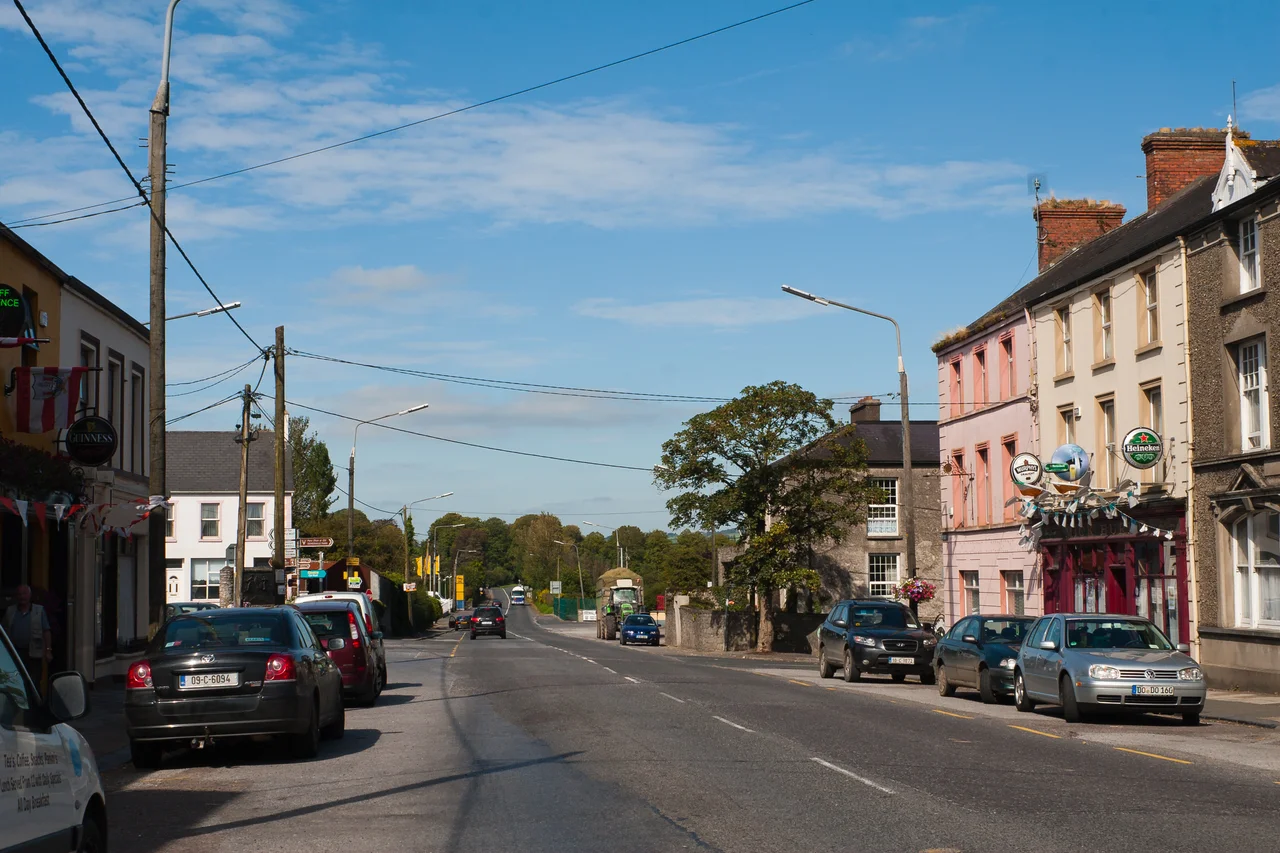

Buttevant
The name is a battle cry. On the coat of arms of the de Barry family, the Norman lords who built Buttevant as their north Cork stronghold in the 13th century, the motto reads Butez en Avant - 'Strike forward,' or, more colloquially, 'Bash your way forward.' Six centuries of Latin scribes, Irish-speaking neighbours, and English officials wore the phrase down into Buttevant. The town the de Barrys built around their keep, their friary, their priory, and their Awbeg bridge has been writing itself into Irish history ever since - in markets and horse fairs, in steeplechases and military barracks, in the train disaster of 1980 and the Cahirmee Horse Fair that still fills the main street every 12 July.
Norman Blueprint
Henry III granted David Og de Barry a market here on 26 September 1234, to be held on Sundays, plus a fair on the vigil and day of St Luke the Evangelist - 17 and 18 October - and on six days following. The town grew on the pattern Normans repeated all over Munster: a keep on high ground at the south end, a pre-Norman parish church (St Brigit, sister of St Colman of Cloyne) on the opposite slope, a mill on the river to the north of the keep, and a leper hospice outside the town wall to the northeast. The Augustinians at Ballybeg got their land from the de Barrys in 1229. The Franciscans came inside the walls themselves in 1251, on the site that still holds the friary ruins. By 1317 Edward II had granted the town £105 for walling, eventually enclosing about 50 acres. The native Irish were not allowed inside; they were confined to a quarter to the northwest. A bridge over the Awbeg, built around 1250, is still standing.
Bash Your Way Forward
It is from one of those friaries that the steeplechase began. In 1752, two local gentlemen - Edmund Blake and Cornelius O'Callaghan - bet on a cross-country horse race from the steeple of the Buttevant Protestant church to the steeple of Doneraile, four and a half miles away. The race established a new sport that took its name from the steeples themselves. The Cahirmee Horse Fair, held just outside town until 1921 and on Buttevant's main street ever since, is one of the oldest continuous horse fairs in Europe, traditionally held on 12 July. Local lore says Napoleon's horse Marengo was bought at Cahirmee, though this is more often claimed than proved. The fair has been a fixture for so long that towns up and down the N20 plan their year around it. The horses come, the cash changes hands in old pound notes and now euros, and the town has its day.
Castle and Barracks
Buttevant Castle, once the Barry stronghold, eventually passed into private hands. In 1812, its owner John Anderson gave 23 acres in the town to the British Army for a military barracks. The barracks took nearly three years to build. Divided into three quadrangles, with a gymnasium, training field, church, school, stables, and parade ground, it could accommodate up to 800 soldiers and staff. Anthony Trollope passed through Buttevant in his novel Castle Richmond. James Joyce, in A Portrait of the Artist as a Young Man, has Stephen Dedalus play a game of hurling in Buttevant. Elizabeth Bowen mentions it in Bowen's Court. Canon Sheehan of Doneraile set part of his novel Glenanaar at the nearby Fair of Rathclare. Thomas Crofton Croker collected the story of the 'Bunworth Banshee' here. Clotilde Graves, novelist and playwright, born in Buttevant Castle in 1863, was a cousin of the poet Robert Graves. At the outbreak of the First World War in 1914, newly raised battalions of the Royal Munster Fusiliers and the Royal Dublin Fusiliers, who had trained at the Buttevant barracks, marched out of Buttevant station for the Western Front. Many did not come home.
Cill na Mullach
What the Irish-speakers called Buttevant has been argued over for centuries. The oral tradition consistently said Cill na Mullach - 'Church of the Hillocks' - and that is what John O'Donovan recorded in the Ordnance Survey field books in the early 19th century, when much of the area still spoke Irish daily. Peadar Ua Laoghaire confirmed the tradition in his memoir Mo Sceal Fein. The Placenames Commission has nevertheless proposed Cill na Mallach, suggesting it might mean 'Church of the Curse' - a theory P.W. Joyce dismissed as an invention of later times in 1871, citing the Annals of the Four Masters, which place the foundation of the Franciscan friary at Cill na Mullach in 1251. The 1980 rail disaster, in which 18 people died when the Dublin-to-Cork express was diverted into a siding at Buttevant station, has its own memorial in the town. The Cahirmee fair has its day every July. The Awbeg still runs under the 1250 bridge. And the de Barry motto - bash your way forward - is, if you say it fast in a French accent, audibly close to Buttevant.
From the Air
Buttevant lies at 52.23 degrees north, 8.67 degrees west, in north County Cork, on the N20 road and the Dublin-Cork main railway line, about 14 km north of Mallow. The nearest commercial airport is Cork International (EICK), about 50 km south; Shannon (EINN) lies 90 km north, Kerry (EIKY) about 75 km west. From altitude, look for the N20 corridor and parallel rail line running north through the Awbeg valley toward Charleville, with Buttevant town clustered on the western bank of the river. Ballybeg Priory's distinctive circular dovecot is visible a kilometre south of the town centre.
Nearby Stories
- Shanbally Castle 2.9 km away
- Crescent College 8.8 km away
- Waterloo Round Tower 8.9 km away
- Ballyvourney 9.7 km away
- Castlemartyr 13 km away
- Abbeyfeale 15 km away
- Holy Cross Abbey 17 km away
- Siege of Carrigafoyle Castle 24 km away