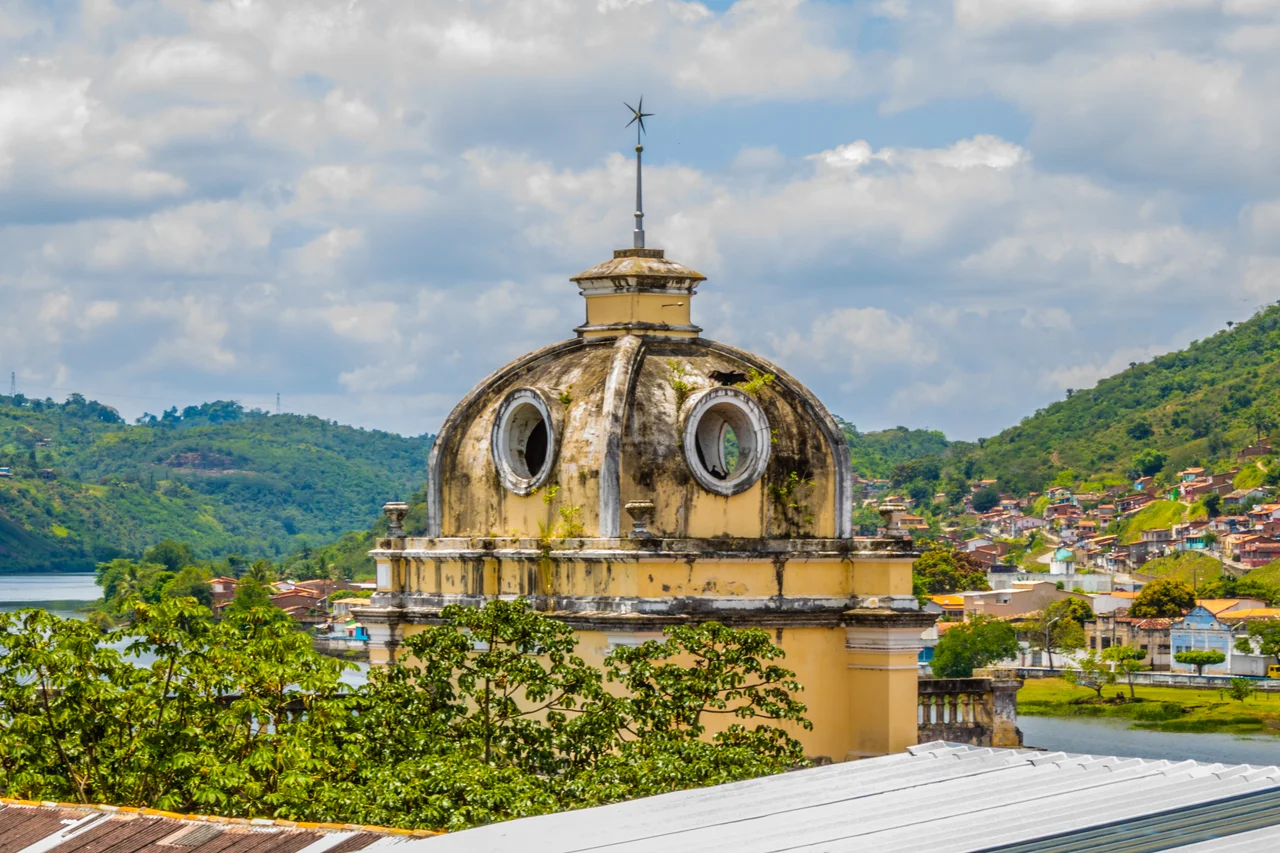

Cachoeira
Arrive on a Saturday morning and Cachoeira will hand you its whole week at once. The interstate bus from Salvador pulls in near the municipal market, where Bahians from the surrounding valleys have set out passion fruit, manioc flour, hot peppers the color of arterial blood, and live chickens in stacked crates. Across the Dom Pedro II Bridge, in the twin town of São Félix, tobacco leaves the color of strong tea are being rolled into cigars by hand the way they have been rolled since the 18th century. Two hours northwest of Salvador by road, Cachoeira is the Bahia that is hard to see from the cruise ships - a working colonial town on the Paraguaçu River where Catholicism and candomblé have coexisted in open daylight for more than three centuries.
The Church on the Hill
Start at the Igreja Matriz Nossa Senhora do Rosário. Its spires are visible from almost anywhere in the lower town, and its position on the hill makes it a natural landmark for orienting yourself. The church is sometimes open in the mornings; if it is not, its forecourt still gives you the best first look at the stacked ceramic tiles, sobrado facades, and royal-blue doors that earn Cachoeira its status as one of the most intact colonial townscapes in Bahia. Down the street behind the church sits the Museum of Hansen Bahia, a small free gallery devoted to the woodcuts of the German-born artist who moved to Brazil, fell for Bahia so completely that he made it home, and spent his career carving the faces of its working people into dark blocks of wood. Go in the morning because the museum often closes around noon. Opposite the museum stands the single-room headquarters of the Irmandade da Boa Morte - the Sisterhood of the Good Death - where a donation buys you a quiet introduction to one of the most important Afro-Brazilian confraternities in the country.
The Sisterhood of the Good Death
The Irmandade da Boa Morte was founded by Black women - most of them formerly enslaved - whose first purpose was to ensure that their own members received a dignified Catholic burial at a time when colonial Brazil often denied them one. Underneath that Catholic work ran something older: the sisters preserved the rites of candomblé, the Afro-Brazilian religion built from West African traditions carried across the Middle Passage. Two faiths, side by side, in a single room. Cachoeira has been a center of historic terreiros - candomblé houses of worship - for generations, and the sisterhood's annual August festival is one of the most watched religious gatherings in Brazil. Visitors who are genuinely curious and respectful may, with the right introduction, be invited to observe a public ceremony. The sisterhood asks for donations; it deserves them. You are standing in a room where women who had every reason to abandon hope built a lineage that has outlived empire, slavery, and the republics that came after.
Across the Bridge to Dannemann
Cross the Dom Pedro II Bridge over the Paraguaçu to reach São Félix, Cachoeira's mirror town on the opposite bank. The riverside Dannemann Cigar Factory is the main draw. Tobacco has been grown in this part of Bahia since the 1700s, when the volcanic red soils of the Recôncavo valley first proved their worth, and the Dannemann brand - founded by German settlers in the 19th century - still rolls cigars the way it did then, with workers at long wooden tables peeling, sorting, bunching, and wrapping leaves entirely by hand. Even non-smokers find the process mesmerizing. The factory showroom serves free coffee and sells the finished cigars at a fraction of the price they fetch abroad; you can smoke them on site, watching the river move past. Across the same bridge, the old Cachoeira railway station sits half-restored, a reminder that this corner of Bahia was once Brazil's tobacco railhead, sending cargo down to the port of Salvador.
A Saturday Shape to the Week
Plan the visit around Saturday if you can. The market along the riverfront is the week's anchor - not a tourist market but the real one where Cachoeirenses do their grocery shopping. The stalls reward slow looking more than buying: handmade clay pots for cooking moqueca, baskets of dendê palm oil in bottles as deep orange as a sunset, cuts of rapadura sugar, medicinal herbs laid out on oilcloth. When you are done, the Pousada do Convento - a Carmelite convent converted into a hotel - offers lunch in what used to be the refectory. Portions are generous and the pastas, in particular, could feed two. The food of Bahia is the food of this town: moqueca with coconut milk and dendê, bobó de camarão, acarajé hot from the pan. After lunch you can walk every corner of Cachoeira in an afternoon, or take the short walk along the railroad bridge and watch the brown Paraguaçu slide past the tile roofs of a town that has kept its shape for three hundred years.
From the Air
Cachoeira sits at 12.62°S, 38.96°W, about 60 nautical miles west-northwest of Salvador on the Paraguaçu River. For a scenic transit, fly at 3,500 to 5,500 feet to trace the river's meander out of the Baía de Todos-os-Santos into the Recôncavo lowlands - Cachoeira and São Félix appear as paired clusters of red-tile roofs split by the Dom Pedro II Bridge. Salvador (SBSV) is the closest major airport. The Recôncavo is humid and tropical with afternoon cumulus; mornings offer the clearest visibility, and the rainy season runs roughly April through July when low clouds can obscure the river valley.
Nearby Stories
- Recôncavo Baiano 15 km away
- Bahia incident 27 km away
- Battle of 4 May 55 km away
- Pé de Serra 58 km away
- MV Araraquara 114 km away
- SS Annibal Benévolo 177 km away
- Sincura 213 km away
- Lençóis 219 km away