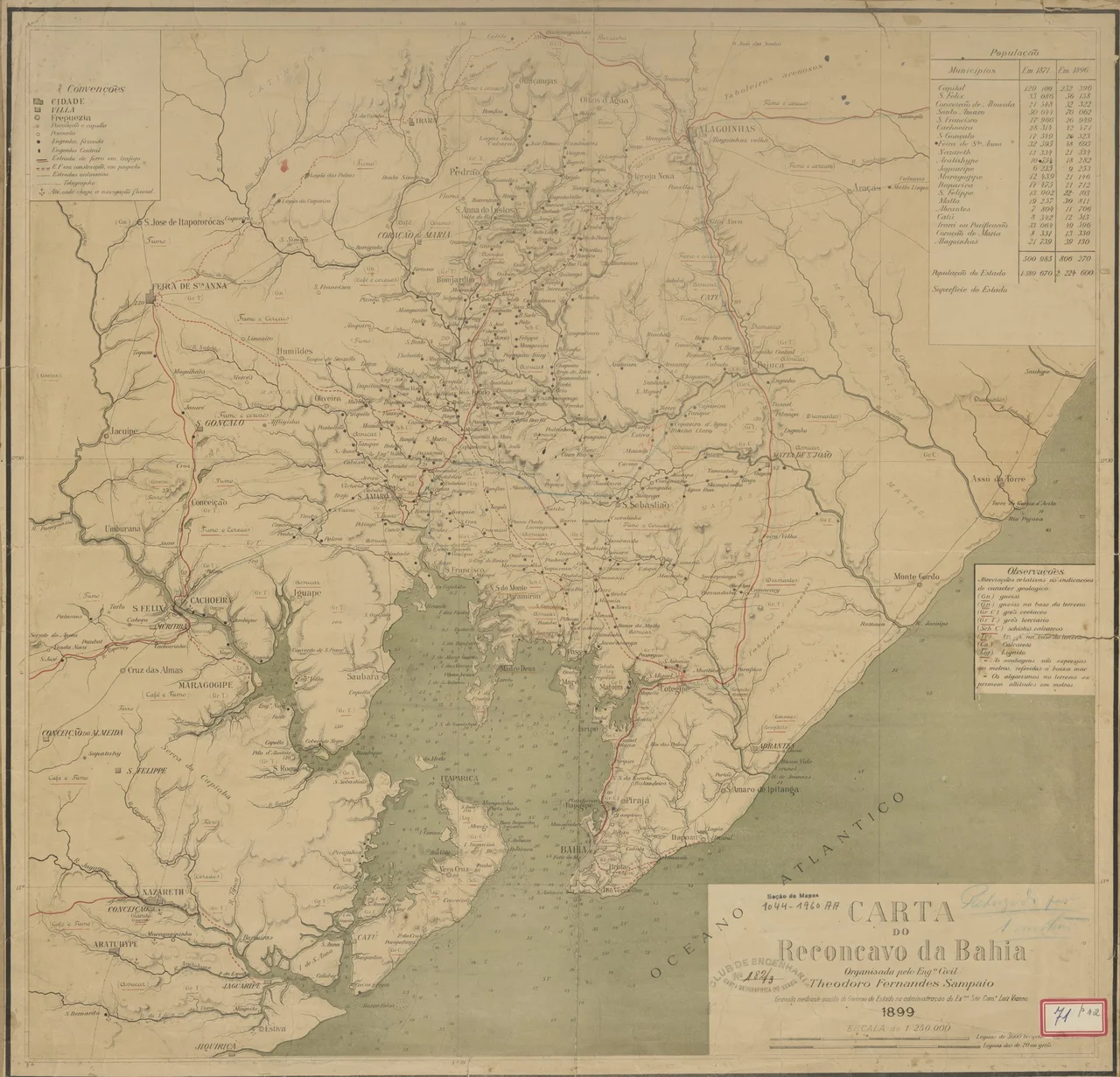
Recôncavo Baiano
The Portuguese word recôncavo meant the bend of land that cups a bay, and when Brazilians say it now they almost always mean this one. Twenty towns are strung around the shore of the Baía de Todos os Santos like beads on a loose thread, and the wide arc of fertile country behind them has been sugar cane country since the sixteenth century, tobacco country since the seventeenth, oil country since the twentieth, and samba country since around 1860. This is the place that made Bahia rich. It is also the place that made Bahia Bahian - the cradle of samba de roda, the hometown of Caetano Veloso, the ground where Afro-Brazilian religion and Portuguese Catholicism grew into each other and refused to separate.
The Shape of the Land
The Bay of All Saints is enormous - one of the largest bays in the Americas - and the Recôncavo is the inland shelf that drains into it. Twenty municipalities fall within the region, from Maragogipe and Santo Amaro on the northern shore to Jaguaripe and Nazaré on the south, with the Paraguaçu, Jaguaripe, and Subaé rivers feeding the bay from the interior. The soils are famously rich, especially the dark, fertile massapê clay that weathered out of basalts and green schists across millennia. Cane planted in massapê grew quickly and milled clean, which is why Portuguese engenhos went up on this soil by the hundreds in the 1500s and 1600s. The surrounding country is Atlantic Forest giving way inland to the drier caatinga and cerrado - an ecological border zone that produces an unusual variety of fruits, birds, and habitats in a relatively small area.
Sugar, Tobacco, Oil
Three economic waves shaped the Recôncavo. Sugar cane came first, in the sixteenth century - the crop that turned Salvador into one of the wealthiest ports in the Atlantic world and ran on the forced labor of hundreds of thousands of enslaved Africans brought across the Middle Passage in chains. Tobacco followed, especially around Cachoeira and Muritiba, producing a dense, dark leaf traded down the coast of West Africa in exchange for more enslaved people and north to Europe for silver. Oil came much later: the Recôncavo became the site of Brazil's first major petroleum discoveries in the 1930s, and Petrobras still pumps from fields along the bay today. The legacy of these overlapping economies is visible everywhere - in the ruined sugar mills along rural roads, in the blackened warehouses of old tobacco towns, in the refinery flares at night on the northern shore.
Samba de Roda and Boa Morte
Around 1860, in the towns of the Recôncavo, a circle dance with call-and-response singing, clapping, and pandeiro percussion began to cohere into what became known as samba de roda. UNESCO recognized it in 2005 as a Masterpiece of the Oral and Intangible Heritage of Humanity. The same region later produced the Velloso family of Santo Amaro da Purificação - the singers Caetano Veloso and Maria Bethânia, who began their careers in the 1960s and reshaped Brazilian popular music. The religious life of the Recôncavo runs along parallel lines. In Cachoeira, the Brotherhood of Our Lady of Good Death - an association of older Black women with roots in nineteenth-century slavery-resistance - organizes the Festa da Boa Morte every August 13: Catholic Mass in the morning, samba and shared food stretching into the night. In Salvador itself, the annual Lavagem do Bonfim brings thousands of Bahian women in traditional white dresses to wash the steps of the Church of Our Lord of Bonfim - a ritual that is Catholic on its face and deeply tied to Candomblé underneath.
Learning and Return
The Recôncavo today supports a cluster of public universities with a specific identity. The Federal University of the Recôncavo da Bahia, founded in 2005, has campuses in Cruz das Almas, Santo Antônio de Jesus, Amargosa, Santo Amaro, and Cachoeira. The University for International Integration of the Afro-Brazilian Lusophony, based in São Francisco do Conde, was created to link Brazilian education with African and Portuguese-speaking partners across the Atlantic - an institutional acknowledgment of a cultural debt that the region itself carries in its music, its food, and its faith. From the air, flying over the bay on a clear morning, you can read the whole history in the landscape below: the green cane fields, the sparse white towns, the refinery smoke, and the long line of beaches where the land bends around the water.
From the Air
The Recôncavo Baiano wraps around the Baía de Todos os Santos at approximately 12.48°S, 38.22°W, one of the largest bays in the Americas (roughly 50 km across). Salvador Bahia Airport (ICAO: SBSV, IATA: SSA) sits at the eastern edge of the region on the Atlantic coast. From 8,000-10,000 feet the bay's near-circular shape is unmistakable, dotted with offshore islands (Itaparica the largest), with the Cidade Alta of Salvador riding a bluff above the narrow harbor mouth. Rivers drain the inland green of the Paraguaçu valley into the bay from the west. Trade winds are easterly to southeasterly; the wettest months are April through July, with afternoon storms common year-round.
Nearby Stories
- Salvador Bahia Airport 21 km away
- Rio São Francisco Mangroves 28 km away
- MV Araraquara 47 km away
- Morro de São Paulo 67 km away
- SS Annibal Benévolo 103 km away
- Pé de Serra 115 km away
- SS Baependy 135 km away
- Roncador Field 1113 km away