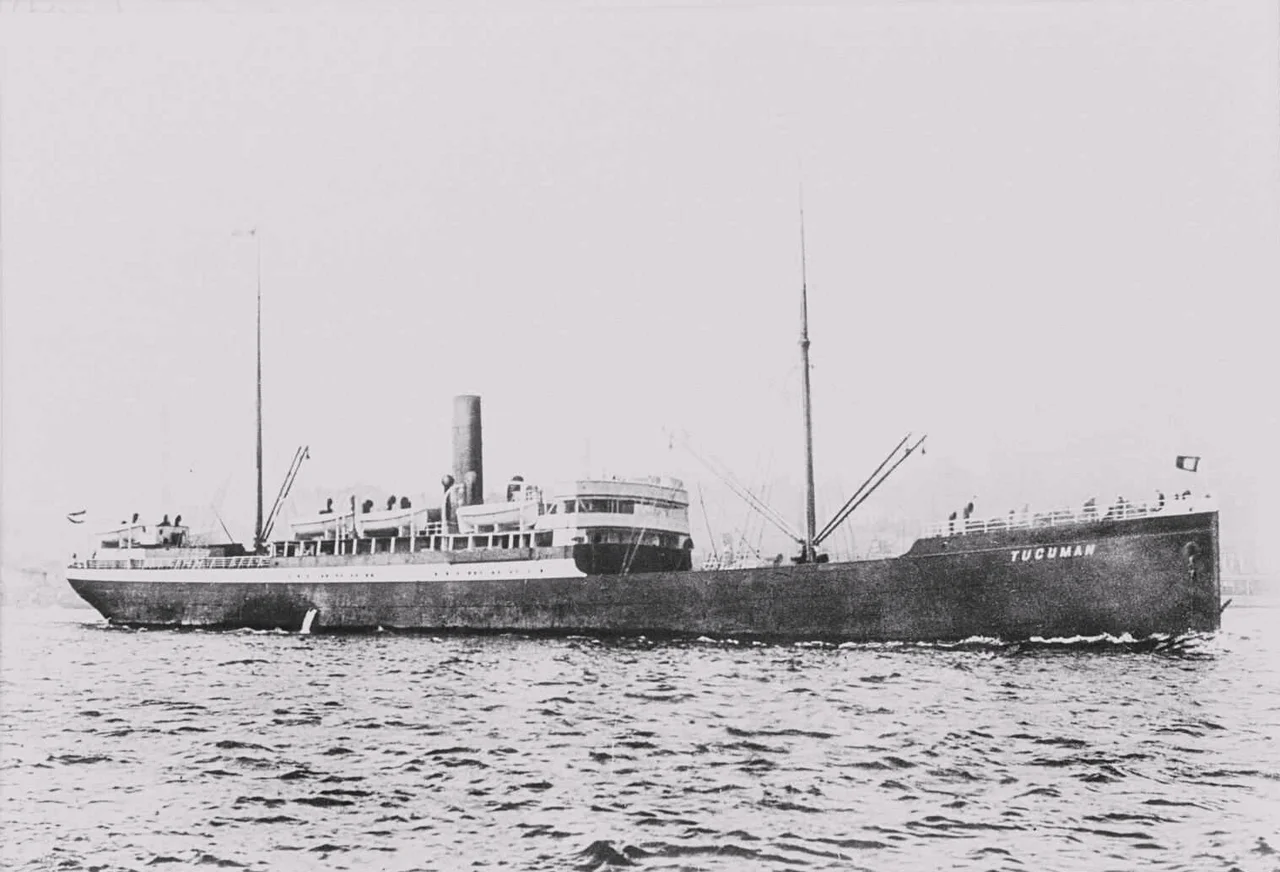

SS Baependy
An orchestra was playing when the first torpedo hit. Baependy had just finished serving dinner roughly twenty nautical miles off the Rio Real lighthouse on the evening of 15 August 1942, and passengers were celebrating the chief officer's birthday. At 19:12 local time two torpedoes from U-507 struck her starboard side, one in the stokehold and one in the bunkers. Flames climbed as high as her masthead. The ship listed, caught fire, and took 270 people down with her — the worst single loss of life in Brazilian maritime history from an act of war.
Tijuca, Then Baependy
She was launched at Blohm+Voss in Hamburg on 5 July 1899 as Tijuca — a German mail steamer, what the shipyards called a kombischiff, carrying both cargo and passengers. For fifteen years she ran the route between Hamburg and the east coast of South America, hauling emigrants south and coffee north. When the First World War broke out she ducked into a neutral Brazilian port for shelter. In 1917, after Germany began sinking Brazilian merchant ships, the Brazilian government seized her and renamed her Baependy, after the town of Baependi in Minas Gerais. (The Y at the end is a registration quirk; that's the correct spelling of the ship's name.) By 1927 she belonged to Lloyd Brasileiro, working cabotage routes along her adopted country's coastline.
The Quiet War
From February 1942 onwards, German U-boats had been sinking Brazilian-owned merchant ships, and the crews knew it. The Brazilian government and the United States Navy began painting hulls grey, blacking out running lights, and taking the flags down. By midyear, Brazilian merchant ships were carrying a single 120 mm naval gun as a defensive measure. On 27 May the Brazilian Minister of Aeronautics, Salgado Filho, announced cheerfully that his pilots had attacked Axis submarines without any formal declaration of war. The Kriegsmarine's response was simple: it asked Berlin to remove all remaining restrictions on attacks against Brazilian shipping. Berlin obliged. The submarines came in earnest.
The Evening of 15 August
Baependy was making about nine knots, paralleling the coast near Aracaju, when the torpedoes hit. The first explosion blew the hatch off Number 2 hold, forward of the bridge; flames roared up from the coal bunkers almost to masthead height. The ship rolled sharply to starboard and began burning. There was no orderly evacuation. Of roughly 306 people aboard, only 36 survived. One of them, an artillery officer named Captain Lauro Moutinho dos Reis, later wrote an account that was published in 1948 in the book Seleções de Seleções. The dead included numerous women and children. Twice as many people died on Baependy as in every previous Axis attack on Brazilian shipping combined — and over the next 48 hours U-507 sank four more Brazilian ships, multiplying the grief.
The Streets of Rio
By 18 August the news had reached Brazilian newspapers, and it moved faster than the government wanted. Students and dockworkers, union members and ordinary citizens, marched through the main cities demanding that Brazil declare war. In Rio de Janeiro the crowds gathered around the Guanabara Palace and the Itamaraty Palace, where Foreign Minister Oswaldo Aranha was already pressing President Getúlio Vargas for a declaration. There were anti-fascist demonstrations everywhere. On 22 August, after a ministerial meeting, Vargas declared a state of belligerence against Germany and Italy, formalised by decree on 31 August 1942. The country that had waited and watched for three years was now in the war — not because its army had crossed a border, but because its steamships full of families had been torpedoed in their sleep.
A Ship Remembered
Baependy's sinking is still the deadliest attack on a Brazilian ship by any act of war, and the fourth-deadliest maritime disaster in Brazilian history. She is the subject of maritime literature, academic research, and military studies, because more than any other single event she marked the moment Brazil stopped being a bystander. Each August in Aracaju and Salvador, the anniversary of her loss is marked by small remembrances — a prayer, a wreath, a reading of names. The water between the Rio Real lighthouse and the shore is shallow and warm, and in the right weather it holds the colour of old glass. Beneath it, somewhere, she is still there.
From the Air
The sinking site is near 11.83°S, 37.00°W, approximately 20 nautical miles off the Rio Real lighthouse and Aracaju, in the stretch of Atlantic where the Sergipe coastline runs roughly north–south. From the air this coast shows as a thin band of white beach backed by mangrove estuaries and scrub caatinga inland. Aracaju–Santa Maria (SBAR) is the closest airfield, about 40 nm north-northwest of the wreck position; Salvador (SBSV) lies roughly 130 nm to the south. The prevailing winds here are the southeast trades, and during dry season (May–September) visibility is usually excellent, with occasional marine haze at sunrise. Cruising altitudes of 6,000–10,000 ft give the best sense of the long, low beaches and the estuary mouths that mark the coast.
Nearby Stories
- Praia do Forte 65 km away
- Recôncavo Baiano 95 km away
- German submarine U-161 (1941) 114 km away
- Salvador Bahia Airport 159 km away
- Morro do Chapéu State Park 400 km away
- Manuscript 512 590 km away
- 1986 João Câmara earthquake 692 km away
- Touros 751 km away