
Manuscript 512
In 1839 a bibliographer working through the National Library's uncataloged papers in Rio pulled out a ten-page document written in faded Portuguese. The author was not named. The date was 1753. The content was startling. A party of bandeirantes, the manuscript claimed, had spent years wandering the interior of Bahia in search of the legendary silver mines of a man called Muribeca, and had instead stumbled onto an abandoned stone city, complete with triumphal arches, Greek-style obelisks, and inscriptions in a language nobody could read. The paper, catalogued years later as document 512, is one of the most famous and most disputed items in Brazilian archives. It has sent men to their deaths. It has inspired Arthur Conan Doyle, Rider Haggard, and possibly Indiana Jones.
A Letter, A Library, A Mystery
The document itself appears to be a transcription of an earlier original that has not survived. Its main body reads like a personal letter; the preamble added by the transcriber frames it as a historical report. Parts of the pages are decayed, and a portion of the text is missing. The story it tells is straightforward. A Portuguese colonel, whose name is among the words lost to damage, led his men deep into the Brazilian interior in 1753. They had been searching for roughly ten years for mines owned by the bandeirante Robério Dias, known as Muribeca, who had been arrested by the Portuguese crown for refusing to reveal where the mines lay. The search carried the party into landscapes few Europeans had seen.
What the Party Described
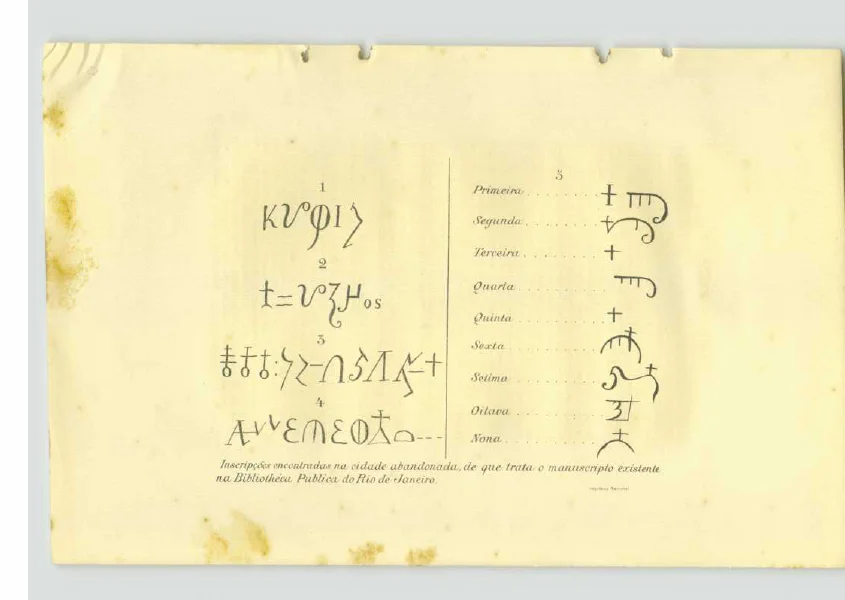
The colonel's men sighted a tall, glistening mountain range and found a path that took them to the summit with surprising ease. From the ridge they looked down on what appeared to be a coastal-style city, except the ocean was hundreds of kilometers away and the city itself was dilapidated and uninhabited. They descended. They entered through a single gate marked with a triple archway that resembled Roman triumphal arches, carved with inscriptions in a script they could not read. The central square held a black pedestal topped with a statue of a man pointing north. Obelisks stood at the four corners. A porticoed building bore a relief of a half-naked figure wearing a laurel crown. A river ran nearby, and following it they found mine shafts lined with silver-bearing rock and more undeciphered inscriptions. The only party member named in the surviving text is João Antônio, who found a gold coin showing a kneeling youth on one face and a bow and crown on the other. Before leaving, the party panned for gold in the river and found it.
A Nation Wants a Past
The timing of the manuscript's rediscovery mattered. Brazil had declared independence from Portugal in 1822 and was urgently constructing a national identity distinct from its former colonial power. The Brazilian Historic and Geographic Institute, founded in 1838, seized on the document. Canon Januário da Cunha Barbosa published the full text in the institute's journal, connecting the lost city to the earlier Muribeca case and to the broader idea that Brazil might hold ruins of an advanced civilization parallel to the Maya at Palenque or the Inca at Machu Picchu. Between 1841 and 1846, the institute sponsored expeditions led by Father Benigno José de Carvalho into the Chapada Diamantina, looking for the city. The searches found nothing. Skepticism grew. By 1881, when the manuscript was first assigned the number 512 in an exhibition catalog, most scholars had concluded the document was imaginative fiction.
Burton, Fawcett, and the Long Shadow
The skepticism did not stop the expeditions. Sir Richard Francis Burton, the English explorer and translator, traveled through Brazil and wrote Highlands of Brazil in 1869 partly in response to the manuscript. Colonel Percy Harrison Fawcett, a British officer who became convinced that Manuscript 512 pointed to an ancient civilization he called Z, led multiple expeditions into the Mato Grosso interior. In 1925, on his final attempt, Fawcett vanished with his son Jack and their companion Raleigh Rimell. Search parties followed for decades; David Grann's 2009 book The Lost City of Z reconstructed the disappearance. Fawcett's bones have never been found. Some scholars argue that his story shaped the character of Indiana Jones. His ghost, in any case, remains tangled with the manuscript that sent him into the forest.
Fiction That Grew From a Fiction
The manuscript's afterlife in literature is substantial. José de Alencar's 1865 novel As Minas de Prata draws on the Muribeca legend. Rider Haggard's King Solomon's Mines, published in 1885, channels the broader European fascination with lost African and South American cities in ways the manuscript helped kindle. Arthur Conan Doyle, whose friendship with Fawcett is documented, published The Lost World in 1912, a story of a plateau in South America populated by prehistoric creatures. A scholar tracing the influence can draw a line from the 1753 letter through the 1839 discovery through Burton and Fawcett to the pulp adventure fiction of the early twentieth century, and from there to the cinematic character of Indiana Jones, whose fedora, whip, and habit of falling into lost archaeological sites read like a condensation of the whole tradition. Whether the colonel and his men ever saw what they claimed to see remains unknown. The manuscript still sits in Rio's National Library, under conservation glass, a fiction or a cipher, ten pages that have outlived everyone who ever tried to confirm them.
From the Air
The manuscript describes a location generally placed in the Chapada Diamantina highlands of Bahia, centered near 11.5°S, 42.5°W, though the precise site (if the city ever existed) is unknown. Chapada Diamantina is a dramatic table-mountain landscape with sandstone ridges, caves, and 300-400 m cliff faces. Recommended survey altitude 7,000-10,000 ft AGL to appreciate the plateau scale. Nearest airports are Lençóis Horácio de Mattos (SNLN / LEC) to the south and Barra (SNBR) to the north. Strong visual landmarks include the Morro do Pai Inácio mesa, the Cachoeira da Fumaça canyon, and the distinctive orange-red sandstone of the Chapada. Best conditions May-September (dry season); summer thunderstorms are violent over the plateau.
Nearby Stories
- Morro do Chapéu State Park 62 km away
- Bahia 84 km away
- Vale do Capão 132 km away
- Barreiras 232 km away
- Atlantic dry forests 302 km away
- Nascentes do Rio Parnaíba National Park 355 km away
- Serra Geral do Tocantins Ecological Station 466 km away
- Serra das Almas Private Natural Heritage Reserve 687 km away