
Nascentes do Rio Parnaíba National Park
The capuchins crack open palm nuts with rocks, and primatologists have been watching them for years. These are not clever individuals. These are a culture. The colony at Nascentes do Rio Parnaíba National Park was the first group of New World primates observed using stone tools in the wild, and researchers now refer to them unofficially as the Einstein monkeys. They live in a park that almost no one visits. Four to six hours of dirt road from the nearest commercial airport, 724,324 hectares of cerrado savanna rolling across northeastern Brazil, the park is typically closed to casual tourism. Most days, the only witnesses to the tool-making are other monkeys.
The Wolf on Stilts
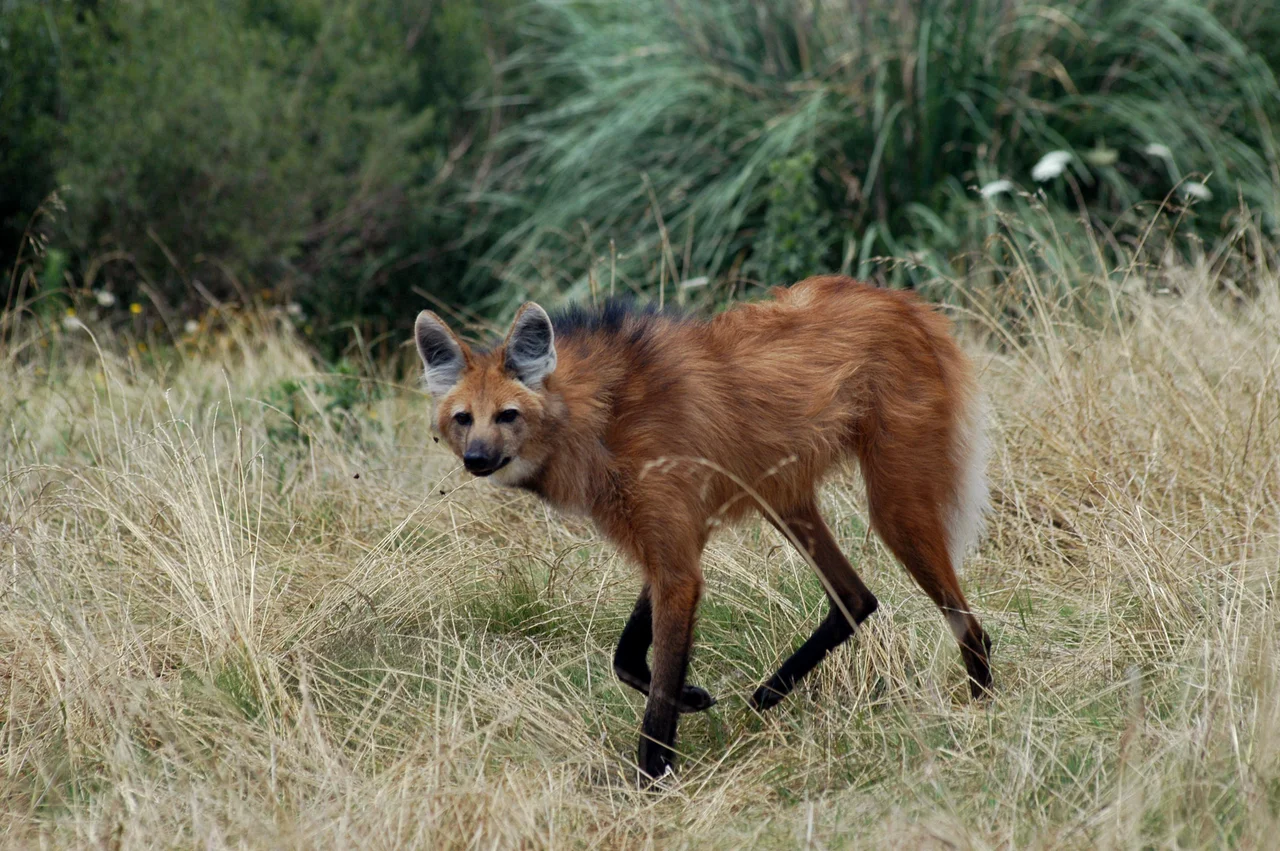
Brazil's cerrado is the world's most biodiverse tropical savanna, and almost nothing embodies its strangeness like the maned wolf. Long legs carry a red-gold body above the tall grass - an evolutionary solution to seeing over the vegetation rather than running through it. Locals call it lobo-guará and sometimes describe it as a fox on stilts. The park supports more than 200 mammal species, and the maned wolf is among the most iconic. Giant anteaters lumber through the brush with their long claws curled under. Giant armadillos dig for termites with shovels for hands. Howler monkeys and tufted marmosets move in the gallery forests along the streams, adding their calls to the morning chorus. Somewhere among the palm groves, a capuchin picks up a stone and positions a nut on a flat surface, preparing to strike.
Where the Parnaíba Begins
The park's name reveals its purpose: nascentes means headwaters, and the Parnaíba River that gives Maranhão and Piauí their shared border begins in these hills. The park was established in 2002 as part of the Brazilian national parks system, part of a slow effort to preserve the cerrado biome that has otherwise been heavily converted to soybean fields and cattle ranches across central Brazil. Altitude and relief give the landscape variety. Some of the plant species estimate runs to 10,000 - an enormous botanical richness for savanna, rivaling many rainforests. The climate is semi-humid tropical with average temperatures between 22 and 27 degrees Celsius. A dry season stretches from April through September, a wet season from October through March, with rainfall totaling around 6.4 inches during the wet months. The wildlife is most visible in the dry season, when water concentrates at remaining sources.
Hyacinth Macaws and the Rarities
More than 600 bird species have been recorded in the park, and the showpiece is the hyacinth macaw. Its deep cobalt plumage and massive beak make it unmistakable, and it is threatened across most of its range. Spix's macaws are extinct in the wild elsewhere but associated with the region; burrowing owls stand upright on the ground at dawn; blue-crowned parakeets fly in chattering flocks; king vultures circle the thermals overhead; swallow-tailed hummingbirds hover at flowering shrubs. Among the rarities, roughly twenty species are considered exceptionally uncommon, including the blue-eyed ground dove and the Brasília tapaculo. The park also supports more than 200 amphibian species, including endangered tree frogs that call through the wet nights. For a place almost no one sees, the biological books are remarkable.
Reaching a Closed Park
Getting here requires planning. Barreiras is the nearest city with commercial flights, accessible by a two-and-a-half hour flight from Salvador on Azul airline. From Barreiras, visitors meet a local guide for a four to six hour drive on remote dirt roads. The park itself is generally closed to the public. Travelers who want in must contact the park service for permission and must hire a local guide to accompany them throughout the visit. The fees are described as reasonable. Two visitor areas offer rustic lodges established in the 1990s and early 2000s, informally called the SouthWild Wolf Camps - a name honest about what comes sniffing around the perimeter at dusk. Vaccines are advised: Hepatitis A and B, Typhoid, and Yellow Fever. Malaria and dengue are present in the region. DEET is not optional.
The Emptiness as a Feature
Most national parks are busy with infrastructure - visitor centers, marked trails, guided tours on schedules. Nascentes do Rio Parnaíba is different. Its remoteness is the reason the wildlife remains. The cerrado has been ground down across most of its range for agriculture, and protected areas are the last reservoirs of the intact biome. Closing the park to most tourists is one of the choices keeping it functional as an ecosystem. For a pilot crossing the Brazilian interior, the park reads from altitude as a long patch of paler, unbroken savanna between the soybean grids that march across the plateaus. In the dry season, the gold of the grasses dominates. In the wet, flushes of green appear around the streams. Somewhere below, a capuchin is teaching its young the exact angle at which a stone must strike a nut.
From the Air
Located at approximately 10.05°S, 45.90°W, spanning portions of Maranhão, Piauí, Bahia, and Tocantins states in northeastern Brazil. Park covers 724,324 hectares of cerrado savanna. Nearest commercial airport is Barreiras (SBBR) - about 2.5 hours by flight from Salvador (SBSV) on Azul airline. From Barreiras, park is 4-6 hours by dirt road. Recommended viewing altitude 15,000-25,000 feet for park-scale features. Visible from altitude: the pale cerrado vegetation contrasting with darker gallery forests along streams; the headwater drainages of the Parnaíba River; the plateau topography characteristic of this part of the Brazilian highlands. Dry season (April-September) offers clearest visibility; wet season (October-March) brings clouds but also flushes of green.
Nearby Stories
- Serra Geral do Tocantins Ecological Station 64 km away
- Jalapão State Park 77 km away
- Luís Eduardo Magalhães, Bahia 192 km away
- Tocantins 197 km away
- Barreiras 202 km away
- Chapada das Mesas National Park 345 km away
- Manuscript 512 348 km away
- Mirador State Park 363 km away