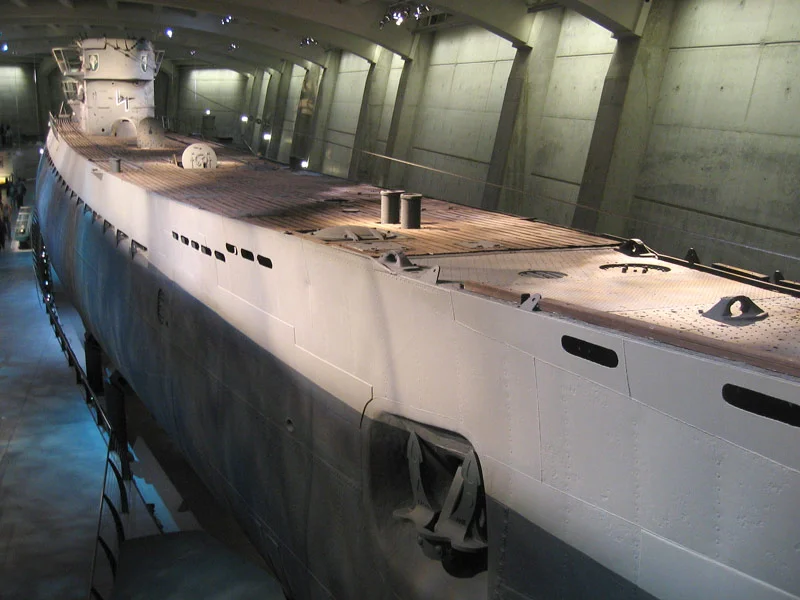

German submarine U-161 (1941)
On the night of 9 March 1942, a German submarine slipped through the mouth of Castries Harbour on the British island of Saint Lucia - a passage narrow enough that local pilots thought it impossible for a submerged boat - torpedoed two moored vessels, and slipped back out. The commander was Kapitanleutnant Albrecht Achilles, only weeks into his command of the boat. The U-boat was U-161, a Type IXC just eight months out of the Bremen shipyards. The Castries raid and a similar strike on Port of Spain, Trinidad, two weeks earlier would earn Achilles the Knight's Cross. They also opened a run of twelve sunken ships, six patrols, and nineteen months of hunting that would end in the South Atlantic off the coast of Brazil.
A Boat Built for the Long Reach
Her keel was laid on 23 March 1940 at the Deutsche Schiff und Maschinenbau yard in Bremen, hull number 700. Launched on 1 March 1941 and commissioned on 8 July under Kapitanleutnant Hans-Ludwig Witt, she was a Type IXC - the long-range version of the German Type IX. At 76.76 meters in length, with a surface displacement of 1,120 tons and a submerged displacement of 1,232 tons, she could travel 13,450 nautical miles on her two MAN diesels at ten knots, enough to cross the Atlantic twice without refueling. Six torpedo tubes, twenty-two torpedoes, a 10.5cm deck gun, and anti-aircraft guns gave her teeth. Her crew numbered forty-eight men. She could dive to 230 meters - a depth at which the pressure alone, if you thought about it too long, would squeeze any claustrophobe into a different line of work. Witt turned over command to Achilles on 1 January 1942, and the combat career began almost immediately.
Caribbean Hunting Grounds
U-161 left Kiel on her first operational patrol on 3 January 1942, threaded the GIUK gap between the Faroes and Shetlands, and reached Lorient on the French Atlantic coast on 3 May. That port would remain her base. Her second patrol - the Castries raid was part of it - rolled up merchant ship after merchant ship in the Gulf of Paria off Port of Spain, Trinidad, and through the Lesser Antilles. The names read as a litany of the global tanker trade: Circe Shell, Lihue, Uniwaleco, Sarniadoc, Mokihana. One of the ships, the Sarniadoc, sank in thirty seconds when her boiler exploded, and her crew died with her. On 15 March she gunned down the United States Lighthouse Tender Acacia off Haiti - the only American tender lost to enemy action in the Caribbean theatre - though her crew abandoned ship first and all survived. These were merchant sailors going about civilian work. They were men with wives, children, and in many cases no defensive armament at all.
Four More Patrols, and a Detail That Stays With You
The third patrol took her past the Azores and Cape Verdes to the Brazilian coast, then up the South American shoreline back into the Caribbean, sinking the sailing ship Nueva Altagracia and the San Pablo at Puerto Limon, Costa Rica. The fourth patrol, 113 days long, was her longest - it reached West Africa, where she damaged a British light cruiser off Pointe Noire and sank a ship southwest of Takoradi, Ghana. On the fifth patrol, north of Bermuda, she stopped another sailing ship, the Angelus, and sank her with gunfire. Ten of the Angelus's crew got into a lifeboat. When the lifeboat was discovered, only two were still alive. That is the kind of detail that follows you. Men in open ocean, in an unpowered boat, far from any shipping lane, waiting for a rescue that would come - for most of them - too late.
Rendezvous, Last Patrol, and 27 September 1943
U-161 left Lorient for the last time on 8 August 1943. On 20 August, somewhere in the middle of the Atlantic, she rendezvoused with the Japanese submarine I-8 and transferred two German radio technicians and a Metox radar detector - a small but telling piece of Axis cooperation between two empires that fought largely separate wars. Back off the Brazilian coast she sank St. Usk on 20 September and the Brazilian steamer Itapage on the 26th. The next day, 27 September 1943, a PBM Mariner flying boat of US Navy Patrol Squadron VP-74 out of Aratu Naval Base caught her on the surface and attacked with depth charges. U-161 went down with all hands. Fifty-three men died, including Achilles, who was twenty-nine. Hans-Ludwig Witt, the boat's commissioning captain, had long since rotated off to other assignments and survived the war. For the merchant sailors, the aircrews, and the submariners alike, the Battle of the Atlantic was not an abstraction. It was the thing that killed them.
From the Air
U-161's final resting position is approximately 12.50 degrees south, 35.58 degrees west, in the South Atlantic off the Brazilian coast of Bahia/Sergipe, where she was sunk on 27 September 1943. Open ocean, hundreds of miles from land; deep bathymetry - roughly 5,000 meters water depth in this region. Any aerial route over the site would typically overfly at transoceanic flight levels (FL340-400). Nearest land-based airports: Aracaju (SBAR) and Salvador (SBSV) to the west, Recife (SBRF) to the north. The 1943 attack was flown by a PBM Mariner of VP-74 operating out of Aratu Naval Air Station near Salvador. Tropical Atlantic weather; afternoon cumulus and scattered showers common year-round.
Nearby Stories
- SS Baependy 101 km away
- MV Araraquara 136 km away
- SS Annibal Benévolo 194 km away
- Battle of 4 May 208 km away
- Salvador Bahia Airport 286 km away
- Rocas Atoll 950 km away
- Atol das Rocas Biological Reserve 979 km away
- Roncador Field 1074 km away