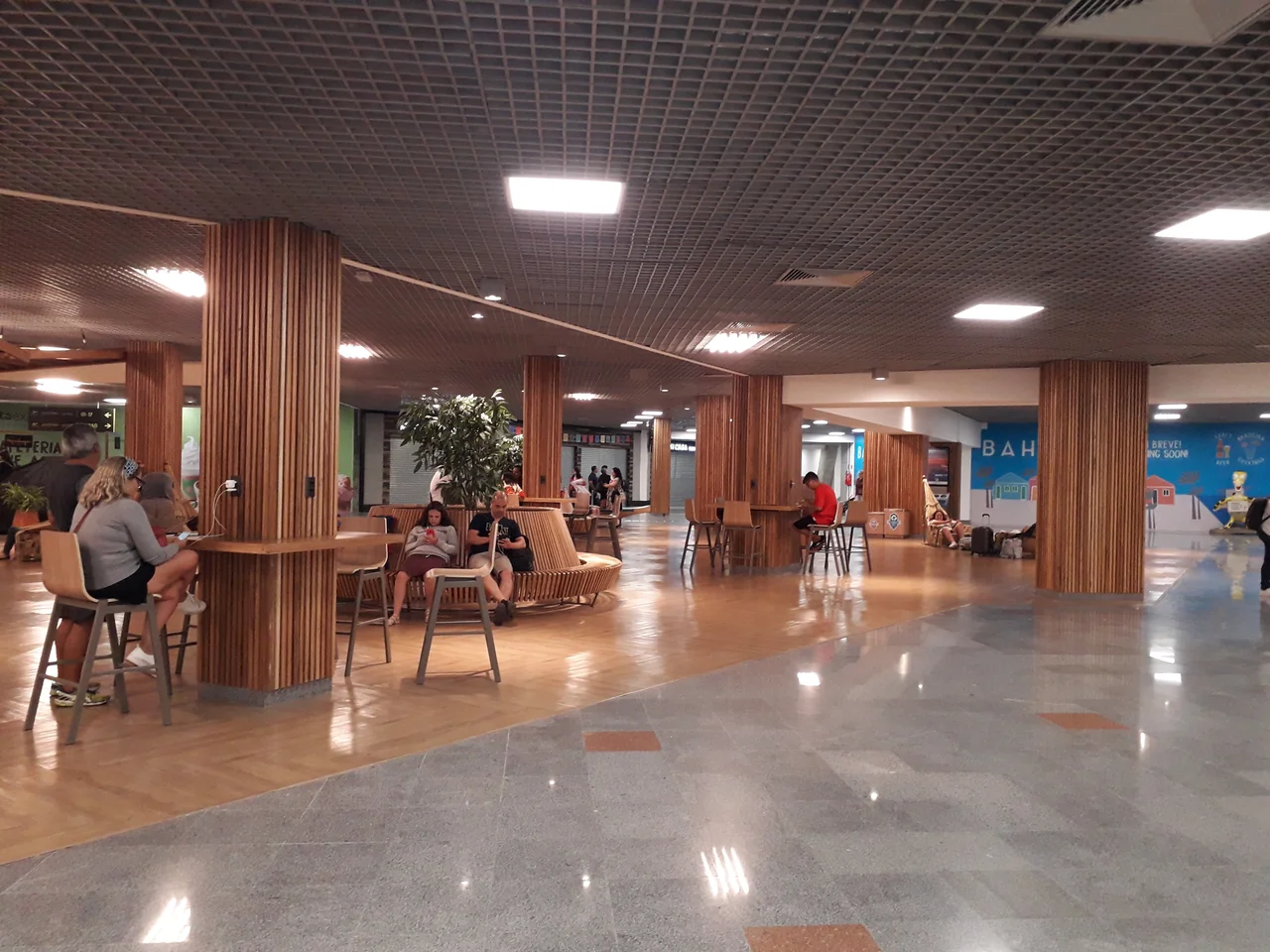

Salvador Bahia Airport
Drive out to the airport from central Salvador and something unexpected happens. The road narrows into a green tunnel of bamboo so tall it arches over the lanes, the light goes dappled, and for a kilometer or two you are not on an airport approach but in something closer to a botanical garden. This is the Avenida Paralela cut, and at the end of it sits Salvador Bahia Airport - originally Santo Amaro do Ipitanga, opened in 1925, making it one of the oldest continuously operating airports in Brazil. The terminal handles six million passengers a year on a six-million-square-meter airfield carved out of sand dunes and coastal forest. The local Bahians, regardless of what the Federal Register says, still call it Dois de Julho.
A Century of Names
The airport has been renamed more than once. Opened in 1925 as Santo Amaro do Ipitanga - after the river that ran nearby - it was completely rebuilt in 1941 by Panair do Brasil with American and Brazilian government support, part of the Allied effort to secure the South Atlantic air ferry route during World War II. Ships carrying aircraft parts, petroleum, and personnel bound for Africa and the European theater staged through here during the war. On December 20, 1955, the government renamed the facility Dois de Julho International Airport, honoring July 2 - the date Bahians celebrate their state's independence from Portugal in 1823. That name stuck in the local memory. On June 16, 1998, a federal law renamed it again, this time for Luís Eduardo Maron Magalhães, a Bahian politician who had died earlier that year at forty-three. The change was and remains controversial; attempts to revert it have come and gone. Since 2017 the commercial operator has simply marketed it as Salvador Bahia Airport.
The Terminal in the Dunes
The airfield occupies more than six million square meters of coastal land twenty-eight kilometers north of downtown Salvador, pressed between the Atlantic and a strip of native restinga vegetation. The current passenger terminal opened in 1998, replacing an older facility that had become too small for the city's growing traffic. Upgrades continued through the year 2000 and again in the late 2010s under private management. The main terminal now covers 69,400 square meters, includes a shopping mall and eleven jetways, and has the capacity to handle six million passengers a year. Traffic had been growing at about 14 percent annually for years before the pandemic. The airport shares some facilities with Salvador Air Force Base, which maintains a Brazilian Air Force presence on the same field.
Public, Private, Back and Forth
For most of its modern history the airport was operated by Infraero, the state-owned infrastructure company that ran the majority of Brazil's commercial airports. In 2011 a government saturation review rated Salvador Bahia as being in good shape - operating at less than 70 percent of capacity - even as complaints about crowding and service grew at other Brazilian airports. Privatization came in 2017. On March 16 of that year, the French infrastructure giant Vinci SA won the thirty-year concession for R$2.35 billion, roughly 640 million euros. Vinci announced plans to duplicate the passenger terminal, though implementation has proceeded more slowly than originally projected. The airport's access improved dramatically on April 26, 2018, when the Aeroporto station on Line 2 of the Salvador Metro opened, giving passengers a rail link directly to the Lapa hub downtown.
Gateway and Landmark
For most visitors to Bahia, this is the first Brazilian ground they touch. Flights arrive from across Brazil and from major South American hubs, plus seasonal European and North American services that come and go with the tourism calendar. For pilots, the approach over the Atlantic on a clear morning offers one of the more memorable airfield sights in northeastern Brazil: the runway laid perpendicular to the coast, long white beaches stretching north and south, and the vast bay of Todos os Santos visible inland. For Salvadorans, the airport is a working part of the city - reached now by Metro rather than a long taxi ride, and still approached along the bamboo-shaded avenue that earlier travelers remembered as one of the most unlikely welcomes any major airport anywhere provides.
From the Air
Salvador Bahia Airport (ICAO: SBSV, IATA: SSA) is located at approximately 12.91°S, 38.32°W, about 28 km north-northeast of downtown Salvador along the coast. Elevation 64 feet (20 meters) above mean sea level; single runway 10/28, approximately 3,006 meters long, oriented roughly east-west. The airport shares its airfield with Salvador Air Force Base (Brazilian Air Force). Approaches from the east pass over the Atlantic; approaches from the west cross the restinga and residential suburbs of northern Salvador. The airport lies on a narrow coastal strip between sand dunes and native vegetation. Easterly and southeasterly trade winds predominate. Expect afternoon cumulus and occasional heavy showers, particularly April through July. The Salvador Metro's Aeroporto station (Line 2) connects directly to downtown at Lapa.
Nearby Stories
- Recôncavo Baiano 36 km away
- Battle of 4 May 46 km away
- MV Araraquara 102 km away
- Pé de Serra 112 km away
- Serra do Conduru State Park 146 km away
- SS Annibal Benévolo 153 km away
- Ilhéus 208 km away
- SS Principessa Mafalda 418 km away