
Pé de Serra
The town's founding story, the one everyone tells, begins with a dog. Three Portuguese brothers were camped near Riachão do Jacuípe in 1745, prospecting the Bahian interior for land worth settling. It was a drought year. One of their dogs disappeared for days and came back soaking wet - but refused to drink the water they offered. The brothers watched him the next time he slipped off. He pushed through the gravatá scrub and vanished into a stand of bromeliads, and when he emerged, he was wet again. They followed him, pulled aside the undergrowth, and found a hidden spring seeping from the rock at the base of a mountain. They called it the heath at the foot of the mountain. *Pé de Serra* is what that name shortened into. The municipality turned forty-one years old as a recognized city on March 20, 2026, and dogs still wander through the streets as if they own the place.
Between Two Mountains
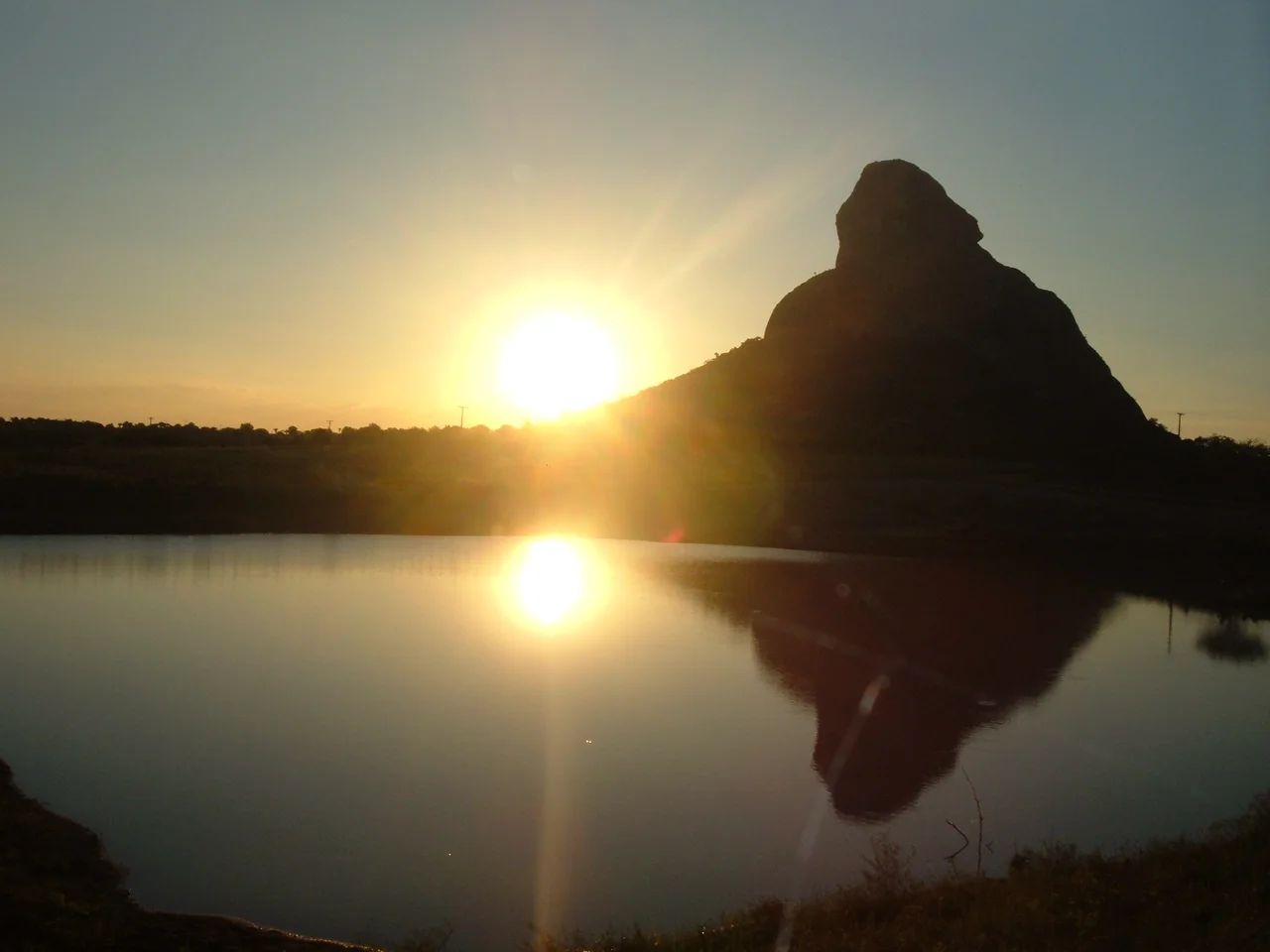
The town sits on the slopes of Serra do Leão - Lion Mountain - with a second peak, Bugi, rising nearby. This is the Sisaleira region, named for the spiky agave that farmers have grown here for a century, harvesting its fibers to spin into rope and twine. Pé de Serra covers 597 square kilometers of dry inland Bahia, part of the Serrinha microregion, and the municipal center is surrounded by small rural hamlets that function as secondary urban nodes. The countryside runs to cattle, sheep, goats, pigs, chickens, and the occasional herd of horses or mules; dairies ship cheese and yogurt to Salvador, Feira de Santana, Camaçari, and Juazeiro. The agricultural picture has shifted. Sisal and beans and cassava and maize still grow, but livestock has been slowly taking over the space that used to be planted, and plantations of *umbu* - a drought-tolerant native fruit tree - are one of the newer bets.
A Town That Is Shrinking
The 1991 census counted 17,048 people in Pé de Serra. By 2004 it was down to 11,727. The 2020 IBGE figure was 13,556 - a partial recovery, but the longer-term trend points out the door. Where do people go? Salvador and Feira de Santana in the same state absorb most of the younger residents; São Paulo gets the rest. This is the oldest Brazilian story, the one that built modern São Paulo: rural sertanejos leaving home because the land cannot pay them what the city can, even in the worst neighborhoods of the biggest cities. The population of Pé de Serra today is a mix of white, brown, and Black residents. The white population descends mostly from Portuguese settlers, with some Spanish and Dutch roots. The Black population descends largely from enslaved Africans brought to the Bahian interior during the colonial sugar and cattle economies. Catholicism remains the dominant religion; evangelical Christianity is steadily growing.
Easter Week Turns the Town Inside Out
For most of the year there is not much tourism. Then comes Holy Week. On Good Friday, the hills around the city become a stage: Passion plays performed on the slopes of Serra do Leão and the other peaks, villagers climbing in procession, the narrative of the Crucifixion enacted against the ridge lines above the town. Hundreds make this pilgrimage every year. On Holy Saturday afternoon, Charanga takes over the streets - a carnival-style parade dragging a euphoric crowd through town behind a band playing *sambas-de-lavagem* and carnival *marchinhas*. At night, a straw effigy of Judas is hung in the public square and set alight in a pyrotechnic display; before the burning, someone reads Judas's mock will aloud, a stream of jokes about the previous year's local scandals. The Micareta festival, known here as Pascareta, runs through the same weekend. The city changes. Relatives come back from São Paulo to see the mountains their grandparents named.
Vaqueiros, Marathons, and Quiet Days
Every January 6 is the feast of the *vaqueiros* - the cowhands of the Bahian interior - and of the farmers who raised the cattle in the first place. The Aboio tradition comes out: the long, wordless song that drovers used to sing to calm herds on the road, wavering through minor intervals, still holding a crowd silent. Horse races, marching bands, barbecue. In March, for the anniversary of the municipality's emancipation, there is a marathon and a civic parade. The rest of the year Pé de Serra is quiet. There are no theaters or cinemas or museums - just bars, schools, a handful of chapels, and the Mother Church standing over the square. For people who leave, what brings them back is not sights but people and a particular brown-stone mountain visible from every porch.
From the Air
Located at 11.83°S, 39.61°W in the Sisaleira region of central-eastern Bahia, part of the Serrinha microregion. Elevation roughly 280-400 m; the surrounding Serra do Leão and Monte Belo rise sharply above the town. No public-use airport in the municipality. Nearest airfields: Feira de Santana (SNJD) about 120 km south-southeast, offering paved runway and regional services; Salvador International (SBSV) about 220 km southeast for larger aircraft. Recommended overflight altitude 3,000-5,000 ft AGL to see the two-mountain silhouette and the sisal fields clearly. Winds in this part of the Bahian interior tend to be easterly trades, moderate most of the day. The sertão interior is drier than the coast; severe thunderstorms are less common than in the Recôncavo, but visibility can be reduced by burning-season smoke August-October.
Nearby Stories
- São João de Deus Hospital 53 km away
- Cachoeira 84 km away
- Morro do Chapéu State Park 134 km away
- Lençóis 150 km away
- Vale do Capão 175 km away
- Manuscript 512 322 km away
- Castanhão Ecological Station 669 km away