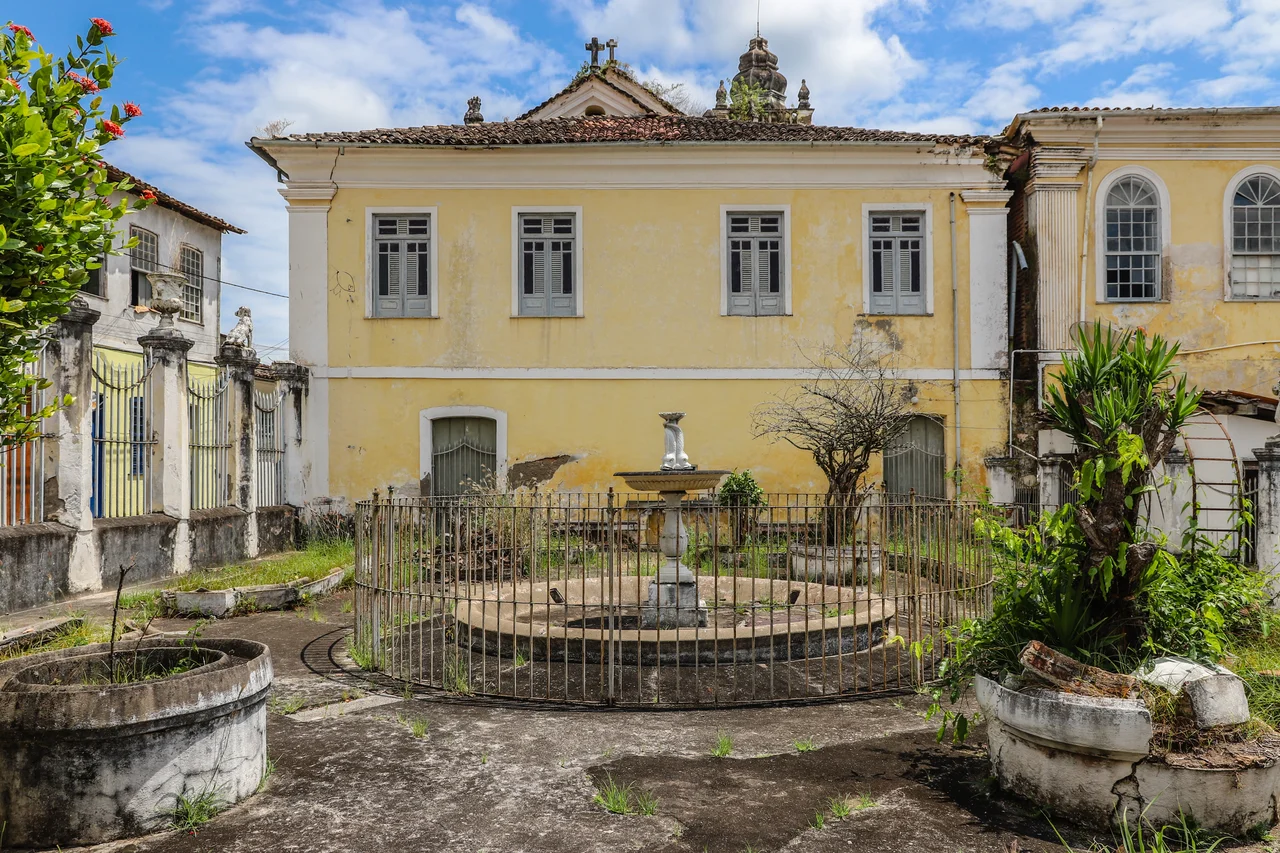

São João de Deus Hospital
In 1729, a friar named Antônio Machado from the Church of Belém da Cachoeira opened a small charity hospital for the poor in what was then one of Colonial Brazil's wealthiest towns. Cachoeira sat on a bend of the Paraguaçu River, the inland port through which the sugar plantations of the Recôncavo shipped their cargo to Salvador and from there to Lisbon. The hospital he founded is still standing. Three centuries later the chapel that opens onto Dr. Aristides Milton square has been listed by IPHAN, Brazil's national heritage institute, since 1943. The garden behind it was listed even earlier, in 1940. Together they are one of the oldest continuously functioning medical complexes in Brazil.
Friar Antônio and His Charity
The hospital de caridade was not an institution for the well-off. The Portuguese colonial system sorted care by class as a matter of policy: the wealthy were treated at home by private physicians, while the hospitais de caridade tended to the poor, the enslaved, the aging, the injured dockworker, the beggar in the Largo. Friar Antônio was from the Church of Nossa Senhora de Belém, itself one of Cachoeira's great colonial landmarks. He founded the hospital in 1729, and in 1754 it was donated to the Order of Saint John of God of Lisbon - the Hospitallers, a religious order formed in sixteenth-century Granada around the life of a Portuguese soldier who devoted his later years to caring for the mentally ill and the indigent. In 1826, four years after Brazilian independence, the hospital was transferred to the Santa Casa da Misericórdia, the lay Catholic charitable brotherhood that ran most of Portugal and Brazil's charity hospitals. It has remained part of the Santa Casa network since.
A Building That Survived
The current building dates from the second half of the nineteenth century - not the original 1729 structure, though the institution is continuous. It still follows the colonial Santa Casa plan: a central courtyard with the chapel on one side, rooms arrayed around the yard. The exterior, rebuilt in that later century, took on a neoclassical skin - plain lines, plain surfaces, the Baroque impulse subdued. Inside the chapel, though, the older instinct survives. The nave has a single side aisle and a transverse sacristy with a room above. Two rows of choir windows stack the front facade. One tower, where a second was planned but never built. The churchyard became a garden in 1912 - French-formal in layout, geometric flowerbeds edged by columns topped with ceramic pots, pine cones, dogs, and lions. A marble fountain with three dolphins anchors the center.
Why Cachoeira Kept It
Cachoeira declined when the railroad bypassed it in the early twentieth century and the sugar economy stopped flowing through. That decline is why the town still looks, in parts, like a 1750 engraving of colonial Bahia - because nothing ever got rich enough to tear it down and rebuild. The hospital complex is part of that preservation. IPHAN listed the garden in 1940 as an archaeological, ethnographic, and landscape monument, and the chapel in 1943 as a fine arts monument. The listings were not honorific - they were legal protections, the kind that make it a crime to alter the building without federal approval. In a region where two-hundred-year-old structures were routinely demolished in the twentieth century for parking lots and banks, that paperwork is the difference between the hospital existing and the hospital being a photograph in an archive. Treatment continues in the modern ward behind the chapel. The poor of Cachoeira still go there for care.
From the Air
The hospital is in the town of Cachoeira, Bahia, at 12.60°S, 38.96°W, on the Paraguaçu River about 100 km west-northwest of Salvador. The Recôncavo Baiano - the sugar-producing coastal region draining into the Bay of All Saints - spreads around it. Nearest major airport is Salvador Bahia International (SBSV). Visibility is excellent year-round in Bahia's sertão approaches; the Paraguaçu River itself is a useful reference feature, snaking westward through the Recôncavo before climbing into the Chapada Diamantina. Tropical climate with April-June wet season.
Nearby Stories
- Recôncavo Baiano 15 km away
- Bahia incident 27 km away
- Battle of 4 May 55 km away
- Pé de Serra 58 km away
- MV Araraquara 114 km away
- SS Annibal Benévolo 177 km away
- Sincura 213 km away
- Lençóis 219 km away