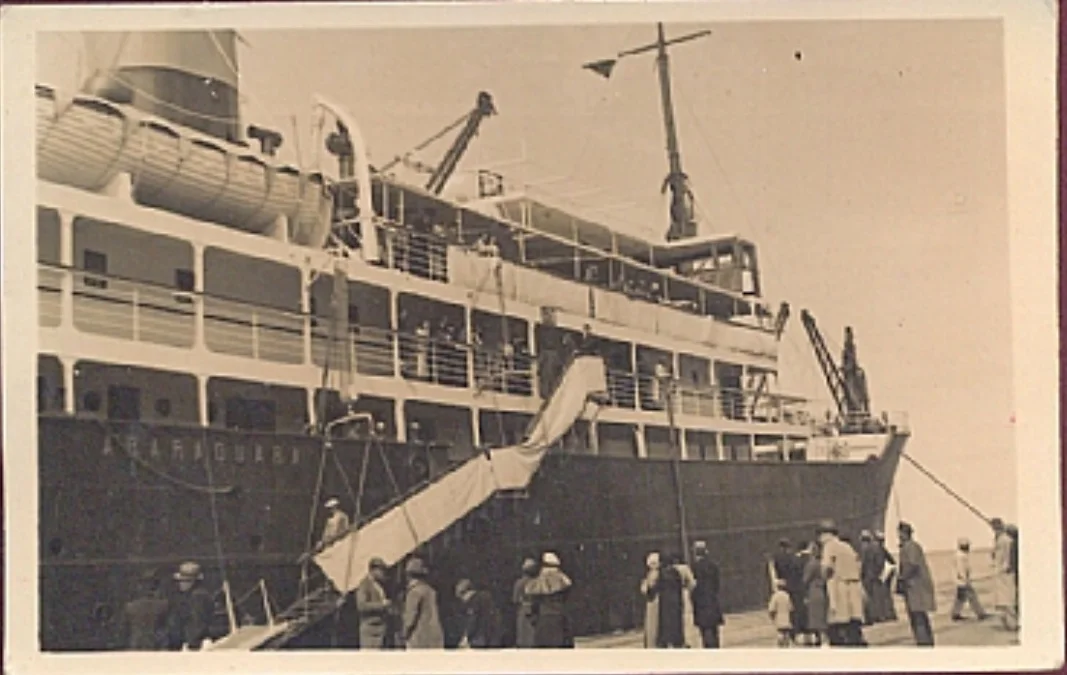

MV Araraquara
Many of her passengers had already gone to their cabins for the night. It was just after nine in the evening on August 15, 1942. The *Araraquara* was steaming north along the Bahia coast, about twenty nautical miles off the mouth of the Real River, bound for Recife with coastal mail, cargo, and civilian passengers. She had no idea that U-507, a German submarine operating under Kriegsmarine orders, had already killed hundreds of Brazilians that same evening and was waiting for her. Two torpedoes hit the starboard side one minute apart - one in the cargo hold, one in the engine room. She listed, burned, and went under in five minutes. A hundred and thirty-one people did not get off. Brazil was not at war. Within two weeks, she was.
A Ship From Monfalcone
The *Araraquara* was not a warship. She was a twin-screw motor ship built at Cantiere Navale Triestino in Monfalcone, on the Italian Adriatic, as yard number 176. Launched on August 1, 1927, completed that October, she joined the Lloyd Nacional fleet - a Brazilian shipping company that worked the long coastal trade between Rio de Janeiro and the northeast. Three sister ships followed her down the ways in the same class, the *Araranguá* first as lead ship. For fifteen years *Araraquara* carried passengers and freight up and down the same ports - São Paulo, Salvador, Aracaju, Recife - ordinary commercial steaming in an ordinary world. In August 1942 that world was no longer ordinary anywhere in the Atlantic, but Brazil was still a neutral country. Captain Augusto Teixeira de Freitas was her master. On August 11 she left Rio de Janeiro. She called at Salvador. On August 15 she sailed north, and she never reached Recife.
The Long Night of U-507
Commanded by Harro Schacht, U-507 had slipped into the shipping lanes off Brazil's northeastern coast earlier that month. At 19:12 local time on August 15, she sank the Lloyd Brasileiro passenger ship *Baependi* about twenty nautical miles off the Rio Real lighthouse. *Baependi* went down so fast she could not send a distress call. Two hundred and seventy people died with her. The *Araraquara*, unaware, was less than two hours away and steaming into the same patch of sea. At 21:03 and 21:04 the two torpedoes struck. Over the following day and a half, U-507 would sink four more Brazilian ships - *Aníbal Benévolo*, *Itagiba*, *Araraquara* itself, and *Arará* - killing more than 600 civilians in total. Not soldiers. Families. Passengers returning to the northeast. Merchant crews. Children.
A Survivor's Account
First Officer Milton Fernandes da Silva lived. He wrote a report of what had happened a month after he was pulled from the sea. Twenty-eight people reached shore in a single lifeboat after a long night on the open Atlantic; four more crewmen clung to wreckage through the dark, and one of them, hallucinating, threw himself into the water and was not recovered. The rest survived until daylight. The names of those who did not survive - the hundred and thirty-one - ran in Brazilian newspapers alongside the names from the *Baependi*, the *Itagiba*, the *Arará*. Families in Salvador, in Recife, in Rio read them over coffee. The country's mood changed within hours.
How a Country Goes to War
Students, trade unionists, and workers marched through Brazil's capital cities demanding that President Getúlio Vargas act. Crowds gathered outside the Guanabara Palace and the Itamaraty Palace in Rio de Janeiro, calling for a declaration. On August 22, 1942, after a ministerial meeting, Vargas declared a state of belligerence against Germany and Italy. Decree-Law No. 10,358, signed on August 31, made it official. Within two years, a Brazilian Expeditionary Force would fight alongside Allied troops in the Italian campaign - the only South American ground force to see combat in World War II - in a country whose shipyards had built the *Araraquara* fifteen years before. The wreck lies at the position where U-507 took her, in water about twenty nautical miles off the Real River mouth. It is not a tourist dive site. For the families of the 131, it is still, in every meaningful sense, a grave.
From the Air
Wreck site at 12.00°S, 37.32°W, roughly 20 nautical miles off the mouth of the Real River on the border between the Brazilian states of Bahia and Sergipe. Nearest coastal airports: Aracaju–Santa Maria (SBAR) about 40 km northwest, a scheduled-service airport with paved 2,200-m runway; Salvador International (SBSV) about 190 km south. Recommended overflight altitude 1,500-3,000 ft for a general sense of the coastline; the open-ocean site itself has no visible marker. Weather in the region is dominated by southeasterly trades with afternoon sea-breeze convergence along the coast; visibility is typically excellent in the dry season (May–September) but can be reduced by coastal haze in humid months. This part of the South Atlantic is heavily trafficked by merchant shipping to and from Aracaju's oil terminal - watch for vessel activity on any low overflight.
Nearby Stories
- SS Annibal Benévolo 14 km away
- Praia do Forte 31 km away
- Recôncavo Baiano 56 km away
- Salvador Bahia Airport 117 km away
- German submarine U-161 (1941) 146 km away
- Morro do Chapéu State Park 364 km away
- Açu, Rio Grande do Norte 690 km away
- 1986 João Câmara earthquake 746 km away