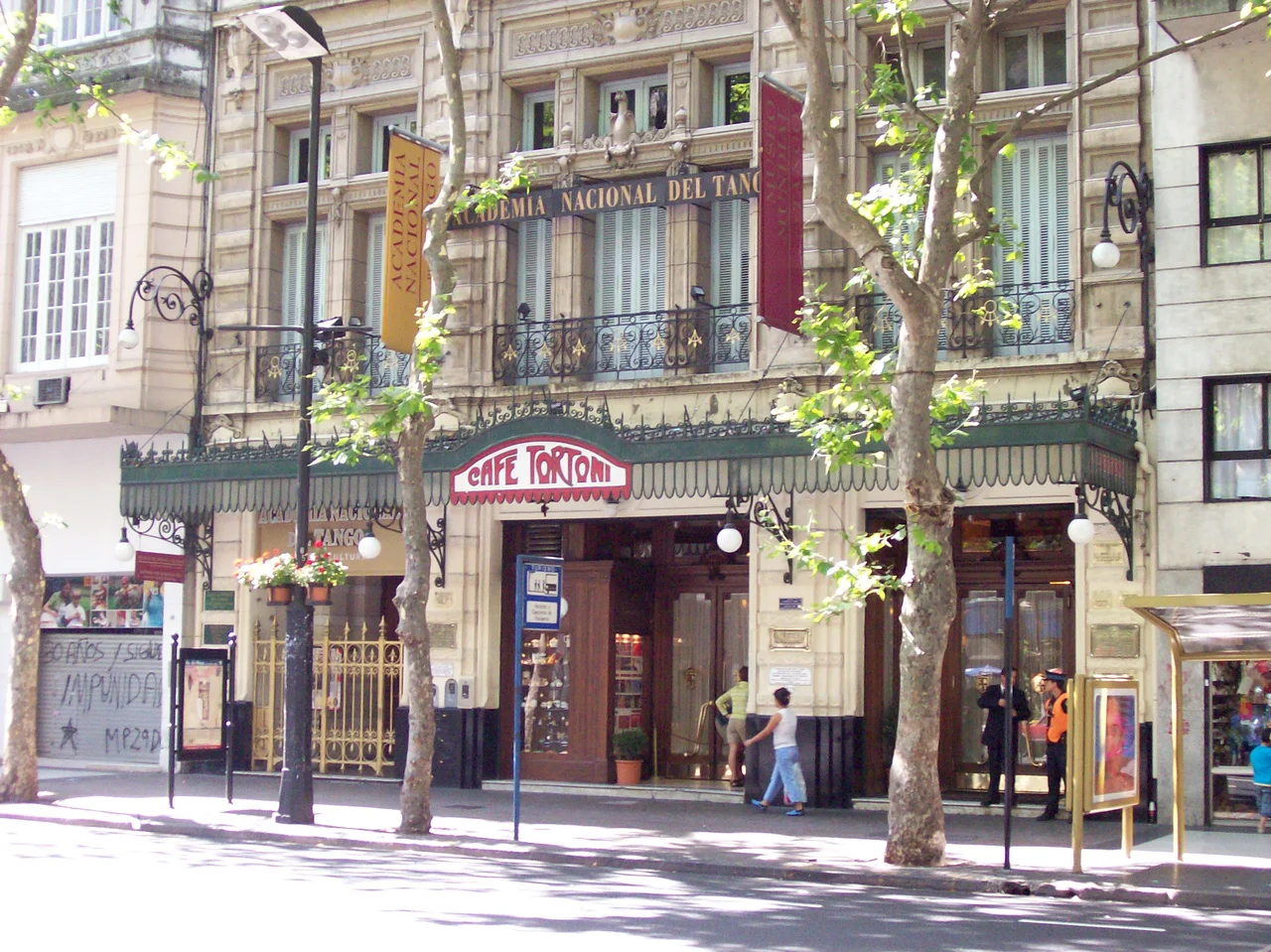

Café Tortoni
There is a table near the back where a wax figure of Jorge Luis Borges sits forever, pen in hand, as if he had only stepped out and might return any moment. Borges was a regular here in the flesh long before he became a statue, one of countless writers who made the Café Tortoni the unofficial parlor of literary Buenos Aires. Opened in 1858 by a French immigrant named Touan, who borrowed the name from a fashionable café on the Boulevard des Italiens in Paris, the Tortoni is the oldest coffeehouse in the city and, by one count, among the ten most beautiful in the world. Step through its doors and the century and a half between then and now seems to thin to almost nothing.
From a Scottish Temple to a Parisian Dream
The ground beneath the Tortoni has worn more than one identity. The site it occupies today once held the Templo Escoces, a Scottish temple, and the café itself began life across the block, on the corner of Rivadavia and Esmeralda. It moved to its present location in 1880, though for years its entrance still faced Rivadavia Street. The grand doorway onto the Avenida de Mayo, the one tourists photograph today, opened only in 1898, when the architect Alejandro Christophersen redesigned the facade. By the close of the nineteenth century another Frenchman, Celestino Curutchet, had bought the place. What he preserved, and what survives still, is the decor of those early years, all dark wood, marble tabletops, and stained glass, a deliberate echo of the fin-de-siecle coffeehouses of Europe transplanted to the far side of the Atlantic.
La Peña and the Golden Years
The Tortoni's soul lives in its basement. In 1926 a group of artists and writers founded La Pena there, a salon dedicated to protecting the arts and literature, and for seventeen years until its dissolution in 1943 it drew the brightest minds of the Spanish-speaking world. The poet Alfonsina Storni came, and the Uruguayan poet Juana de Ibarbourou, the novelist Roberto Arlt, the painter Benito Quinquela Martin, and the Spanish philosopher Jose Ortega y Gasset. The pianist Arthur Rubinstein passed through. So did Borges. To sit in that basement during those years was to sit at the center of a continent's cultural life, surrounded by the people inventing its literature and arguing about its future over cups of coffee that went cold while they talked.
Where Everyone Came
The roster of the Tortoni's guests reads like a century of fame distilled into a single room. Carlos Gardel, the tango singer whose voice still defines Argentine longing, drank here. So did the racing driver Juan Manuel Fangio, five times a Formula One world champion. The Spanish poet Federico Garcia Lorca came during his time in Buenos Aires. Albert Einstein sat at these tables. In later decades the visitors included Hillary Clinton, the actor Robert Duvall, and Juan Carlos, the king of Spain. They came for the same reason the poets did, because the Tortoni had become a place where the ordinary act of drinking coffee carried the weight of everyone who had done it here before.
A Living Monument
The Tortoni refuses to be a museum. Down in the same basement where La Pena once met, jazz and tango musicians still perform, and the room hosts book launches and poetry contests, the literary life continuing rather than commemorating itself. The main floor keeps its library, and at the back you can still find tables for billiards, dominoes, and dice. The café has been declared a National Historic Monument, but the honor has not frozen it. People queue on the Avenida de Mayo not to see a relic but to take a seat in a place that is still, stubbornly and gloriously, a working café, where the next person at Borges's table might be a tourist, a student, or a poet no one has heard of yet.
From the Air
Cafe Tortoni stands at 825 Avenida de Mayo in central Buenos Aires, at 34.6088 degrees south, 58.3783 degrees west. It is far too small to identify directly from the air, but it sits on the ceremonial Avenida de Mayo, the broad, dead-straight boulevard linking the Plaza de Mayo and the pink Casa Rosada at the eastern end to the green-domed Congress building to the west, both of which are easily picked out from altitude. The café fronts the avenue roughly midway along this axis, near the historic Line A subway entrance. The downtown core lies about 4 km south of Aeroparque Jorge Newbery (ICAO SABE) on the Rio de la Plata waterfront, with Ministro Pistarini (Ezeiza) International Airport (ICAO SAEZ) some 30 km to the southwest. The city sits essentially at sea level; best surface orientation comes at low altitude in clear conditions.
Nearby Stories
- Ezeiza Massacre 1.9 km away
- Luján, Buenos Aires 5.1 km away
- Curutchet House 13 km away
- Colonia del Sacramento 17 km away
- Martín García Island 28 km away
- Atucha Nuclear Power Plant 37 km away
- Lobos 43 km away
- Cry of Asencio 87 km away