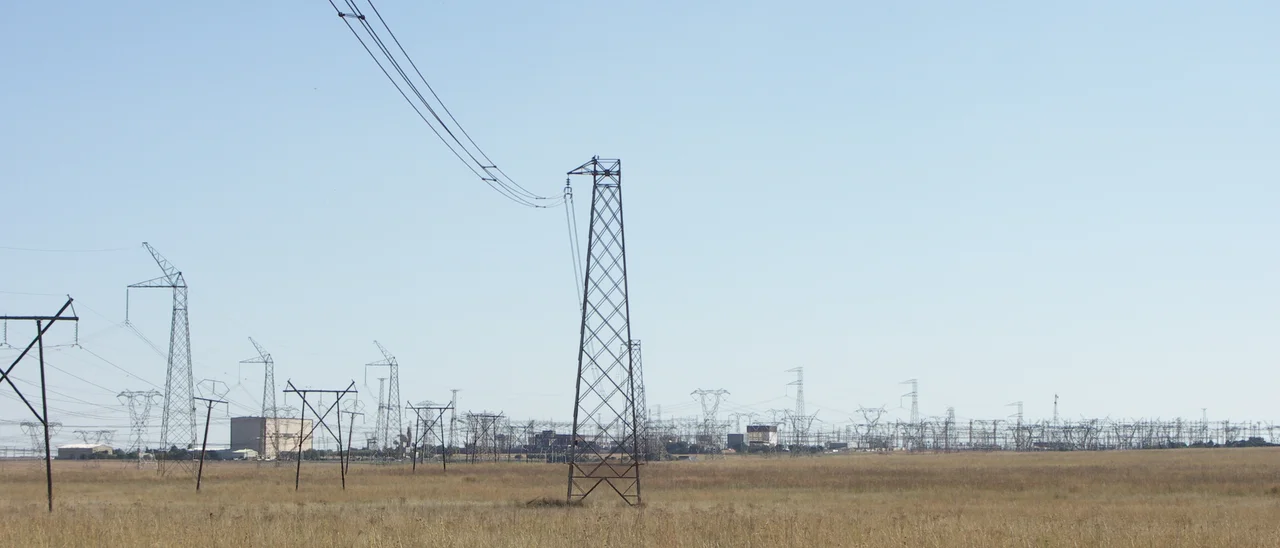

Cahora Bassa (HVDC)
Twenty-two thousand, six hundred and fifty-six thyristors. That is how many semiconductor switches had to fire in synchronized, millisecond precision at each end of the line just to make the electricity flow from Cahora Bassa to Johannesburg. When the project was designed in the late 1960s, the thyristors available were rated at a mere 1.6 kilovolts each, which meant each valve needed 280 of them wired in series, with two more in parallel - the largest count ever used in a single HVDC valve before or since. Two converter stations, outdoor-mounted thyristors oil-cooled for insulation, 1,420 kilometers of wire, and two parallel pylons named Zeus and Apollo: this was the frontier of power electronics in 1974.
First of Its Kind
Cahora Bassa was a collection of firsts. First HVDC scheme in Africa. First anywhere in the world to operate above 500 kilovolts - its working voltage of 533 kV DC with 1,800 amperes gave it a transmission capacity of 1,920 megawatts. First HVDC scheme ordered with thyristor valves from the start, when mercury-arc valves had been the de facto standard for every prior scheme. And unusually, its thyristor valves were mounted outdoors rather than inside a climate-controlled valve hall. Only one other HVDC scheme ever did this from day one: the first phase of Japan's Shin Shinano frequency converter, since decommissioned. The system was a joint venture between Portugal's Hidroelectrica de Cahora Bassa and South Africa's Electricity Supply Commission - ESCOM, which became Eskom. Equipment was supplied by ZAMCO, a consortium of AEG-Telefunken, Brown Boveri, and Siemens. The grand ambition was matched by the grand arbitration that followed: commercial hurdles ended up before an International Arbitration Tribunal in Lisbon in 1988.
Zeus and Apollo
The two power lines, both named for gods, run from the Songo converter station near the dam to the Apollo converter station near Johannesburg. They travel one kilometer apart, monopolar rather than bipolar along most of their length, because the terrain is so inaccessible that if one line fails, transmission can continue through the surviving pole with current returning through buried graphite electrodes in the earth. Each self-supporting steel tower carries two bundles of four aluminum cables - 565 square millimeters each - plus a grounding conductor. There are roughly 7,000 towers along the route, with an average span of 426 meters and a maximum span of 700 meters using reinforced towers. Near the Apollo station, the HVDC lines pass so low under a 400-kilovolt AC line that the area beneath is fenced off - walking there would put you at risk of electric shock from induced voltage alone.
Out of Service for a Decade
From 1985 to 1997, the HVDC system did not transmit power. Mozambique's civil war had arrived in the transmission corridor. Sabotage dropped towers. Long stretches of the line became unusable. Nearly all 4,200 transmission-line towers on the 893 kilometers in Mozambican territory needed to be replaced or refurbished. Rebuilding started in 1995, around the same time that demining crews were still clearing landmines from the servitudes, and the first line was re-energized in August 1997 with the second following that November. Full capacity was restored by 1998. Portugal paid roughly 2.5 billion dollars out of pocket to repair the damage. When Mozambique took majority control of the Cahora Bassa hydroelectric project in November 2007 - a memorandum of understanding signed on 2 November 2007 gave Mozambique 85 percent and Portugal 15 percent - Mozambique also agreed to pay Portugal 950 million dollars in compensation for post-war reconstruction. The math of who owed what to whom took longer than the rebuilding itself.
The Apollo Upgrade
By the mid-2000s, the original oil-filled thyristor valves at the Apollo station were showing their age. In 2006, ABB was awarded the contract to replace them. The outdoor mounting concept was kept - it had worked for thirty years - but each new housing now contained a complete six-pulse bridge rather than just two valves, using 125-millimeter, 8.5-kilovolt thyristors in air-insulated, water-cooled designs. Thirty-six thyristors per valve in series, with no parallel connection, replaced the older count of 192 per valve with two in parallel. The new valves are capable of future upgrade to 600 kilovolts and 3,300 amperes. At the same time, the AC harmonic filters - tuned to the 5th, 7th, 11th, and 13th harmonics of the 50-hertz supply - were replaced. Replacement at Apollo took from 2006 to 2009. Songo is still running on older equipment. Cahora Bassa HVDC now feeds into the Southern African Power Pool, supplying roughly 2,000 megawatts of mostly hydroelectric power across borders that did not exist when the scheme was first designed.
From the Air
The HVDC line runs approximately 1,420 kilometers from Songo converter station at Cahora Bassa Dam (15.61 degrees south, 32.75 degrees east, elevation around 340 meters) southwest through Mozambique, across the Zambezi lowlands, into South Africa via the Pafuri area, and terminates at Apollo converter station near Pretoria (roughly 25.90 degrees south, 28.28 degrees east, elevation 1,360 meters). Two parallel lines one kilometer apart make the corridor easy to spot from cruising altitude, especially where the towers climb over the Drakensberg escarpment. Nearest major airports along the route include Chingodzi (FQTT) at Tete and OR Tambo International (FAOR) at Johannesburg. Cruise at 5,000 to 8,000 feet AGL to follow the corridor.
Nearby Stories
- Tete, Mozambique 43 km away
- Cahora Bassa 56 km away
- Kalemba Rockshelter 135 km away
- Great Dyke 147 km away
- Majete Wildlife Reserve 149 km away
- Lilongwe 153 km away
- Mchinji 166 km away
- Centenary, Zimbabwe 217 km away