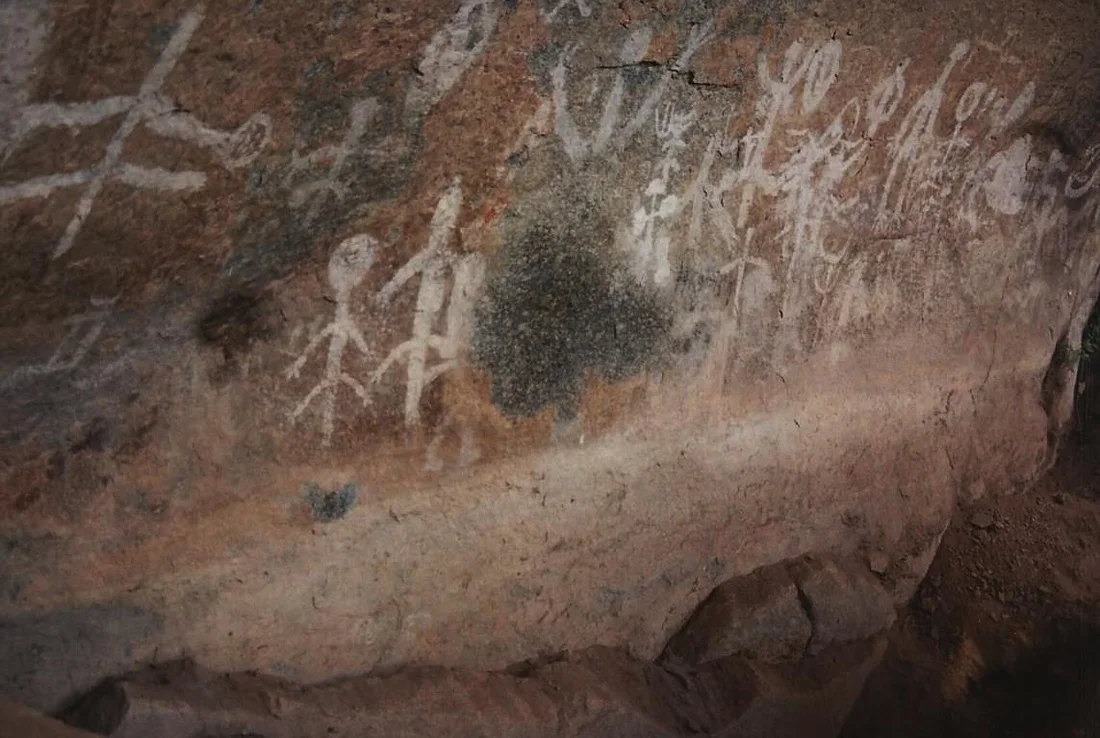

Kalemba Rockshelter
Thirty-seven thousand years is a long time to call one place home. At Kalemba Rockshelter in eastern Zambia, the dates returned from radiocarbon samples trace a human presence stretching back more than thirty millennia. Before the last glacial maximum, before agriculture, before any writing system existed anywhere on Earth, people sat beneath this granite overhang and looked out across the Chipwete valley, much as visitors do today. They made stone tools, cooked, slept, painted the walls. Their descendants fled here again in the nineteenth century to escape Ngoni raiders. The rock remembers all of it.
Discovery on a Valley Ridge
Kalemba was identified in 1955 by R. A. Hamilton, who reported the site to what was then the Rhodes-Livingstone Museum, the colonial-era forerunner of Zambia's Livingstone Museum. Sixteen years passed before anyone excavated it. In 1971, the British archaeologist D. W. Phillipson began work at the site, which sits atop an outcrop of granite gneiss rising more than 30 meters above the Chipwete valley. The main shelter's overhang reaches a maximum height of 4.5 meters and extends 7 meters back into the rock, with a flat working surface near the northeast side and a steep rocky headland closing it off from the main hillside. A second, smaller shelter adjoins to the southwest. Between them, they offered both room and defensibility, which is to say exactly the qualities that kept people returning for 37,000 years.
Paintings on the Wall
The site is known for its rock paintings, preserved on the rear wall of the main shelter and under the southwest overhang of the smaller adjoining shelter. The two panels are roughly twelve meters apart. The surviving images belong to a tradition of hunter-gatherer art that spans central and southern Africa, a body of work made by the ancestors of the San, Khoe, and related Late Stone Age communities whose descendants still live across the region. We should be careful about naming certainty where there is only interpretation. What we can say with confidence is that people cared enough about this place, and about some idea they were trying to record, to mix pigment and press it to the rock, and that the rock has kept their marks for anyone willing to walk up and look.
Digging Down Through Time
Phillipson began with a grid of ten squares but had to extend the excavation to avoid collapse along the shelter walls. A massive fallen boulder divided the dig into two parts. Over several seasons, the team identified thirteen separate soil horizons covering a total area of 40.2 square meters. Charcoal from hearth fires went off for radiocarbon dating. Soil samples went off for analysis. At a depth of 4.3 meters, the side walls became unsafe. To continue deeper meant removing boulders weighing about 25 tonnes with a block and tackle. The resources for that scale of work were not available to Phillipson in 1971, and the excavation stopped. The richest deposits, archaeologists believe, remain buried beneath those boulders. Kalemba is a site still half-read, a book whose pages nobody has turned since the year Richard Nixon visited China.
A Shelter Through Seasons and Centuries
The dates returned from the deposits sort into several periods of occupation. The earliest deposits predate 35,000 years BCE. A second period spans roughly 25,000 to 21,000 years BCE. A third period runs from approximately 15,000 to 11,000 years BCE, and there is a fourth, later period that extends toward the historic era. Between the periods, the shelter would have been empty for stretches as climate and food availability shifted. The microlithic stone tools recovered from the later layers are exceptionally fine, small blades hafted onto bone or wood to make composite arrows and scrapers, a technology that gave Late Stone Age communities extraordinary efficiency. Each blade is the size of a thumbnail. Each one was struck from a core by a hand that knew exactly what angle and force the stone required.
Refuge from the Ngoni
The last chapter of Kalemba's occupation is the closest to living memory. Local tradition recalls that in the nineteenth century, during the Ngoni raids that followed the Mfecane upheavals of southern Africa, communities in the Chipwete valley took refuge in the rockshelter. They carried their children, their food, their few valued things, and waited out the raiders under the same overhang that had sheltered their ancestors thirty millennia earlier. That continuity is not sentimental. It is a fact of human geography. Good shelters are rare, and people remember where they are. To visit Kalemba today is to stand at the intersection of deep archaeology and living tradition, a site whose rock paintings and hearth charcoal honor the patience of the communities that made this valley theirs, generation after generation, in the face of whatever was coming.
From the Air
Kalemba Rockshelter sits at 14.12 degrees South, 32.05 degrees East on the granite uplands of eastern Zambia, overlooking the Chipwete valley. From 3,000 to 5,000 feet above ground the site is difficult to pick out among the surrounding kopjes, but the Chipwete drainage and the granite domes typical of the region are visible features. Nearest airport with published identifier is Chipata Airport (FLCP) to the south. Clear, dry weather is typical from May through October. The Luangwa River and escarpment lie to the west.
Nearby Stories
- Mchinji 23 km away
- Chipata 59 km away
- South Luangwa National Park 100 km away
- Lilongwe 120 km away
- Tete Province 126 km away
- Cahora Bassa Dam 130 km away
- Luangwa Bridge 166 km away
- Luangwa River 208 km away