
Calstock
Twelve arches stride across the River Tamar at Calstock, each one sixty feet wide, the whole viaduct rising 120 feet above the water at high tide. It was built between 1904 and 1907 from 11,148 concrete blocks cast in a temporary yard on the Devon bank. Today the structure still carries trains along the Tamar Valley Line, but more than that, it defines the village. Calstock huddles beneath it on the Cornish side of the river, a tangle of slate-roofed houses tumbling down to a quay where, two thousand years ago, Roman legionaries built the largest fort yet discovered in Cornwall, and where in May 2025 the passenger ferry returned after a decade of absence, this time entirely solar-powered.
Romans on Church Hill
Between 2007 and 2011, archaeologists from the University of Exeter excavated around St Andrew's Church on Calstock's Church Hill and found something that genuinely surprised them. Beneath the medieval churchyard lay the remains of a Roman fort, established around 50 to 55 CE, contemporary with the legionary fortress at Exeter. This is only the third Roman fort known in Cornwall and by far the largest, with capacity for up to 500 soldiers of the Legio II Augusta. Nearby were the remains of a Roman silver mine, with pits connected by tunnels, and traces of a Roman road. The Cornish landscape, long thought to have been touched only lightly by Rome, turned out to have had a substantial Roman presence here for about thirty years before the legion moved on to South Wales around 75 CE. Long before the legionaries, Bronze Age settlers had lived on the same hill, and Iron Age people had ringed it with earth ramparts. Layer upon layer of occupation, all forgotten until the trenches went in.
Mining and the River
Calstock's modern history is the history of metal. Medieval miners worked the area for silver under the Duchy of Cornwall, but the boom came in the nineteenth century, when copper and tin were found in commercial quantities. The mines around the village had wonderful names: Cotehele Consols, Calstock Consols, Okeltor Consols, Wheal Trelawny, Wheal Zion, Wheal Edward, Wheal Arthur. Their pump houses still dot the hillsides, ivy-grown ruins among the woods. The Tamar itself was the highway. Calstock Quay and the smaller Danescombe Quay handled mineral exports, lime imports, granite from local quarries, and tourists. In 1846 Queen Victoria and Prince Albert visited by steamer. The river had its own boat type, the Tamar barge, and Calstock's two boat-building yards, Goss's Yard and May's Yard, turned them out by the dozen. The cholera outbreak of 1849 was a price of the mining boom: too many people crowded into too few cottages, with no proper sanitation. Foreign competition killed the mining industry in the early twentieth century. The ruins remain, and so do the quay walls.
The Viaduct, the Railway, the Ferry
The East Cornwall Mineral Railway opened in 1872 to carry ore down to Calstock Quay, ending in a 0.4-mile cable-worked incline at a gradient of 1-in-6. Even by Victorian railway standards it was steep. When the LSWR's main line opened at Bere Alston in 1890, the local company built a connecting line and the old mineral railway was converted to standard gauge. This required a bridge across the Tamar at Calstock, which is where the viaduct comes in. John Lang of Liskeard built it between 1904 and 1907, with engineers Richard Church and W. R. Galbraith. The first train crossed by truck on 8 August 1907; passenger trains followed on 2 March 1908. The line survived the Beeching axe of the 1960s, kept open as a Plymouth-to-Gunnislake commuter route, and still runs today. In May 2025 the Calstock Ferry resumed service between the village and Ferry Farm on the Devon bank, a solar-powered crossing that lets walkers on the new Tamara Coast to Coast Way avoid a long detour via Bere Alston. The river is alive again with small boats.
Charles I's Letter on the Wall
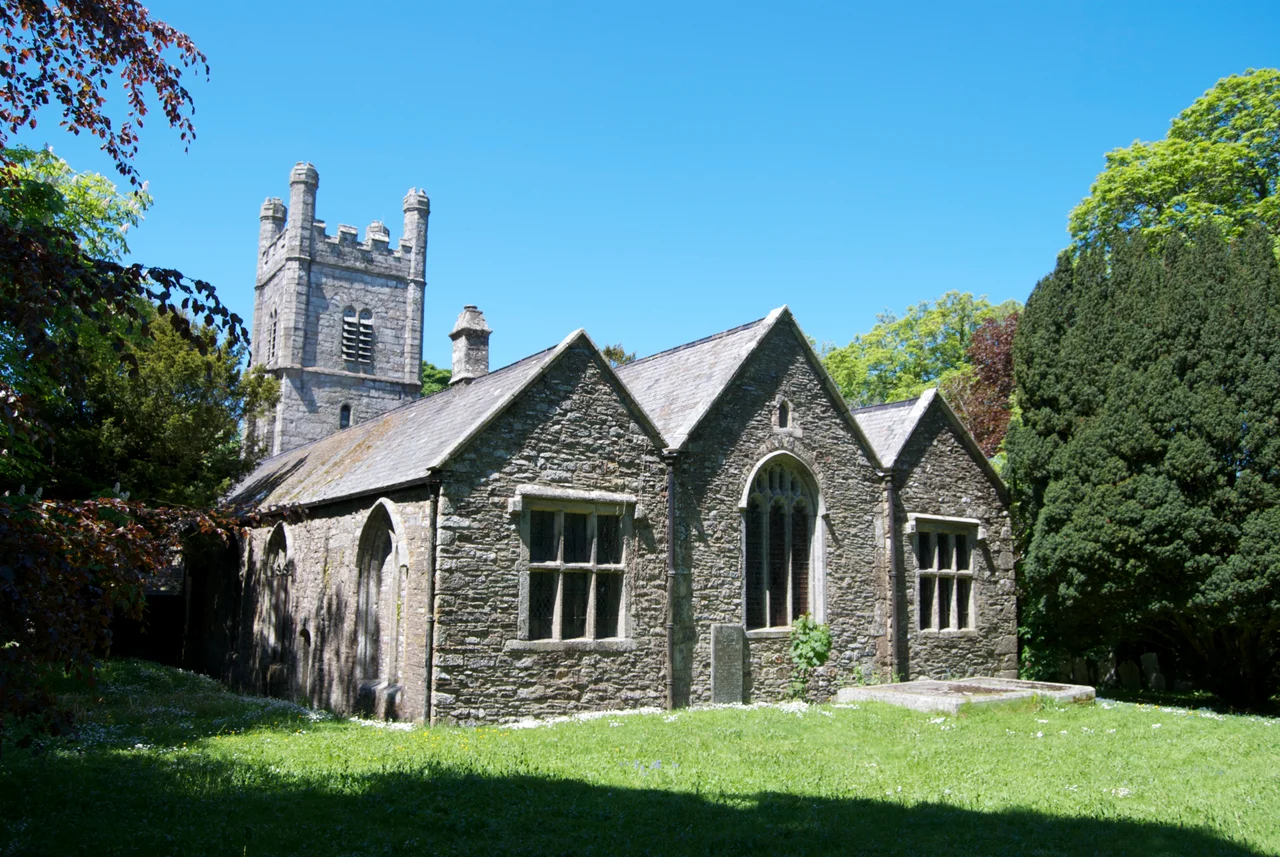
St Andrew's Church, consecrated around 1290, holds a remarkable piece of Stuart history on its wall. During the English Civil War in 1644, Calstock and the surrounding Cornish parishes raised about 1,200 men for the Royalist cause, quartered at Cotehele and Harewood House under Sir Richard Grenville and Captain Southcote. They fought the Parliamentarians at Gunnislake New Bridge over the Tamar; the bridge was lost at the cost of some 200 Royalist casualties, but the Parliamentarians could not push further into Cornwall. King Charles I, grateful for Cornish loyalty, wrote a letter of thanks to the people of Cornwall. The original was lost. But a copy is displayed in St Andrew's Church to this day, four centuries after a king wrote it to villagers whose great-grandchildren would build the viaduct that now dominates their parish. Calstock is a small place, but it has been remembering itself for a very long time.
From the Air
Calstock lies at 50.50 N, 4.21 W, on the Cornish bank of the River Tamar about 6 miles southwest of Tavistock and 10 miles north of Plymouth. From the air the village's most prominent feature is the white concrete-block viaduct striding across the wooded Tamar valley, with the river winding away in both directions through the Tamar Valley AONB. Cotehele House and gardens are visible just downstream. Plymouth City Airport (EGHD) closed in 2011; nearest active airfields are Exeter (EGTE) about 30 nm northeast and Newquay Cornwall (EGHQ) 38 nm southwest. Best low-level viewing is 1,500 to 2,500 feet AGL with sunlight raking across the viaduct piers.
Nearby Stories
- Bodmin Moor 4.1 km away
- South Devon Railway sea wall 4.8 km away
- Tiverton Castle 12 km away
- Hope Cove Lifeboat Station 14 km away
- Caerhays Castle 20 km away
- Holsworthy 22 km away
- HMS Formidable (1898) 32 km away
- HMS Montagu 41 km away