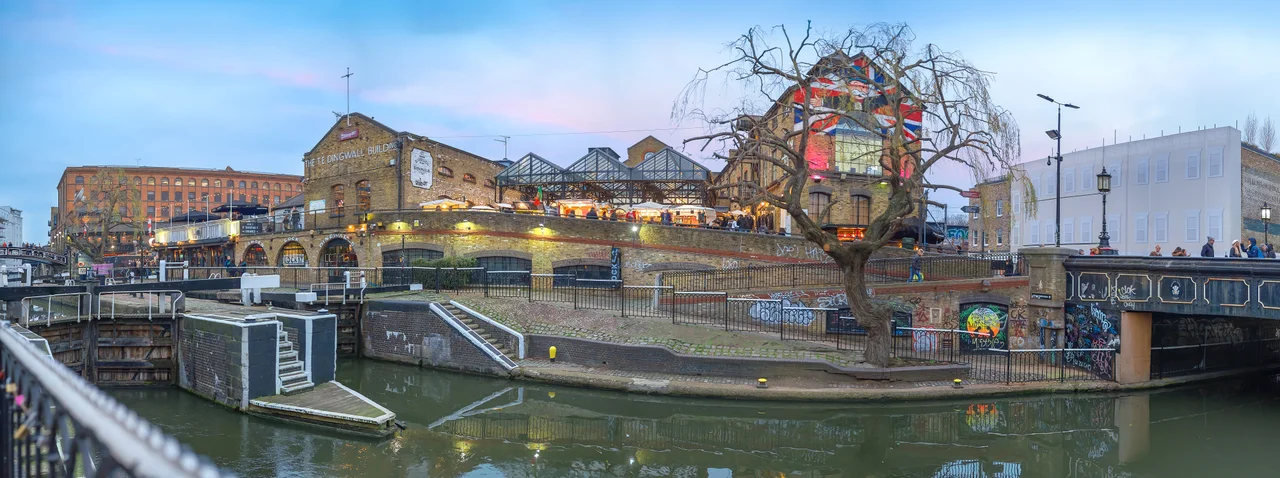

Camden Lock
Before Camden Lock was a market, before it was a cultural touchstone, before Kate Winslet strolled through it for an American Express advertisement, there was an engineering problem. Colonel William Congreve, a military engineer, proposed a radical solution for moving boats up and down the Regent's Canal: instead of conventional locks, he would use hydropneumatic boat lifts — water-filled caissons raised and lowered by hand, assisted by compressed air. A prototype was built at Camden Town. It never worked properly, and in 1818 the directors cut their losses and reverted to paired locks. The prototype equipment was auctioned off in November 1819 for a total of £404. The building constructed to house its air compressors still stands at the south-east corner of the lock. By 2010 it had become a Starbucks.
The Canal That Built Camden
Regent's Canal was authorized by Parliament in July 1812, intended to run from Paddington Basin to Limehouse, linking London's western canal network to the Thames at the East End. Construction was overseen by architect John Nash — better known for Regent's Street and the Royal Pavilion at Brighton — with James Morgan as supervising engineer. The Hampstead Road Locks, the twin chambers that make up what is popularly called Camden Lock, were built between 1818 and 1820, with brick chambers and stone coping along the top. They were Grade II listed in 1992. The two chambers sit side by side with an island platform between them, and together they dropped the canal level as part of a series of 12 paired locks that descended 96 feet from the Paddington arm down to Limehouse Basin. During the canal's commercial peak, the locks were permanently staffed around the clock, with lock-keepers working shifts to manage the 24-hour flow of freight.
Freight, Railways, and Decline
Camden Goods Depot, built on the north bank of the canal, was the London freight terminus of the London and Birmingham Railway — the first inter-city railway to reach London. Robert Stephenson chose the site specifically for its direct interchange with the Regent's Canal, from which freight could reach the London docks. The goods depot was completed in 1839 on a 25-acre site. It included a winding engine house to haul trains up the incline from Euston, stables for 50 horses, 18 coke ovens, and various goods sheds and workshops. Pickfords built a warehouse on the south bank in 1841, designed by William Cubitt — the first rail, road, and canal interchange building in Britain, linked to the goods depot by a wooden railway bridge over the canal. The railways that the canal had connected eventually contributed to its decline. As rail freight expanded and canal commerce contracted, lock-keeping shifts were reduced, and eventually commercial traffic ceased altogether.
From Wharf to Market
The lock's transformation into a cultural destination was gradual and accidental. By the early 1970s, canal trade had largely ended. A planned north London motorway threatened to cut through the area, making any permanent development uncertain, and in 1974 a temporary crafts market was established near the lock. By 1976, when the motorway plans were abandoned, the market had become established enough to continue. It grew through the 1970s and 1980s into Camden Market, now one of London's most visited attractions. The lock itself became central to the market's identity — its name, 'Camden Lock,' was adopted for the entire market complex. The Roundhouse, the remaining northern engine shed from the goods depot era, became a celebrated music venue. The towpath along the canal is now open to pedestrians and cyclists, and water bus services run from the lock to London Zoo and Little Venice.
Art, Music, and Ongoing Feuds
Camden Lock found a place in popular culture through the arts community that gathered around the market. The lock was the registered address of TV-am, the ITV breakfast television franchise, in the 1980s and early 1990s. Banksy worked in the wider Camden area; so did the graffiti artist King Robbo, and a years-long feud between the two artists played out on walls around the lock between 2009 and 2014. Kate Winslet strolled through the lock for an American Express 'My Life, My Card' campaign in 2005. A Japanese rock duo named a song 'Camden Lock Style' after shooting a music video here. The London Waterbus Company runs historic vessels from the lock westward to Little Venice, passing through Regent's Park and calling at London Zoo — a boat journey that turns the old commercial canal into an urban nature experience. Camden Town Underground station on the Northern line is the nearest tube, making the lock one of London's more accessible waterside destinations.
From the Air
Camden Lock is located at coordinates 51.5411°N, 0.1457°W in the London Borough of Camden. From altitude, the Regent's Canal is clearly visible running through north London, with the lock identifiable at the Camden Town crossing point. The parallel market structures and the Roundhouse venue are nearby landmarks. Heathrow Airport (EGLL) is 22km to the west; London City (EGLC) is 15km to the east.
Nearby Stories
- Stevenage 5.7 km away
- Malling Abbey 5.7 km away
- 1952 Farnborough Airshow Crash 7.7 km away
- Ingatestone Hall 8.2 km away
- Hellfire Caves 9.1 km away
- The Carrington Event: The Solar Storm That Could Happen Again 9.8 km away
- Bletchley Park 16 km away
- Castle Hedingham 23 km away