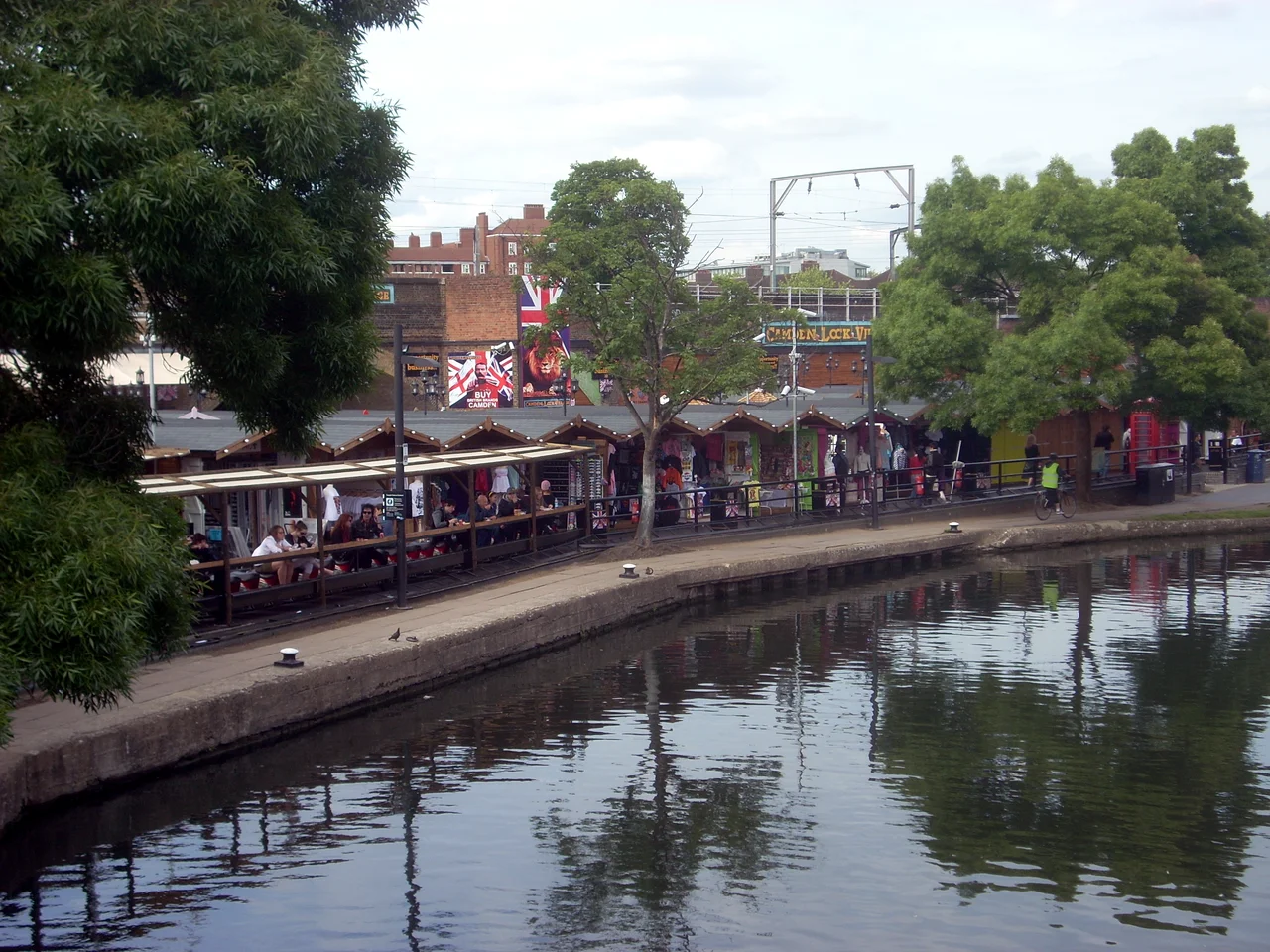

Camden Market
Camden Market began because a motorway was going to be built. In the early 1970s, a planned north London urban motorway threatened to cut through the canal-side area near Camden Lock, making any permanent development of the site impossible. In 1974, with redevelopment off the table, a small temporary crafts market was established there instead — operating only on Sundays, selling handmade goods from stalls on the former wharf. The motorway was cancelled in 1976. The market stayed. What followed over the next five decades was one of London's more improbable transformations.
From Stalls to Empire
The original Camden Lock Market occupied outdoor areas by the canal and some existing warehouse buildings. By 1976 it had become established enough to survive the abandonment of the motorway plans. A 1991 expansion added a three-storey indoor market hall designed by architect John Dickinson — built in brick and cast iron in the style of the surrounding nineteenth-century industrial architecture. The markets drew large numbers partly because they were open on Sundays, when, before the Sunday Trading Act of 1994, most shops were legally prevented from operating. Six distinct markets eventually developed across the area: Camden Lock Market by the canal, the Stables Market in the former Pickfords horse stables and railway arches, Hawley Wharf (formerly Canal Market and Camden Lock Village), Buck Street Market, the Electric Ballroom on Camden High Street, and Inverness Street Market near the tube station. Today approximately 250,000 people visit each week, making Camden Market the fourth most popular visitor attraction in London.
The Stables and What They Sold
The Stables Market takes its name from the horse hospital that occupied the site when it served horses pulling Pickfords distribution vans and barges along the canal. The former stalls and shops are set in large arches in the railway viaducts that cross the area. Chain stores are not permitted. The range of goods leans toward the eclectic: furniture, household goods, ethnically influenced decorative items, second-hand clothing, 20th-century antiques, and items made for alternative subcultures — the goth shop Black Rose, which sold coffin-shaped handbags, was a Stables Market fixture. Cyberdog, specializing in neon PVC and rubber clothing for cyberpunk aesthetics, has also had a long presence. In the weeks before Christmas 2004, radio presenter Chris Evans sold his personal possessions — sofas, televisions, crockery — from a stall in the Stables Market.
Fire, IRA, and Resilience
Camden Market has absorbed several crises. On 28 February 1993, the Provisional IRA exploded a bomb hidden in a litter bin on Camden High Street near the market, shortly after lunchtime. Eleven people were injured. The market continued. In February 2008, an unauthorized gas heater started a fire in the Canal Market section that spread and badly damaged the Hawley Arms pub on Castlehaven Road. The market reopened in May 2009. A large fire at Camden Lock Market broke out in the early hours of 10 July 2017, requiring at least 70 firefighters and 10 engines. The market section was damaged; rebuilding followed. A fire at the Stables Market in May 2014 was controlled within an hour without injuries. The market's response each time has been to rebuild and reopen. Fire has been part of Camden's history since the canal days.
Ownership at Scale
What began as a collection of stalls on land with various owners became, by the 2010s, a major commercial property portfolio. In 2014, Israeli billionaire Teddy Sagi began acquiring the Camden Market properties. By March 2015 he had bought the four most significant sections, announcing plans to invest £300 million in development by 2018. Permanent structures replaced temporary stalls across much of the site. The Hawley Wharf development, replacing the former Canal Market, cost more than £500 million and opened from 2021, housing sixty fast-food providers, 150 shops, co-working offices, and 200 new homes. In 2022, the entire portfolio was put up for sale through Rothschild & Co, with the owner seeking around £1.5 billion. The temporary Sunday crafts market that couldn't commit to permanent development because of a motorway that was never built had become a property asset worth more than a billion pounds.
From the Air
Camden Market is centered at approximately 51.5414°N, 0.1464°W in the London Borough of Camden. From altitude, look for the Regent's Canal running through north London, with the market complex occupying the area around the lock and canal-side warehouses. The Roundhouse venue and Camden Town tube station are nearby landmarks. Heathrow Airport (EGLL) is 22km to the west; London City (EGLC) is 15km to the east.
Nearby Stories
- Stevenage 5.7 km away
- Malling Abbey 5.7 km away
- 1952 Farnborough Airshow Crash 7.7 km away
- Ingatestone Hall 8.2 km away
- Hellfire Caves 9.1 km away
- The Carrington Event: The Solar Storm That Could Happen Again 9.8 km away
- Bletchley Park 16 km away
- Castle Hedingham 23 km away