.jpg)
Cantacuzino Palace
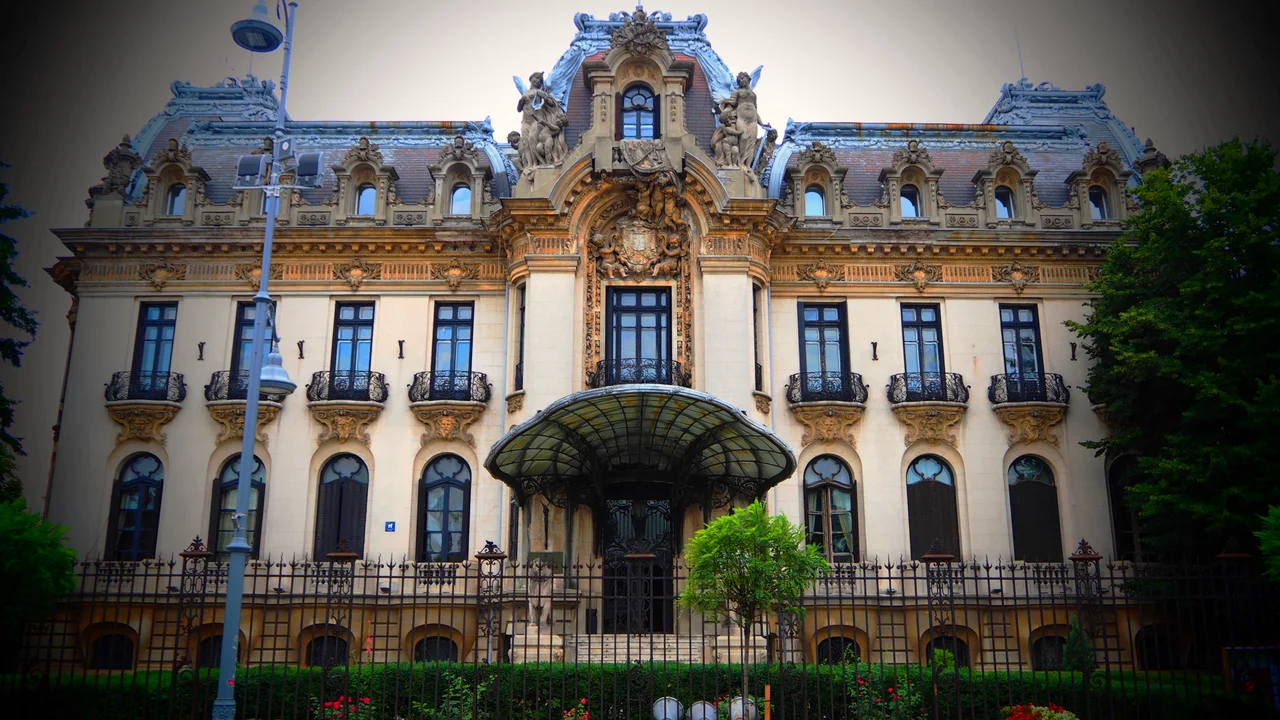
The man who built it was nicknamed The Nabob, after a colonial-era word for someone fabulously, suspiciously rich. Gheorghe Grigore Cantacuzino had been mayor of Bucharest, then prime minister of Romania twice over, and his fortune was old, large, and sharpened by political access. In 1901 he hired the architect Ion D. Berindey to build him a palace on the Calea Victoriei - the boulevard locals were already calling Bucharest's Champs-Elysees - in the most fashionable French Beaux Arts manner. Two stone lions in the Louis XIV style flanked the entrance. The building was finished in 1902. It is, by some margin, the most theatrical of Bucharest's belle epoque mansions still standing.
The Nabob's Address
Calea Victoriei runs north from the river through the heart of central Bucharest, lined with banks, ministries, and the mansions of the late nineteenth-century Romanian elite. Number 141 was Cantacuzino's stretch of it. Berindey designed a palace that addressed the avenue head-on: a curving gravel drive sweeping up to a glass-and-iron canopy at the entrance, the two stone lions on either side, the wrought-iron gates kept the boulevard's noise at a respectful distance. The exterior is restrained Beaux Arts - rusticated stone, balanced fenestration, a copper-trimmed mansard roof - but the interiors break out into Rococo Revival in the salons where the Cantacuzinos held the famous balls that helped make their address one of the social anchors of Romanian political life. For the painted decoration, Cantacuzino hired the most expensive Romanian artists of the day: George Demetrescu Mirea, Costin Petrescu, and Nicolae Vermont, who painted six oil-on-canvas medallions set above the doorways of the ground-floor hallway.
The Treaty Signed Inside
On 10 August 1913, in one of the palace's reception rooms, Romania, Bulgaria, Serbia, Montenegro, and Greece signed the Treaty of Bucharest that ended the Second Balkan War. It was an awkward, fragile peace - the treaty redrew Balkan borders that the First World War would scramble again within a year - and the choice of the Cantacuzino Palace as the venue says something about its standing. The actual government ministries had ample reception space. The Cantacuzino Palace had something the ministries did not: prestige, comfort, and an owner whose political reach made his hospitality an asset of state. By the eve of the Second World War, the palace was hosting the Presidency of the Council of Ministers - the prime minister's office, more or less - while the country's leaders prepared for a war Romania would enter on the German side and exit, after a 1944 royal coup, on the Allied one. The lions at the gate watched all of it happen.
The Composer's Wife, Then the Composer
Cantacuzino died in 1913. The palace passed to his son Mihail, who died prematurely in 1929. Mihail's widow Maria - known to friends as Maruca - was an elegant, restless woman with literary friends and her own romantic complications. In December 1939, she married George Enescu - the violinist, composer, and conductor whom Yehudi Menuhin would later call his master and the greatest musical phenomenon since Mozart. Enescu was Romania's most famous artist; he is still on the country's currency. He and Maruca lived in the palace through the war years, in increasingly modest quarters - Communist nationalisation was coming, and the couple withdrew to a small annex in the garden rather than try to maintain the great salons. Enescu died in Paris in 1955. Maruca's will stipulated that the palace become a museum to her husband's memory. In 1956 the National Museum George Enescu opened in the building. The composer's piano, his violins, his manuscripts, and the photographs that mapped his quiet, devoted, internationally celebrated life are all here.
What the Walls Hold
Of the original suite of rooms only about five are open to visitors today; the rest of the palace is occupied by various cultural institutions. But the five public rooms are enough. Vermont's medallions still hang above the doors, including Shepherd with Sheep and Peasant Woman with Vessel - the latter painted under the influence of Nicolae Grigorescu, the founding father of modern Romanian painting, whose rural subjects shaped how Romanians saw their own countryside through the late nineteenth and early twentieth centuries. Rococo Revival stuccos foam across the chimneypieces in vines and shells and laughing cherubs. The ceiling of the main salon is dense with painted decoration. In the entrance hall a glass-and-metal canopy filters the light coming in from the avenue. Stand in any of these rooms and the palace's two lives press together - the Belle Epoque balls and the quiet music of Enescu's later years, when he played for friends in a house too large for his quiet way of being.
The Avenue, Still Walking
Calea Victoriei survived Ceausescu's bulldozers more or less intact, partly because it ran north of the great demolition zone he opened up to build the Centrul Civic and the Palace of the Parliament. The Cantacuzino Palace, with its lions and its glass canopy and its Beaux Arts stone, is one of a string of belle epoque survivors along this stretch - the CEC Palace, the Athenaeum, the Athene Palace Hilton, the National Military Circle. Walk the avenue today and the buildings still talk to one another. The Cantacuzino Palace talks loudest. Its proportions are the most extravagant. Its lions are the most theatrical. And the museum inside it makes the case that even a country whose twentieth century was as brutal as Romania's can hold onto its quieter, more elegant moments - if it chooses to. The Nabob built the palace to be admired. The composer's widow turned it into something more lasting. The rooms keep both legacies.
From the Air
Cantacuzino Palace is at 44.4487 N, 26.0884 E on Calea Victoriei in central Bucharest, Romania. Henri Coanda Airport (LROP/OTP) lies about 16 km north; Aurel Vlaicu (LRBS/BBU) is about 8 km north. Recommended viewing altitude 1,500-3,000 m AGL. The palace itself is a small target from above; navigate by Calea Victoriei running north-south through central Bucharest, with the Romanian Athenaeum and Revolution Square as nearby landmarks. The Palace of the Parliament's enormous bulk a little to the southwest provides an unmistakable orientation point.
Nearby Stories
- National Transport Museum, Bulgaria 34 km away
- Slanic Mine 68 km away
- Sinaia 79 km away
- Great Basilica, Pliska 87 km away
- Sinaia Monastery 108 km away
- Holy Forty Martyrs Church, Veliko Tarnovo 115 km away
- Shumen Fortress 126 km away
- Danube Delta 227 km away