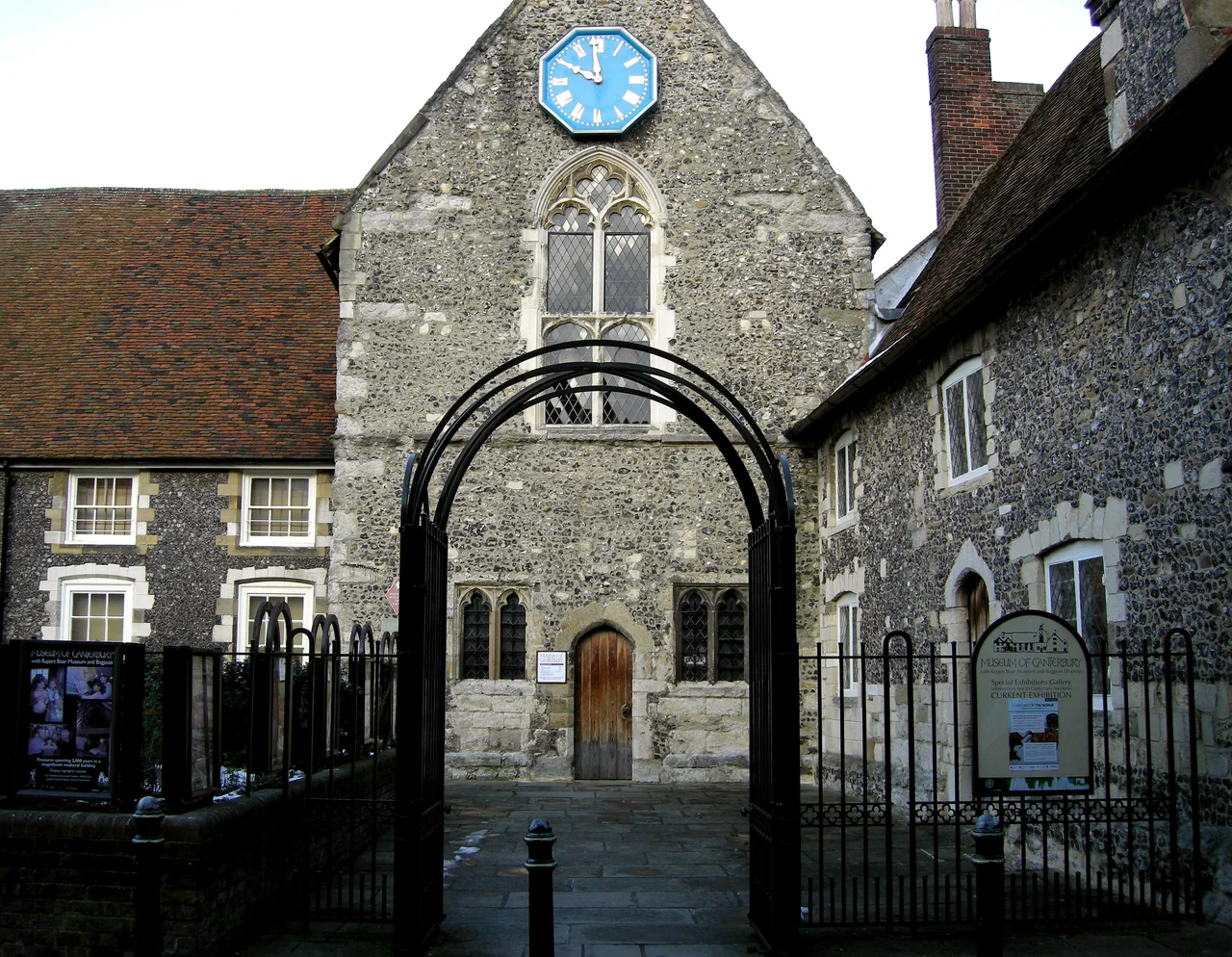

Canterbury Heritage Museum
Alexander the minter's son did something unusual with his inheritance. Between 1174 and 1207, he took his father's stone house on the bank of the River Stour and gave it away - converting it into an almshouse for old and poor priests, dedicated to the Virgin Mary. Eight hundred years later, that same long, low building was still standing on Stour Street, its medieval crown-post roof still arching overhead, this time housing a museum that tried to compress all of Canterbury's history into a single timeline you could walk.
The Almshouse on the Stour
The Poor Priests' Hospital was never a hospital in the modern sense. Aging clergy gathered around a central fire in a single great hall, eating and sleeping in shared space - communal monastic life stripped of its monastery. In 1373 a private upper room called a solar was added with an undercroft beneath, giving the master of the hospital a measure of privacy. A small chapel of St Mary stood next to the solar, its single open space later subdivided into floors with chimney and windows. Then in 1575 the religious purpose ended. The buildings turned secular, serving in turn as a school, a poorhouse, a workhouse, and a clinic. The walls absorbed every variation of helping or housing the desperate that Canterbury could devise.
The Time Walk
When the museum opened on Stour Street in 1987, the curators arranged the galleries as a walk through time. You moved from prehistoric handaxes through an Anglo-Saxon display, then a medieval discovery gallery, a Christopher Marlowe whodunit room investigating the playwright's mysterious 1593 death, and a wartime Blitz experience built around Canterbury's terrible night of 1 June 1942. A three-walled tapestry traced the life of Thomas Becket. The Saxon gallery held the museum's most prized object: the Canterbury Cross, a small brooch dating to around 850 AD that had been found in St George's Street in 1867. It was shaped as a consecration cross - one of twelve such crosses that a bishop would mark on a church's walls during consecration, each one for an apostle.
The Pendant That Told the Hours of Prayer
Among the smaller wonders sat the Canterbury Pendant, a portable silver sundial small enough to wear around the neck. Made some time in the late tenth century - and traditionally attributed to St Dunstan, the silversmith-archbishop who lived 909 to 988 - the pendant could probably only tell time accurately at noon. That was enough. A monk did not need to know the exact hour; he needed to know when to pray. The pendant was found in the cathedral cloisters during excavations in 1938, dropped by some long-forgotten owner, and the museum loaned it back to the cathedral in 2009. Nearby sat the Invicta locomotive, Robert Stephenson's 1830 engine that ran on the Canterbury & Whitstable Railway - the first regular passenger steam railway in the world.
Rupert and the Clangers
On the upper floors lived something stranger: a children's gallery dedicated to characters from British television and storybooks. Rupert Bear had a museum-within-the-museum, opened in 2003 with a 500,000 pound Heritage Lottery Fund grant. Rupert's creator Mary Tourtel grew up in Canterbury and attended art school there, and a first edition of the 1921 Rupert annual was among the exhibits. The gallery also held items from Bagpuss and the Clangers - Oliver Postgate and Peter Firmin shot those programmes at Firmin's house just outside Canterbury, and Postgate gave many of the original props and figures to the museum during his lifetime. The Emily shop window from the opening titles of Bagpuss sat on display, still pink and slightly faded, the way it looks just before the rag doll wakes up.
Closing the Door
By 2018 visitor numbers had fallen from 30,000 a year to fewer than 9,000 over five years. The Canterbury Archaeological Trust and other local institutions campaigned to keep the doors open, but Canterbury City Council closed the museum. Yet the building did not stay dark for long. On 6 April 2019 the venue reopened as The Marlowe Kit, an escape room and creative space named for Canterbury's most famous playwright. The medieval roof timbers, the central hall where priests had once huddled around their fire, the chapel where a minter's son had endowed a small act of mercy - all of it carried on, refitted again for a new century. After all, this building has always been changing what it does. That is the only thing about it that has stayed the same.
From the Air
Canterbury Heritage Museum sits on Stour Street in central Canterbury at 51.2786 degrees N, 1.0775 degrees E, beside the River Stour and roughly 500 metres west of Canterbury Cathedral. Nearest airport is Manston (closed but visible) to the north-east. Best viewed at low altitude approaching Canterbury from the south; the cathedral's Bell Harry tower is the dominant landmark.
Nearby Stories
- Ringlestone Inn 3.4 km away
- Cliffs Pavilion 3.5 km away
- Citadel of Calais 6.5 km away
- 2021 English Channel Disaster 11 km away
- Stag Inn, Hastings 15 km away
- Dungeness Lighthouse 19 km away
- Clacton Pier 32 km away
- Four Days' Battle 54 km away