
Canterbury Roman Museum
On 1 June 1942, a German bomb fell on Butchery Lane in Canterbury and tore through the building above what would, three years later, prove to be a Roman pavement. The Baedeker Blitz - so named because the Luftwaffe was working from guidebooks, targeting cultural cities rather than industry - had just exposed something the city had forgotten was there. When the archaeologists Audrey Williams and Sheppard Frere began excavating the rubble in 1945, they uncovered a corridor of mosaic tile laid around 300 AD, intact under the dust of seventeen centuries. The museum that grew up around it is one of the few places in England where you walk down into Britain.
Durovernum Cantiacorum
Long before the museum, before the bomb, there was a settlement of the Cantiaci - the Celtic people who inhabited what is now Kent - on a defensible spot beside the River Stour. When Roman legions captured it in the first century AD, they kept the name and Latinised it: Durovernum Cantiacorum, the stronghold of the Cantiaci by the alder marsh. They laid out streets in a partial grid, raised a theatre and a forum and public baths and a temple precinct, and let the place grow. By 300 AD - the height of Roman Canterbury - the town covered 130 acres inside seven gates of a defensive wall, built late in the third century against the threat of barbarian raids. A wealthy townhouse stood near the public buildings, its corridor floored with three panels of mosaic in geometric patterns. Then, around 410 AD, the Roman administration of Britain ended. The townhouse went out of use. The walls fell in. The mosaic stayed where it was, slowly buried by centuries of Canterbury living on top of it.
A Stairway Through Time
The museum's central architectural idea is simple and stunning. The mosaic sits underground, and visitors descend a staircase to reach it. Each step downward represents roughly a hundred years of archaeological strata - a thousand years of accumulated rubbish, demolished houses, packed earth, and rebuilding, compressed into a flight of stairs. You arrive at the 300 AD level slightly out of breath, with the abstract sense that you have just sunk through every century since. The museum was first opened above the pavement in 1961 as the Roman Pavement Museum, then refurbished and re-established as the Roman Museum in 1994. It remains a Grade I listed building - the historic remains of a Roman courtyard house with brick walls about three feet high, 13 hypocaust pillars, and the mosaic pavements themselves at the bottom.
The Canterbury Treasure
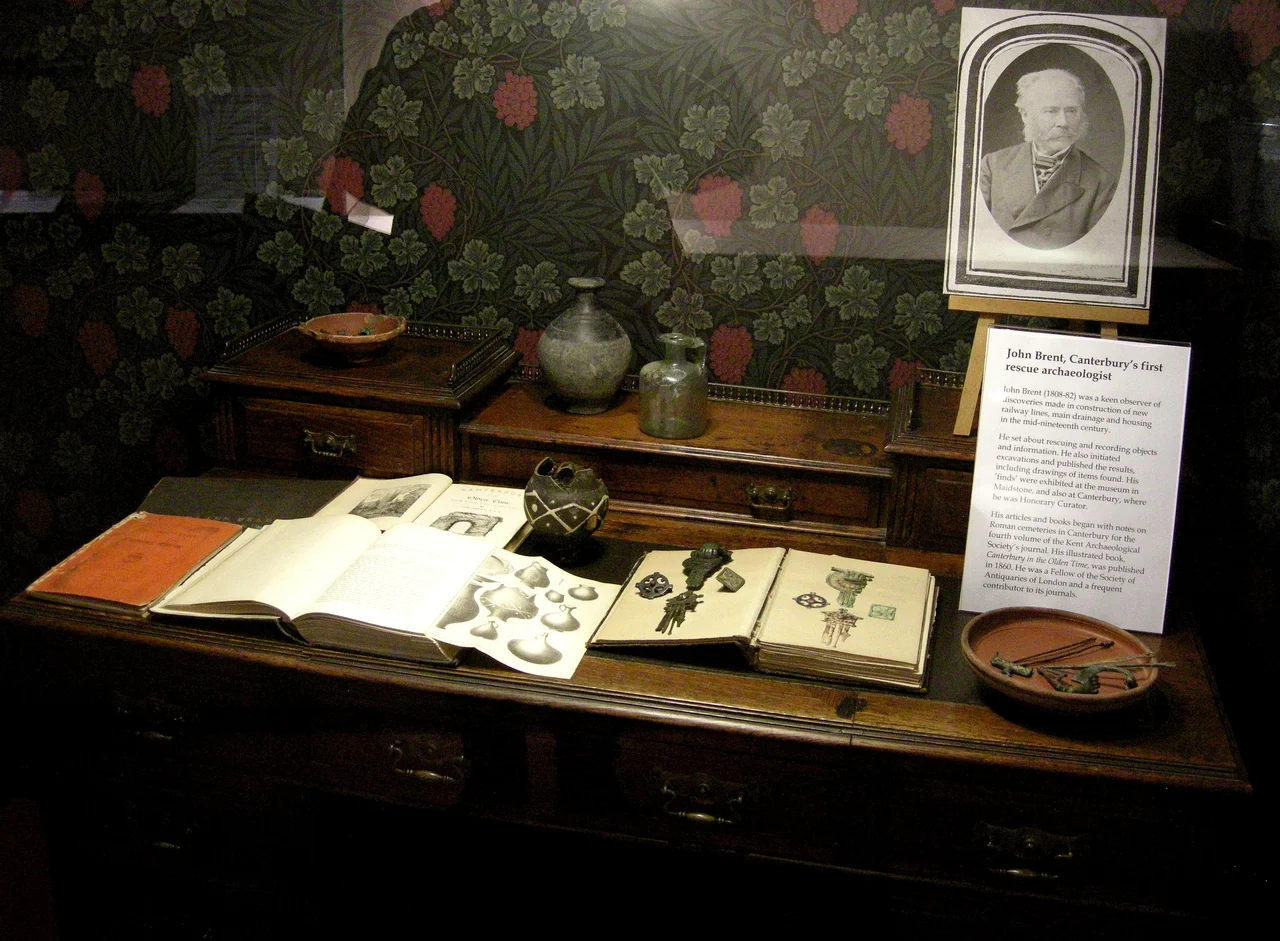
Among the museum's most important holdings is the Canterbury Treasure - a hoard of late Roman silver objects, including spoons, that was discovered in the Longmarket area of the city. It dates to the early fifth century, the very twilight of Roman Britain, suggesting that someone buried wealth for safekeeping just as the imperial order collapsed and never came back to dig it up. The collection also includes a darker find: two cavalry swords, called spathae in Latin, recovered from a double burial that archaeologists believe may have been a murder. Whoever those Roman soldiers were, they did not get a quiet death. Reconstructed cavalry harness, roof tiles - one with a dog's pawprints pressed into the clay before firing - and a tableau of Roman shops with cobbler, haberdasher, greengrocer, and fast-food seller round out the displays.
The Cobbler's Off-cuts
The cobbler exhibit is the museum's quietest miracle. Archaeologists working in Canterbury found cut-out pieces of leather - the discarded scraps left over when a Roman shoemaker traced and trimmed sandal soles. The reinforced leather sandals reconstructed from those off-cuts look almost exactly like what you might find in a hiking shop today. That is the strange intimacy of Roman Britain. The empire of legionaries and emperors and triumphal arches turns out, at street level, to have been people sitting on stools cutting sandal soles, slipping floor tiles past a curious dog. The museum holds an interactive screen for a virtual tour of the Temple site, magnetic mosaic puzzles for children, and tables where visitors can handle real Roman artefacts with a guide to identifying them.
What the Bomb Uncovered
There is a small irony at the museum's heart. The same Baedeker Blitz that destroyed Canterbury's medieval streets - 10,445 bombs across 135 raids, 731 homes lost, 119 civilians killed in the borough - also gave the city a window into its deepest past. The bomb that fell on Butchery Lane on 1 June 1942 cleared a Victorian building off the surface and left the third-century floor naked to the air for the first time since Rome. Public access was permitted from 1946, and royalty came to visit while the country was still rebuilding. Most of Roman Canterbury remains hidden under modern shops and streets. But here at least, behind a small entrance on Butchery Lane, you can stand on a mosaic floor that was new when Diocletian was emperor.
From the Air
Canterbury Roman Museum sits at 51.2789 degrees N, 1.08139 degrees E on Butchery Lane in central Canterbury, just south of the cathedral close. The site is essentially invisible from the air - it is underground. Best viewed in the context of Canterbury's medieval city wall ring, which traces the line of the Roman fortifications. Nearest airfield: Manston (decommissioned) to the east.
Nearby Stories
- Ringlestone Inn 3.4 km away
- Cliffs Pavilion 3.5 km away
- Citadel of Calais 6.5 km away
- 2021 English Channel Disaster 11 km away
- Stag Inn, Hastings 15 km away
- Dungeness Lighthouse 19 km away
- Clacton Pier 32 km away
- Four Days' Battle 54 km away