
Canterbury
Four knights walked into Canterbury Cathedral on the evening of 29 December 1170 and killed an archbishop on his own altar. The murder of Thomas Becket - performed in front of horrified monks who pressed his blood into rags as relics before the body was cold - turned a Kentish market town into one of the most visited places in Christendom. Pilgrims streamed in for three and a half centuries, until Henry VIII demolished the shrine in 1538 and shipped the gold and jewels to the Tower of London. The pilgrimage stopped. The city remained. Today Canterbury holds about 55,000 residents, one of the highest student ratios in Britain, and a cathedral that still draws a million visitors a year.
Durovernum to Cantwareburh
People have lived here since the Paleolithic, drawn by the River Stour and the natural defensible terrain. The Celtic Cantiaci held the site when Roman legions arrived in the first century AD and built Durovernum Cantiacorum - stronghold of the Cantiaci by the alder grove. Roman Canterbury covered 130 acres inside a defensive wall, with theatres and baths and a forum. After the Romans withdrew, Jutish refugees moved in over the following century, possibly intermarrying with the locals. The Old English name became Cantwareburh, stronghold of the Kentish men. By 630 AD, gold coins were being struck at the Canterbury mint. Then in 597 Pope Gregory sent Augustine of Canterbury to convert the Anglo-Saxons. The mission stayed, and from that founding moment, Canterbury became the mother see of the English church.
The Pilgrim Road
Becket's murder in 1170 made Canterbury an international destination. The four knights had ridden from Henry II's Christmas court at Bures in Normandy after the king reportedly muttered something about turbulent priests - though Henry would later do public penance, walking barefoot through Canterbury and submitting to a flogging by the monks. The shrine raised over Becket's tomb in 1220 attracted pilgrims from every part of Europe. Geoffrey Chaucer used that pilgrim road in the late 1380s as the frame for The Canterbury Tales, his unfinished masterpiece in which a Knight, a Wife of Bath, a Miller, a Pardoner, and twenty-six others ride toward Canterbury telling stories along the way. Chaucer never finished. The pilgrimage did not survive the Reformation. But the road remained, and the cathedral kept its pull. Today the Bell Harry Tower - completed in 1498 after 400 years of building - rises 235 feet above the city centre, visible for miles across the Kent countryside.
Refugees and Silk
Canterbury has been a refuge city before. In 1548, the first Huguenot congregation in England formed in Canterbury, founded by Jan Utenhove and others fleeing Protestant persecution in the Low Countries. When Catholic Queen Mary I came to the throne in 1553, the Huguenots fled again, scattering to Emden, Zurich, Strasbourg, Geneva. After Elizabeth I's accession they returned. In 1576 they began holding services in the crypt of Canterbury Cathedral itself - a French-speaking Protestant congregation worshipping below the bones of an English Catholic saint, in the heart of Anglican Canterbury. By the seventeenth century, French-speaking Huguenots made up two-fifths of the city's population. They brought silk weaving with them, and by 1676 silk had overtaken wool as Canterbury's defining industry. The half-timbered Huguenot Old Weaver's House still stands by the River Stour, one of the most photographed buildings in the city.
The Baedeker Blitz
On the night of 1 June 1942, German bombers attacked Canterbury - one of a series of raids that historians later called the Baedeker Blitz because the Luftwaffe was working from tourist guidebooks, deliberately targeting English cities of high cultural and historical value. Over the course of the war, 10,445 bombs fell on Canterbury across 135 separate raids. They destroyed 731 homes and 296 other buildings. They killed 119 civilians in the borough. The cathedral somehow survived almost intact - fire watchers stationed on its roofs put out incendiaries as they fell - but the medieval streets around it did not. The missionary college was destroyed. Simon Langton Girls' Grammar School was destroyed. After the war, the bombed area was eventually rebuilt and a ring road was constructed outside the city walls, leaving the centre pedestrianised. In 2000 a major redevelopment of the Whitefriars Shopping Centre prompted the Canterbury Archaeological Trust's Big Dig, supported by Channel Four's Time Team, which exposed layer upon layer of buried history.
A City of Students
Modern Canterbury runs on three things: tourism, retail, and education. The University of Kent opened in 1965 on St Stephen's Hill, a mile north of the city centre. Canterbury Christ Church University, founded as a teacher training college in 1962, became a full university in 2005 - it now has around 30,000 students. The University for the Creative Arts adds a smaller third campus. Altogether the student population approaches 40,000, in a city of 55,000 permanent residents. That balance gives Canterbury an unusual texture for a small English city - young, multilingual, lively in term time and quieter when the students go home. The Marlowe Theatre - rebuilt in 2011 with a 1,200-seat auditorium and named for Christopher Marlowe, who was born in Canterbury in 1564 - hosts touring productions. The Canterbury Festival fills two weeks in October. And down at the cathedral, services are still held three or more times a day, the same daily round of prayer that has continued, with interruptions, since Augustine arrived in 597.
The Crooked House and the Christ Church Gate
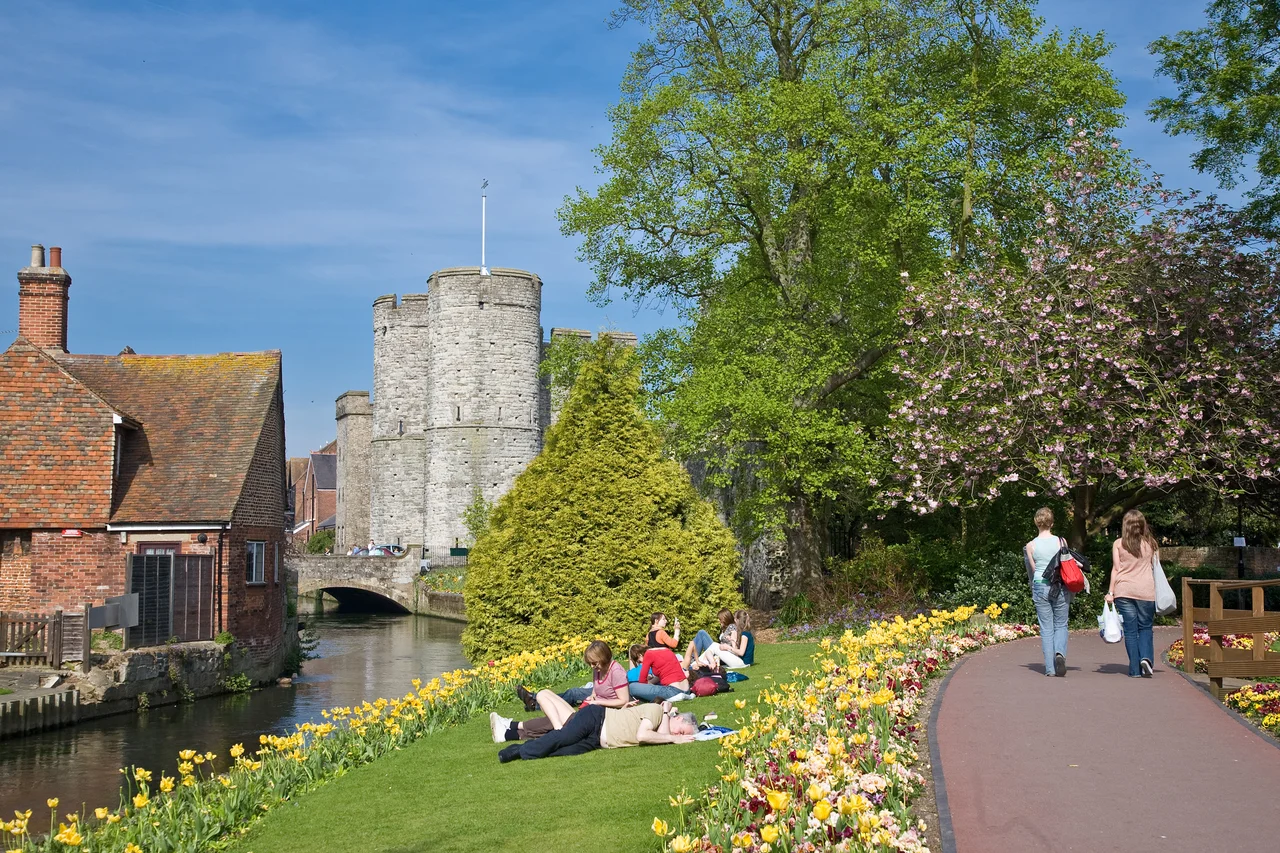
Walk Canterbury's centre today and you walk through layered time. The Westgate, the only one of the seven medieval city gates not demolished in 1787, still arches over Canterbury Castle Road, with its towers now serving as a small museum about its days as the city jail. The 17th-century Crooked House on Palace Street leans so dramatically that visitors photograph it constantly - it now operates as a bookshop for the Catching Lives homelessness charity. The half-timbered houses, the Norman castle ruins, the King's School - founded by Augustine and the oldest surviving secondary school in the United Kingdom - and the Bell Harry Tower rising over all of it. The Stour still curves through the city, and small punts take visitors past the back gardens of medieval buildings. Of every English city that calls itself ancient, Canterbury has the strongest claim. It has been a place worth coming to for two thousand years.
From the Air
Canterbury sits at 51.2783 degrees N, 1.0775 degrees E in east Kent, roughly 55 miles east-southeast of London and about 12 miles from the Channel coast. The Bell Harry Tower of the cathedral - 235 feet tall and visible across the surrounding countryside - is the dominant landmark from the air. The medieval city wall ring is still clearly visible from altitude. Nearest airport: Manston/Kent International (closed but recognisable). Manston is roughly 10 nautical miles north-east. Best viewed at 1,500-3,000 feet AGL, ideally approaching from the north on a clear day.
Nearby Stories
- Ringlestone Inn 3.4 km away
- Cliffs Pavilion 3.5 km away
- Citadel of Calais 6.5 km away
- 2021 English Channel Disaster 11 km away
- Stag Inn, Hastings 15 km away
- Dungeness Lighthouse 19 km away
- Clacton Pier 32 km away
- Four Days' Battle 54 km away