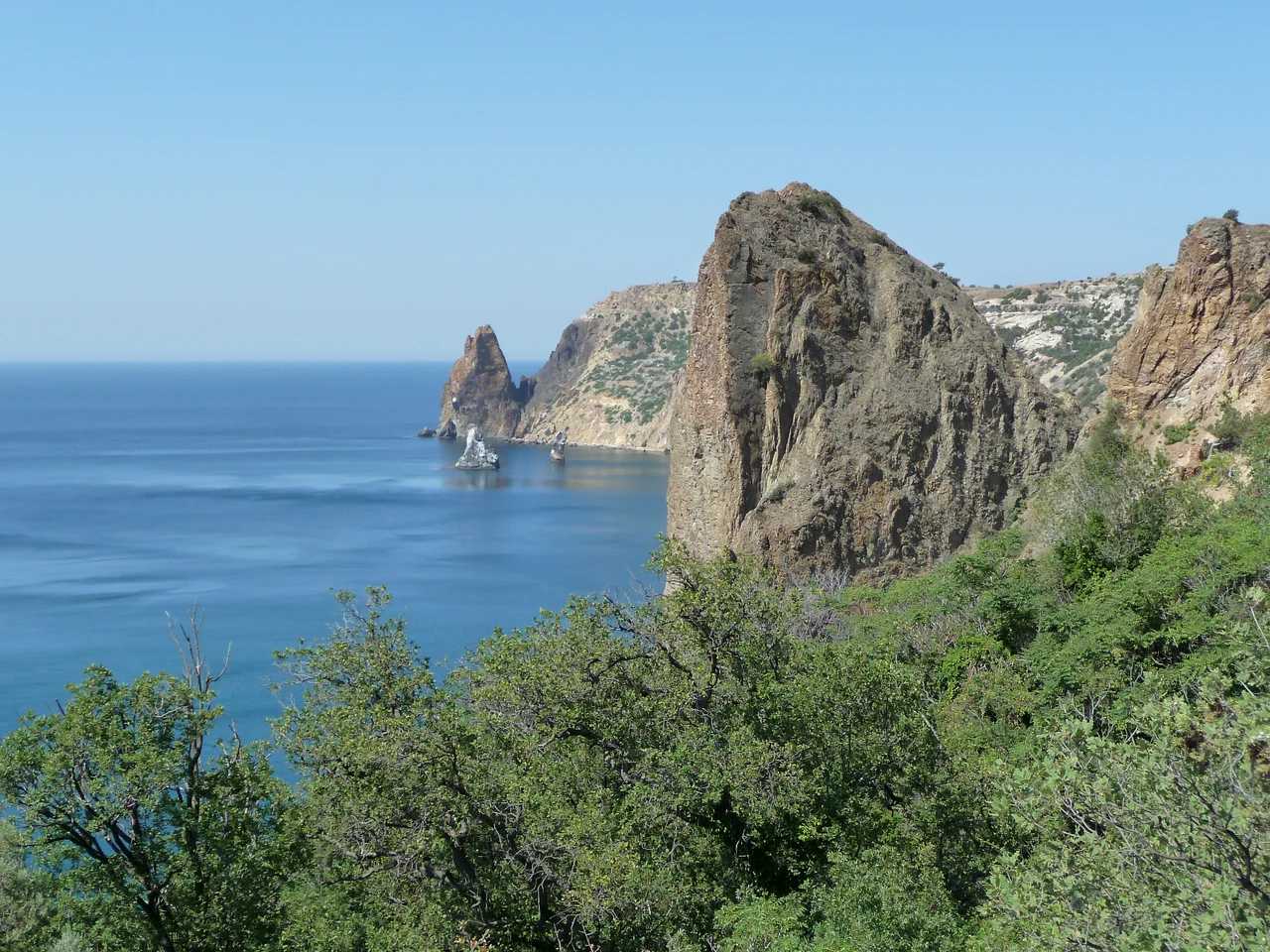

Cape Aya
The name tells you how people once felt about this place. Cape Aya takes its name from the Greek word for "holy one," a fitting title for a wall of rock where the Crimean Mountains march thirteen kilometers out into the Black Sea before dropping away. It is a landscape of sea caves and sheer stone, its highest point a summit the locals call Kokiya-Kiya, the Blue Cliff, rising 559 meters straight from the water. Sailors have always given such headlands respect, and Cape Aya, hollowed with grottoes and lashed by open-sea weather, has earned it.
Where the Mountains Meet the Sea
Cape Aya is the last gesture of the Crimean Mountains, a rocky spur that juts southeast of the harbor town of Balaklava and divides two bodies of water: Laspi Bay to the east, Balaklava Bay to the west. The rock is riddled with grottoes, sea-carved hollows that give the cliffs a honeycombed, secretive quality, and the whole headland is protected as a national reserve, a zakaznik, shielding its rare plants and steep, hard-to-reach slopes. This is not a gentle coast of beaches and promenades. It is a place of scale and edge, where the land rises abruptly and the sea works ceaselessly at its base, and where the boundary between mountain and water is drawn almost vertically.
A Storm Worth Painting
Wild coastlines attract artists, and Cape Aya drew one of the greatest painters of the sea who ever lived. Ivan Aivazovsky, the Armenian-Russian master whose canvases made the Black Sea famous, chose a storm off Cape Aya as the subject of one of his paintings. It is easy to see why. Aivazovsky built his reputation on light breaking through spray, on waves rendered with such translucence they seem lit from within, and a tempest crashing against these particular cliffs offered exactly the drama he loved. To stand at the cape on a rough day is to step inside that painting, to watch the same collision of water and stone that a nineteenth-century brush tried to hold still.
The Coast Reclaimed
For a stretch of recent years, part of this holy headland was walled off from the public. A lavish private residence, begun under Ukrainian president Viktor Yanukovych, closed locals off from their own coastline and sat unfinished when he was ousted in 2014; rather than being abandoned, the parcel later changed hands, and by 2025 reporting was home to an even larger walled compound. The wider cape's grottoes and trails have reopened to the hikers, botanists, and boaters who had always prized them, even as that fenced parcel itself stays off-limits. It is a small parable of a place that has outlasted many claimants: the grottoes and the Blue Cliff were here long before any wall went up, and they remain, indifferent to the comings and goings, still catching the light exactly as Aivazovsky saw it.
From the Air
Cape Aya lies at 44.43 degrees north, 33.65 degrees east, on Crimea's southwestern coast just southeast of Balaklava. From 4,000 to 6,000 feet the sheer 559-meter face of the Blue Cliff (Kokiya-Kiya) and the twin bays it separates, Laspi to the east and Balaklava to the west, make it easy to pick out. The nearest airfields are Sevastopol's Belbek (UKFB) and Simferopol (UKFF).
Nearby Stories
- Charax, Crimea 5.1 km away
- Soviet Destroyer Otvazhny 11 km away
- Russian Battleship Ekaterina II 15 km away
- Chatyr-Dag 19 km away
- Battle of the Alma 22 km away
- Januarius MacGahan 324 km away
- Tottenham (1802 Indiaman) 356 km away
- Abkhazia 568 km away