_il._08_(cropped).jpg)
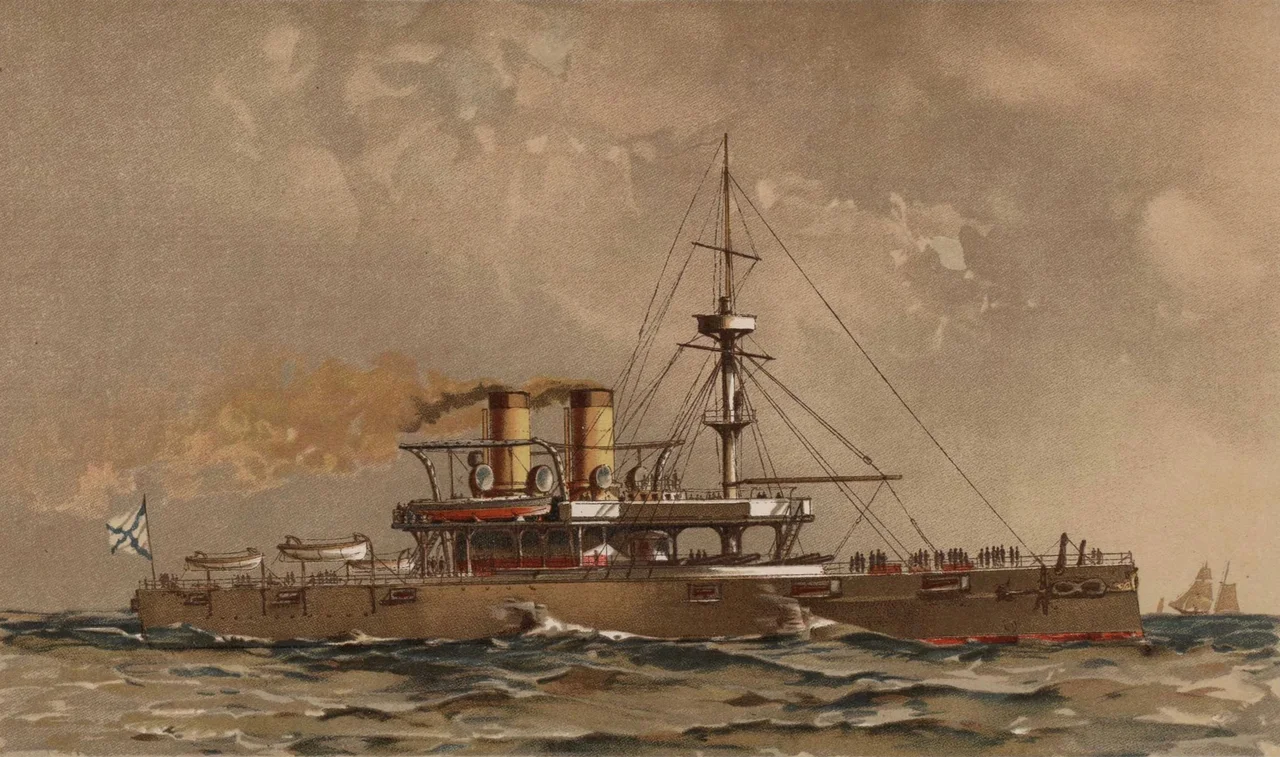
Russian Battleship Ekaterina II
In June 1905, as the battleship Potemkin's crew rose in mutiny and shocked the Russian Empire, the navy made a quiet, telling decision about another warship in the Black Sea Fleet. Rather than trust the crew of the ironclad Ekaterina II, officers decoupled her engines from her propellers, deliberately paralyzing one of their own capital ships. The men aboard were thought too sympathetic to the revolution to be relied upon. It is a strange distinction for a vessel named after an empress: the flagship of her class was considered dangerous not to the enemy, but to the very fleet that built her.
An Empress in Iron
Ekaterina II was named for Catherine the Great and launched into an era when navies were reinventing themselves in steel. She was the lead ship of a class of ironclad battleships built for the Imperial Russian Navy in the 1880s, laid down in 1883, launched in 1886, and completed in 1889. Alone among her sisters, she was constructed at the Nikolayev Admiralty Dockyard at Nikolaev, now the Ukrainian city of Mykolaiv, then transferred to Sevastopol to be fitted out. At more than 11,000 tons and over 330 feet long, she was a formidable presence in a fleet that spent her entire career patrolling the Black Sea. She was, from the start, a Sevastopol ship.
Guns That Wrecked the Deck
Ekaterina II differed from her sisters chiefly in her main armament, and the difference was memorable. Her twelve-inch guns sat in bulky, hydraulically powered Moncrieff disappearing mounts, an ingenious idea meant to let a gun rise to fire and then drop back behind armor to reload. In practice the arrangement was awkward. The guns were mounted only about four feet above the main deck, so low that firing them over the bow or stern caused extensive damage to the deck itself, the muzzle blast tearing at the ship that carried them. Reloading was slow, over five minutes between aimed rounds. A warship's own artillery, in other words, was among the greater hazards she faced.
A Quiet End at Sea
After the mutinies subsided, Ekaterina II's story wound down without glory. She was turned over to the Sevastopol port authorities and stricken from the register in 1907. In 1912 she was reduced to an anonymous designation, Stricken Vessel Nr. 3, and given a final duty no crew would envy: she was sunk as a torpedo target for the Black Sea Fleet, her hull used to sharpen the very weapons that would define the next war. Two years later, her remnants were salvaged back at Nikolaev, where she had first taken shape. The empress's namesake ended as practice, then as scrap, the wheel of her life closing where it began.
From the Air
The ship spent her career in the Black Sea Fleet and met her end as a torpedo target off Sevastopol, in the coastal waters around 44.50 degrees north, 32.95 degrees east. From 4,000 to 7,000 feet the approaches to Sevastopol's harbors and the indented southwestern Crimean coast are the key landmarks. The nearest airfields are Sevastopol's Belbek (UKFB) and Simferopol (UKFF).
Nearby Stories
- Maxim Gorky Fortresses 0.7 km away
- 1988 Black Sea Bumping Incident 16 km away
- Battle of the Alma 21 km away
- SS Santa Fé (1921) 42 km away
- Soviet Hospital Ship Armenia 113 km away
- Zaliznyi Port 144 km away
- Racecourse of Achilles 181 km away
- Januarius MacGahan 304 km away