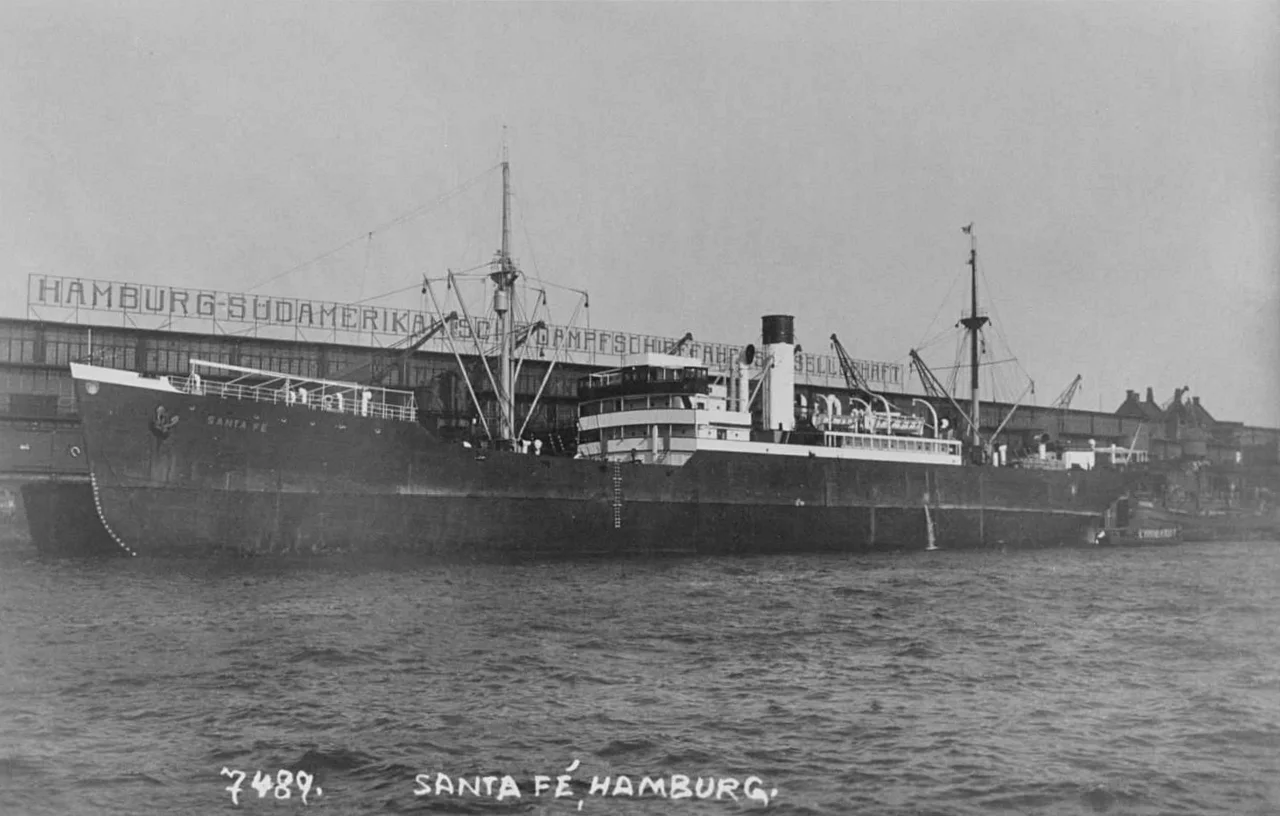

SS Santa Fé (1921)
Somewhere off the Crimean coast, in only ten meters or so of water, the broken hull of a cargo ship still holds the machinery of a war it never chose to fight. The SS Santa Fé went down in 1943, taking forty-four of her crew with her, but her strangest legacy came decades later, when divers began pulling German assault guns from her flooded holds one by one. She was a refrigerated freighter built for the banana and beef trade, not for battle, and yet she carried tanks to the bottom of the Black Sea. Her wreck has become one of the region's most unusual pieces of underwater history.
A Ship With Four Names
She was launched in Hamburg in 1921 as Steigerwald, named for a forest in Franconia, one of a pair of refrigerated cargo steamers built for the Hamburg America Line to carry perishable goods between Germany and South America. Her life read like a passport stamped by an anxious century. In 1937 new owners renamed her Santa Fé. In 1939 the French Navy captured her and the French government called her Saint André. Then, after France fell in 1940, Germany repossessed the ship and restored the name Santa Fé once more. Along the way her engineers even rebuilt her heart, fitting an exhaust-steam turbine alongside her original triple-expansion engine to squeeze more efficiency from every ton of coal.
The Torpedo
By November 1943 the ship, pressed into wartime service, was carrying fourteen Wehrmacht armored vehicles when a Soviet submarine found her off the coast of Crimea. A torpedo tore into her forward hold, touching off an explosion and a fire; a second blast broke her hull in two, and she went down fast. Forty-four of her crew were lost, twenty-eight listed as killed and sixteen as missing, the distinction between the two categories often being nothing more than whether a body was ever found. They were merchant sailors caught in a soldier's war, and the sea closed over them in minutes. Their ship settled into the shallows where she would rest, and be disturbed, for generations.
Raising the Dead Cargo
The Santa Fé's wreck lies close to the surface, and that has made her cargo reachable. Beginning in 2002, divers recovered the remains of two Sturmgeschütz III assault guns from the hull; a British charity, the Weald Foundation, obtained one and painstakingly restored it to running order, a wartime relic brought back to life from the seabed. In 2017 several Russian institutions signed an agreement to preserve military heritage and cooperate on projects like this one, and Russian Black Sea Fleet divers later raised a third StuG III from the wreck. By early 2020 the priority had shifted from salvage to safety: the plan now was to make the wreck secure by detonating the unexploded ordnance still lying in her cargo, the last dangerous remnant of the day she sank.
A Grave in Shallow Water
There is something uneasy about a wreck this accessible. Most sunken ships lie far beyond casual reach, sealed away in the dark and the depth, but the Santa Fé rests in only about ten meters of water, shallow enough that her hull and her cargo have become the subject of repeated visits and recoveries. That accessibility has made her a magnet for salvage and interest to marine archaeologists, her assault guns hauled up one by one to be displayed and restored. It is worth remembering, amid the fascination with her steel and her tanks, that this is also a grave. Forty-four men died when she broke apart, and the same shallow water that lets divers reach her cargo also holds the memory of the crew who never came home from that November day in 1943.
From the Air
The wreck of the SS Santa Fé lies in shallow water near 45.08°N, 33.27°E off the western Crimean coast south of Yevpatoria, at a depth of only about ten meters. From 2,000–4,000 feet in calm, clear conditions the shallow site may show as a darker patch beneath the surface near the coast. The nearest airport is Saky (UKFI) just inland to the northeast.
Nearby Stories
- Tarkhankut Peninsula 7.6 km away
- Eski Yurt 11 km away
- Soviet Destroyer Otvazhny 21 km away
- Crimea 22 km away
- Tarkhankut Lighthouse 33 km away
- Kalos Limen 44 km away
- Syvash 93 km away
- Januarius MacGahan 368 km away