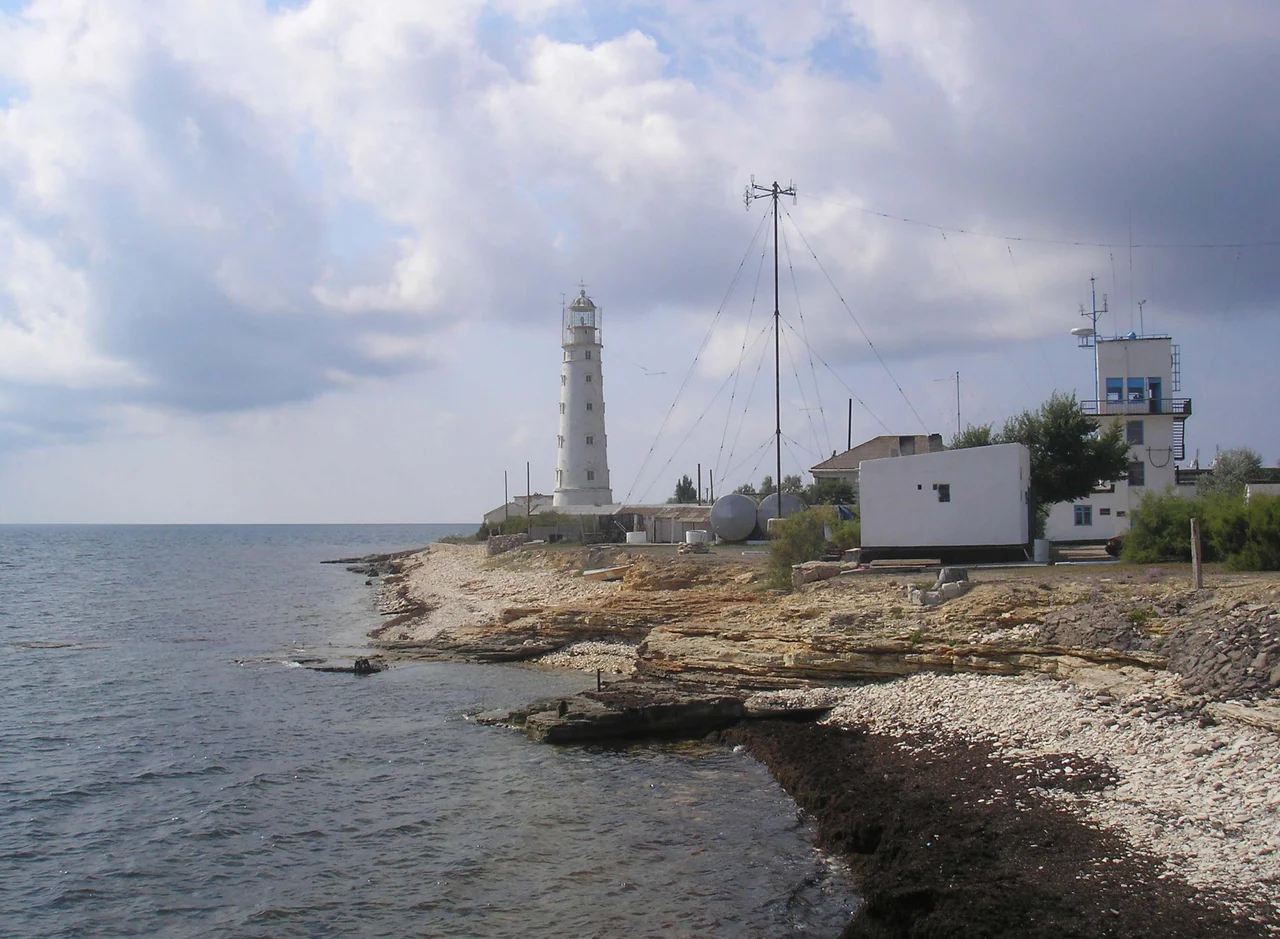

Tarkhankut Lighthouse
Building a lighthouse on the Tarkhankut Cape in 1816 meant fighting the very isolation the lighthouse was meant to relieve. There was no proper harbor here on Crimea's remote western tip, so the pale Inkerman stone, quarried near Sevastopol, arrived by barge, was anchored offshore, ferried ashore in small boats, and then dragged the rest of the way across open steppe to the building site. Out of that laborious effort rose a conical tower of stone, thirty-six meters tall, crowned with a ten-sided wooden lantern. It was not alone: the Tarkhankut Lighthouse was conceived as one of twins, its sister rising simultaneously on the Khersones peninsula to the south.
A Hard Post to Keep
The tower first threw its beam in 1817, after its lighting system was repaired, and from the start this was a punishing place to work. Three houses went up beside the lighthouse for its keepers and stores, but the cold, damp winters of the Tarkhankut Peninsula made them nearly unlivable, leaving the men who tended the light to endure a raw, exposed existence on the edge of the sea. Their job only grew more demanding as the technology advanced. In 1910, the lighthouse switched to burning kerosene, a fuel that demanded constant care and vigilance from keepers who could not afford a careless moment. To live at Tarkhankut was to keep a lonely, unglamorous vigil, trading comfort for the certainty that ships passing in the dark would see the shore before they struck it.
Layers of Light and Sound
Over more than a century, the lighthouse gathered improvements like sediment. In 1862 its lighting was upgraded until the beam carried some 12.4 miles out to sea. Construction resumed in 1873, when the building was at last completed and painted the brilliant white it wears today. A telegraph station followed in 1876, tying the remote cape into the wider world. On the first day of 1883, a compressed-air fog siren was installed, though it was slow to ready in an emergency, so in 1899 a simple bell was added to be rung while the siren warmed up. The modern age arrived in stages: an electric beacon with a remarkable 300-kilometer reach in 1934, and a proper electrical power system in 1959. Each addition was another answer to the same old question of how to be seen and heard across a treacherous stretch of water.
Twin Towers of Pale Stone
Tarkhankut was never meant to stand alone. When work began in 1816, it was one half of a pair, its sister tower rising at the same time on the Khersones peninsula to the south, the two lights together framing the approaches to this dangerous coast. Both were raised from the same material: Inkerman stone, a soft, pale limestone quarried near Sevastopol, prized for how easily it could be cut and how handsomely it weathered. Getting that stone to the cape was its own ordeal, barged up the coast, transferred to small boats offshore, landed by hand, and hauled across the open steppe with no road to ease the way. The result was a tower built to last, a 36-meter cone of stone that has outlived the empire that ordered it, the fuels that once lit it, and generations of the keepers who kept its flame.
The Beam and the Wreck
For all its guiding light, the sea around Tarkhankut has still claimed its victims. On a foggy morning in October 1878, the Romanov imperial yacht Livadia ran aground almost within sight of this very tower, a reminder that even the best beacon cannot conquer fog. Today the lighthouse still works, if in a weathered, run-down state, its white column a fixed point against the steep cliffs and the wide Black Sea beyond. Visitors can come to the site and even shadow the keeper through his daily routine, then climb the spiral stairway to the observation platform, where the view opens onto the sea and the rugged shores of the cape. Two centuries on, the tower keeps doing the one thing it was hauled across the steppe to do.
From the Air
Standing at 45.3469 N, 32.4942 E on Tarkhankut Cape, about 5 km southwest of Olenivka. From 1,500 to 3,000 feet the tall white tower is unmistakable against the cape's steep limestone cliffs and the surrounding open steppe, a natural coastal waypoint. Saky (Saki) airfield lies to the east along the Crimean coast.
Nearby Stories
- National Space Facilities Control and Test Center 10 km away
- Karkinit Bay 31 km away
- Soviet Cruiser Chervona Ukraina 35 km away
- Soviet Destroyer Otvazhny 47 km away
- Battle of the Alma 53 km away
- Tendra Spit 84 km away
- Black Sea Biosphere Reserve 115 km away
- Januarius MacGahan 360 km away