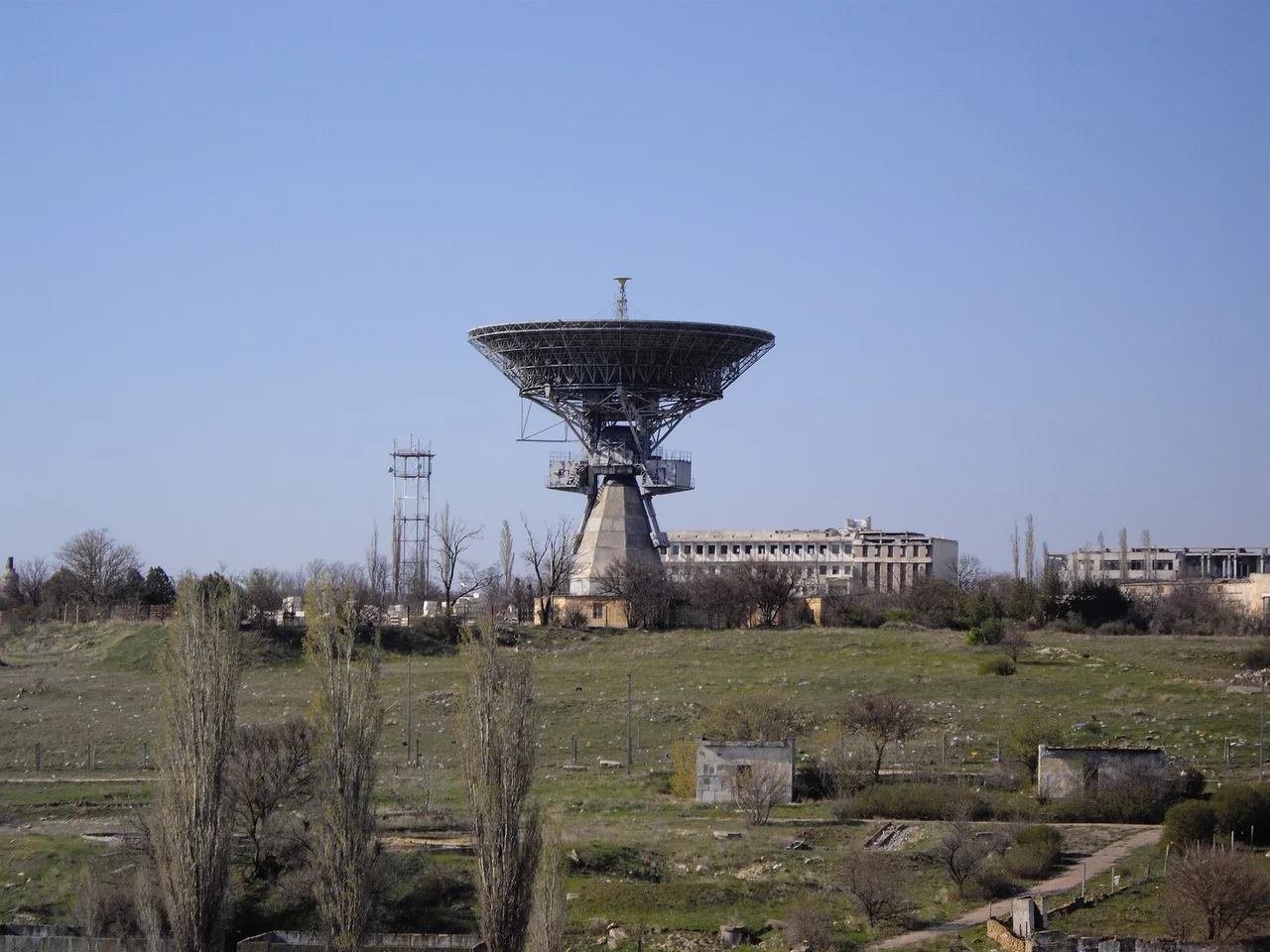

National Space Facilities Control and Test Center
For the first two decades of the space age, if a Soviet spacecraft was headed for Venus or Mars, someone on this flat Crimean coast near Yevpatoria was flying it. Interplanetary flight control happened here and nowhere else, on a plain of steppe and antennas where engineers commanded machines drifting tens of millions of kilometers away. The institution that grew out of that work still exists, but it no longer lives in the place that made it famous. Its history is the story of a control center that outlasted the country that built it, and eventually had to leave home entirely.
Commanding the Planets
The center's facilities were established in 1960 on a coastal plain near Yevpatoria, built around the deep-space radio complex called Pluton, whose enormous antennas were said to have no equal anywhere in the world. On 12 February 1961 the station took command of Venera 1, the world's first automatic interplanetary probe, a spacecraft sent to fly past a planet no human had ever reached, and from there the roster only grew: Venera 2 and 3 in 1965, then a long series of Luna, Venera, and Mars spacecraft aimed at the Moon and the neighboring worlds. The engineers here tracked flight paths, guided landings on other worlds, and gathered the scientific signals streaming back across the void. It was patient, exacting work, carried out around the clock by specialists who understood that a spacecraft millions of kilometers away answered only to the commands this station sent. Out of that deep, accumulated expertise came a new instrument, the giant RT-70 radio telescope, which joined the deep-space program in December 1978.
A Ukrainian Institution Is Born
When the Soviet Union dissolved, the center found itself in independent Ukraine, and it adapted. On 31 August 1995 it managed the launch of Sich-1, Ukraine's first national satellite, sent up on a Cyclone-3 rocket for Earth observation. The following year, by presidential decree, the National Center for Control and Testing of Space Vehicles was formally established at Yevpatoria, built on the foundation of the old Deep Space Communications Center and designed to operate spacecraft in both national and international programs. What had been a Soviet facility became a Ukrainian one, its mission broadening from Cold War exploration to serving a young country's economy, security, and scientific ambitions. The organization put out roots beyond Crimea, with branches spreading to sites like Mukachevo in the far west and Dnipro in the industrial heartland, so that it was no longer a single installation but a network stretched across the country.
Leaving Home
Then geography and history diverged. With the Russian annexation of Crimea in 2014, the center's original technical facilities near the village of Vityne fell inside Russian-occupied territory, cut off from the institution that legally held them. To keep control of the wider organization and its branches, Ukraine's space agency moved the headquarters to Kyiv that same year. The center carried on from the capital, tasked with developing the country's space industry, cooperating with the State Space Agency of Ukraine, and supporting the national programs meant to serve the country's security and economy, even as the ground where it all began remained beyond reach. There is a peculiar poignancy in an organization whose entire identity was rooted in a single stretch of Crimean coast having to reconstitute itself hundreds of kilometers away, keeping the name and the mission while losing the place. On 20 December 2023, a strike hit the former site near Yevpatoria. An institution had, in effect, been separated from its own birthplace, continuing its work in exile from the coast where the Soviet planets were once flown, its history now split between the antennas it can no longer use and the offices where it endures.
From the Air
The center's original Crimean facilities lie near 45.22°N, 33.16°E on the coastal plain northwest of Yevpatoria, near the village of Vityne; the institution itself is now headquartered in Kyiv. From 3,000–5,000 feet the large antenna installations are visible against the flat steppe near the Black Sea coast. The nearest airport is Saky (UKFI) to the southeast.
Nearby Stories
- Tarkhankut Peninsula 17 km away
- Simferopol 28 km away
- Karkinit Bay 31 km away
- Soviet Cruiser Chervona Ukraina 35 km away
- Soviet Destroyer Otvazhny 35 km away
- Crimea 35 km away
- Syvash 77 km away
- Januarius MacGahan 385 km away