
Kalos Limen
The Greeks who founded it gave it a name that was also a promise: Kalos Limen, the beautiful harbor. More than two thousand years later, low walls of dressed stone still trace the outline of that promise on a windswept shore of western Crimea, the remains of a colony that lived and died on the edge of the Greek world. For roughly three centuries this was a working port, a place of grain and trade and defensive walls, before it was abandoned to the steppe. What survives is a ruin you can walk through, reading a settlement's whole life in the courses of its fortifications.
The Beautiful Harbor
Kalos Limen appears in an ancient sailing account, a periplus, which places it 700 stadia from Kerkinitis, the Greek town on the site of modern Yevpatoria. Those old coastal handbooks were the sailor's memory of a shoreline, listing harbors, distances, and dangers, and from this one scholars were able to fix the colony's location on the coast of the Tarkhankut Peninsula. It belonged to the constellation of Greek colonies that ringed the Black Sea from the fourth century BC onward, outposts of a Mediterranean civilization pushing into the grasslands of Scythia to trade with the peoples of the interior. Grain flowed out of these ports toward the hungry cities of the Aegean; goods and culture flowed back. The name itself tells you what the Greek sailors valued: a safe anchorage, a good harbor, a beautiful place to bring a ship in from the open sea. Everything a colony needed began at the water's edge.
A Town That Kept Changing Hands
Life on this frontier was never settled for long. In the second century BC, the Scythians, the horse-riding people who dominated the surrounding grasslands, captured Kalos Limen from the Greeks. The Greeks took it back. Then the Scythians seized it once more, a tug-of-war for a walled harbor that both sides understood mattered, control of the coast passing back and forth like a coin between two hands. The fortification walls that still stand were built for exactly this world, a place where a change of rulers might arrive from over the horizon at any season, and where a harbor town had to be a stronghold as much as a marketplace. In the first century BC, the pressure finally proved too much: an invasion by the Sarmatians, another people of the great steppe, emptied the town for good. There would be no comeback this time. After centuries of being fought over, won, lost, and won again, Kalos Limen was simply left behind, its walls surrendered not to a conqueror who wanted them but to the wind and the grass.
Stone That Outlasted Everyone
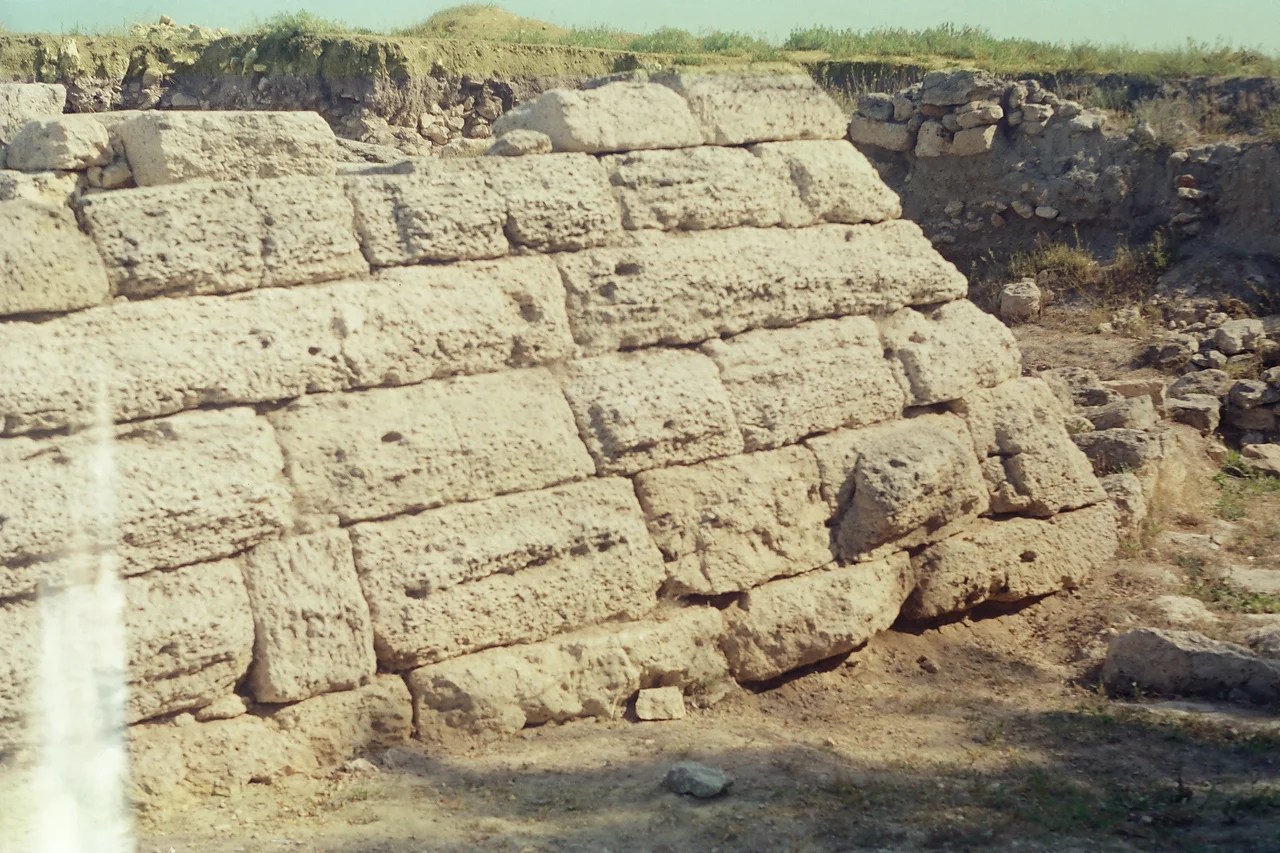
The people are long gone, but their masonry endures. Sections of the defensive walls remain standing on the site, weathered but legible, the lower courses of a fortress that once decided who controlled this stretch of coast. On 22 April 1997, the ground was formally set aside as the State Historic-Archaeological Preserve, giving the ruins the recognition their age deserves and protecting what archaeologists continue to study. Walking among the stones, you stand in a place that connected the Aegean to the Eurasian interior, where Greek settlers, Scythian horsemen, and Sarmatian invaders each left their mark. There are no grand columns here, no restored temples, only the honest outline of walls in the grass and the quiet company of the sea that first drew the Greeks to this shore. Kalos Limen is a rare thing: a whole town's rise and fall, still readable in the ground where it happened, its beautiful harbor still keeping watch over an empty coast, waiting for anyone willing to slow down and read it.
From the Air
The ruins of Kalos Limen sit near 45.52°N, 32.71°E on the western coast of the Tarkhankut Peninsula, close to the modern town of Chornomorske. From 3,000–4,000 feet the walled site is visible against the coastal steppe where land meets the Black Sea. The nearest airport is Saky (UKFI) to the southeast.
Nearby Stories
- Saky 15 km away
- Swan Islands Nature Reserve 22 km away
- Karkinit Bay 23 km away
- Pluton (complex) 30 km away
- Saky Air Base 42 km away
- Zaliznyi Port 47 km away
- Racecourse of Achilles 86 km away
- Januarius MacGahan 389 km away