
Pluton (complex)
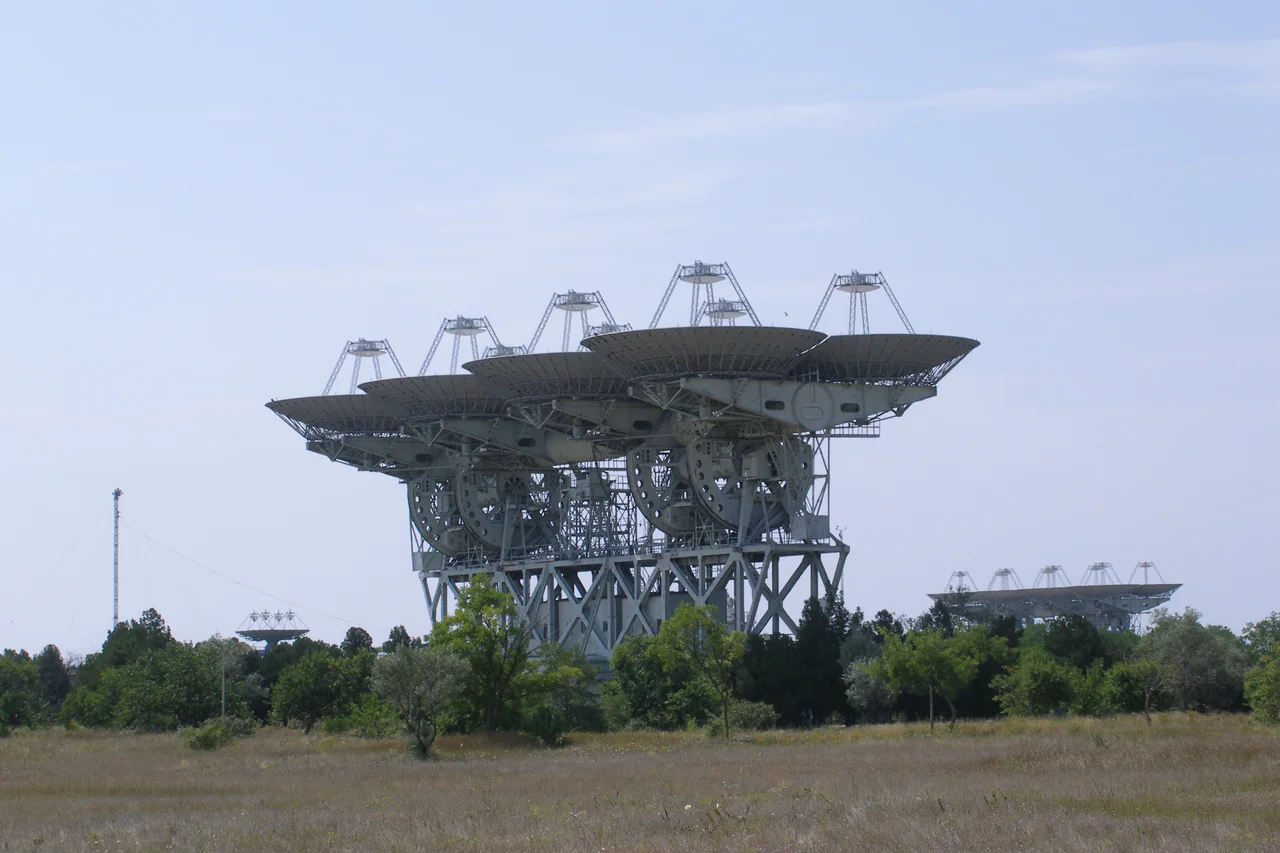
To build antennas big enough to hear a whisper from another planet, Soviet engineers scavenged the hardware of war. The great dishes of the Pluton complex were welded onto the hulls of two diesel submarines and mounted on frames made from battleship gun turrets, all of it laid across railway bridge trusses so the whole improvised structure could swing to track a spacecraft across the sky. It looks, in old photographs, like something a giant assembled from spare parts. Yet from this stretch of Crimean coast near Yevpatoria, humanity managed some of its first conversations with the other worlds of the solar system, and sent its first deliberate messages to the stars.
An Antenna Built From Warships
Pluton was raised in 1960 as the heart of a deep-space communications center, its purpose to command spacecraft flying to Venus and Mars and to bounce radar off distant planets. The engineering was audacious and thrifty. The complex used at least three ADU-1000 antennas, each an array of eight sixteen-meter reflectors, with receiving dishes at a North Station near Vityne and a transmitter eight and a half kilometers away at a South Station near Zaozerne. The dishes rode on submarine hulls; the steerable mounts came from battleship gun turrets. Crude as it sounds, it worked. In February 1963 the station made a successful radar detection of Mars, and that autumn it reached across the solar system to Jupiter.
The First Words to the Stars
On 19 and 24 November 1962, the operators at Pluton did something no one had done before. They aimed the antennas at a star in the constellation Libra and transmitted three words in Morse code: MIR, LENIN, SSSR. Known as the Morse Message, these were the first radio broadcasts ever deliberately sent toward extraterrestrial civilizations, humanity's opening line in a conversation that may never be answered. In the years that followed, Pluton guided a long procession of robotic explorers, the Venera probes to Venus and the Mars spacecraft among them, and achieved the world's first radar contact with Mercury in 1962. For two decades this coast was the nerve center of Soviet interplanetary flight.
The Astronomer Who Feared He'd Been Poisoned
The first Westerner to see the site was the British radio astronomer Bernard Lovell, founder of the Jodrell Bank Observatory, who visited in 1963. It was not a comfortable memory. Decades later, in 2009, Lovell told The Daily Telegraph that he had developed radiation sickness after the visit, and that he believed the Soviet authorities, knowing Jodrell Bank formed part of Britain's early-warning system, had tried to kill him with a deliberate dose. The claim has never been settled, and it may say as much about the paranoia of the era as about any real plot. But it captures the strange doubleness of a place like this, at once a monument to scientific curiosity and an instrument of Cold War suspicion, where wonder and mistrust shared the same antennas, and where a visiting scientist could not be entirely sure whether he was a guest or a target.
A Ruin Still Watched
Time and politics have worn the complex down. By November 2013 the transmitter antenna at the South Station had been dismantled. After Russia annexed Crimea in 2014, the site passed to the Russian Aerospace Forces, and Ukrainian intelligence believes modernization work began around 2017, though its purpose remains unclear, perhaps tied to missile early warning or satellite navigation. On 23 June 2024, the North Station was struck by five Ukrainian ATACMS missiles; satellite images later showed damage, and a NASA fire-detection system confirmed a blaze burning at the facility. The station that once sent friendly words to the stars now sits inside the shadow of a modern war, its scavenged giants still standing on the coast where the space age began.
From the Air
The Pluton complex sits near 45.17°N, 33.25°E on the coastal plain northwest of Yevpatoria, with its historic North Station near Vityne and South Station near Zaozerne. From 3,000–5,000 feet the large antenna arrays stand out against the flat coastal steppe. The nearest airport is Saky (UKFI) to the southeast.
Nearby Stories
- Tarkhankut Peninsula 7.6 km away
- Eski Yurt 11 km away
- Soviet Destroyer Otvazhny 21 km away
- Crimea 22 km away
- Tarkhankut Lighthouse 33 km away
- Kalos Limen 44 km away
- Syvash 93 km away
- Januarius MacGahan 368 km away