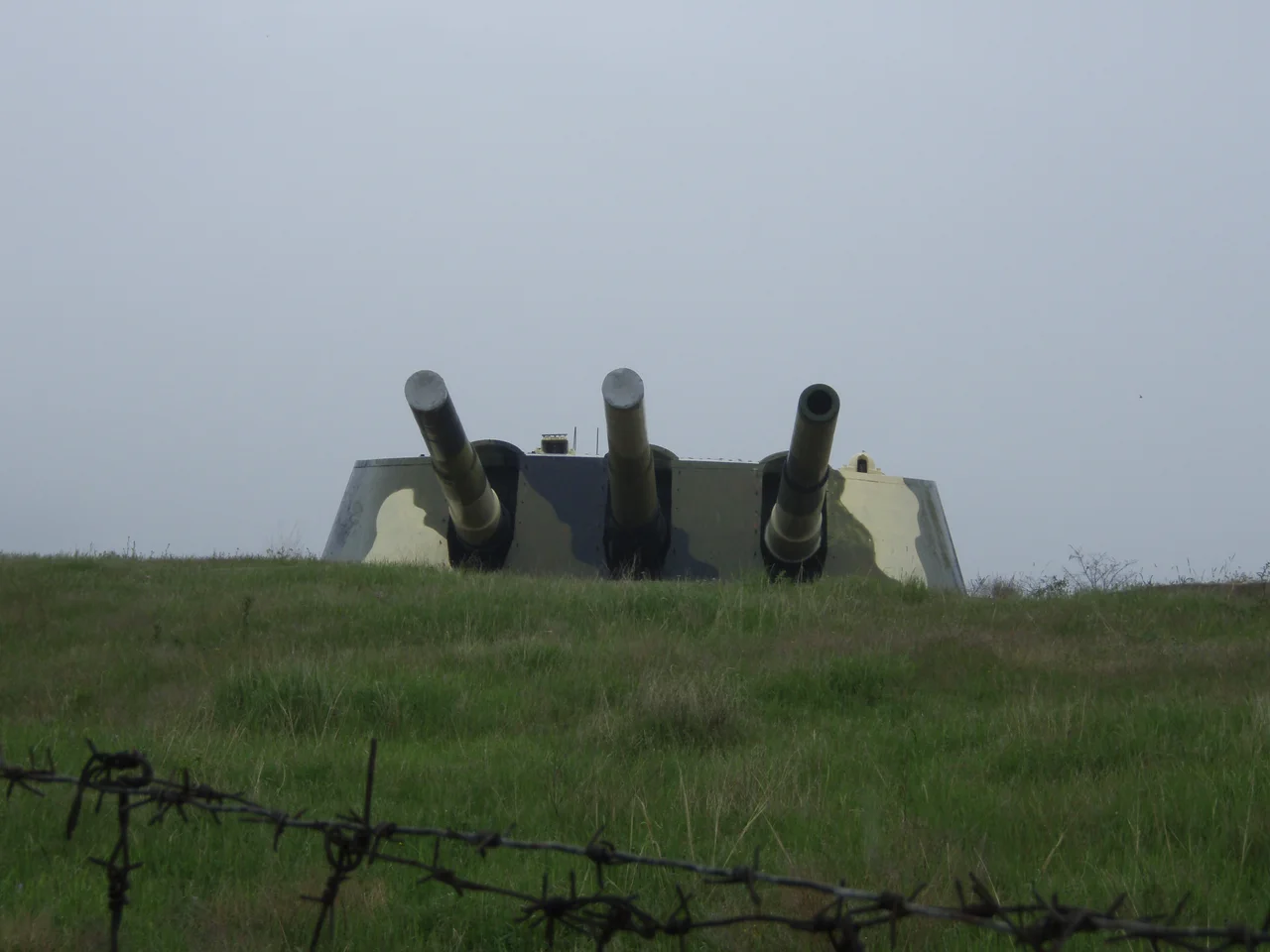

Maxim Gorky Fortresses
The Germans named them for a writer. As their armies battered at Sevastopol in 1942, they found two Soviet coastal batteries so formidable that they gave them a name from Russian literature, calling them Maxim Gorky I and Maxim Gorky II, after the celebrated Soviet author and political activist. Officially these were Armored Coastal Batteries Number 30 and Number 35, but the literary nickname stuck, and it is how the fortresses are remembered in English to this day. Each was a squat crown of steel over the cliffs, turrets lifted from battleships and set into the rock to command the sea approaches to the harbor.
The Largest Gun Ever Fired in Anger
Maxim Gorky I stood north of the great bay that formed Sevastopol's harbor, its two twin turrets able to fire four thirty-centimeter guns out to sea. When German forces broke through the Perekop Isthmus in October 1941 and drove toward the city, the battery blocked their path. To crack it, the Germans brought a monster. They deployed Schwerer Gustav, an eighty-centimeter railway gun that remains the largest-calibre rifled weapon ever used in combat, hurling shells that weighed several tons. On 6 June 1942, that gun and the huge Karl-Geraet siege mortars scored direct hits, wrecking one turret and damaging the other. Even so, the battery fought on. Not until 17 June did German assault engineers finally silence it, and by Soviet accounts the guns fell quiet only when the ammunition was gone, after which the crew blew up what remained rather than surrender it intact.
The Last Fortress to Fight
Maxim Gorky II guarded the opposite flank, mounted on seaward cliffs on the southwestern side of Sevastopol and armed with similar battleship turrets. Its end came in the final days of the siege. On 4 July 1942, after the Germans had captured the neighboring Sapun heights, Maxim Gorky II was taken as well, and with its fall came a small, grim distinction. It was the last major pre-war fortification anywhere to take part in a campaign, a design conceived in an earlier era of coastal defense that fought until the very last moment the war allowed it. The great fixed forts had had their day, and this one closed the chapter on the cliffs above the Black Sea.
Ruins, Robbers, and Remembrance
The two batteries met very different fates after the war. Maxim Gorky I was not only rebuilt but strengthened, fitted with triple gun turrets salvaged from a battleship that raised its firepower from four guns to six, and given thicker armor and a modern fire-control system. It stayed on the books until 1997, when it was finally mothballed, and the last time it fired its guns was in 1968, for a Soviet film about the sea aflame. By some accounts it could still be brought back to life in just seventy-two hours. Maxim Gorky II was never so fortunate. Parts of it served other coastal batteries until 1963, when the military abandoned the fort outright, and in the 1980s and 1990s it suffered further at the hands of scrap salvagers and grave robbers, a bleak indignity for ground where so many had died. In 2007 it was turned into a museum complex honoring the sacrifice of its defenders, funded largely through charity, so that the cliffs would keep the memory of the men who held them.
A Name Meant as Grudging Respect
There is something telling in the name itself. The batteries were officially just numbers, Number 30 and Number 35, cold entries in a defense plan. It was the attackers who gave them a name, reaching past their own military catalogue for a figure from Russian culture and calling the forts after Maxim Gorky, the famous Soviet author and political activist. A nickname like that is not given to a weakling; it is the kind of name an enemy invents for an obstacle that has earned attention the hard way. These were not improvised trenches but purpose-built armored fortresses with battleship guns set in the rock, the very last of a vanishing breed of fixed coastal fortification. To break them, the Germans hauled in the largest artillery on Earth and still needed weeks. In the naming, in the effort, and in the days it cost, the forts left a record of exactly how hard they were to take.
From the Air
Maxim Gorky II, the museum site, lies at 44.558 N, 33.407 E, on the seaward cliffs southwest of Sevastopol; Maxim Gorky I stood on the north side of the bay. From 2,000 to 3,000 feet, look for the coastal headlands flanking the mouth of Sevastopol Bay, with the city and its long inlet to the northeast. The nearest airport is Belbek (UKFB) to the north; Simferopol (UKFF) lies northeast.
Nearby Stories
- 1988 Black Sea Bumping Incident 5.4 km away
- Battle of the Alma 7.5 km away
- Yalta 8 km away
- Russian Battleship Ekaterina II 10 km away
- Akmesdzhyt Friday Mosque 12 km away
- Soviet Hospital Ship Armenia 15 km away
- KaZantip 52 km away
- Januarius MacGahan 338 km away