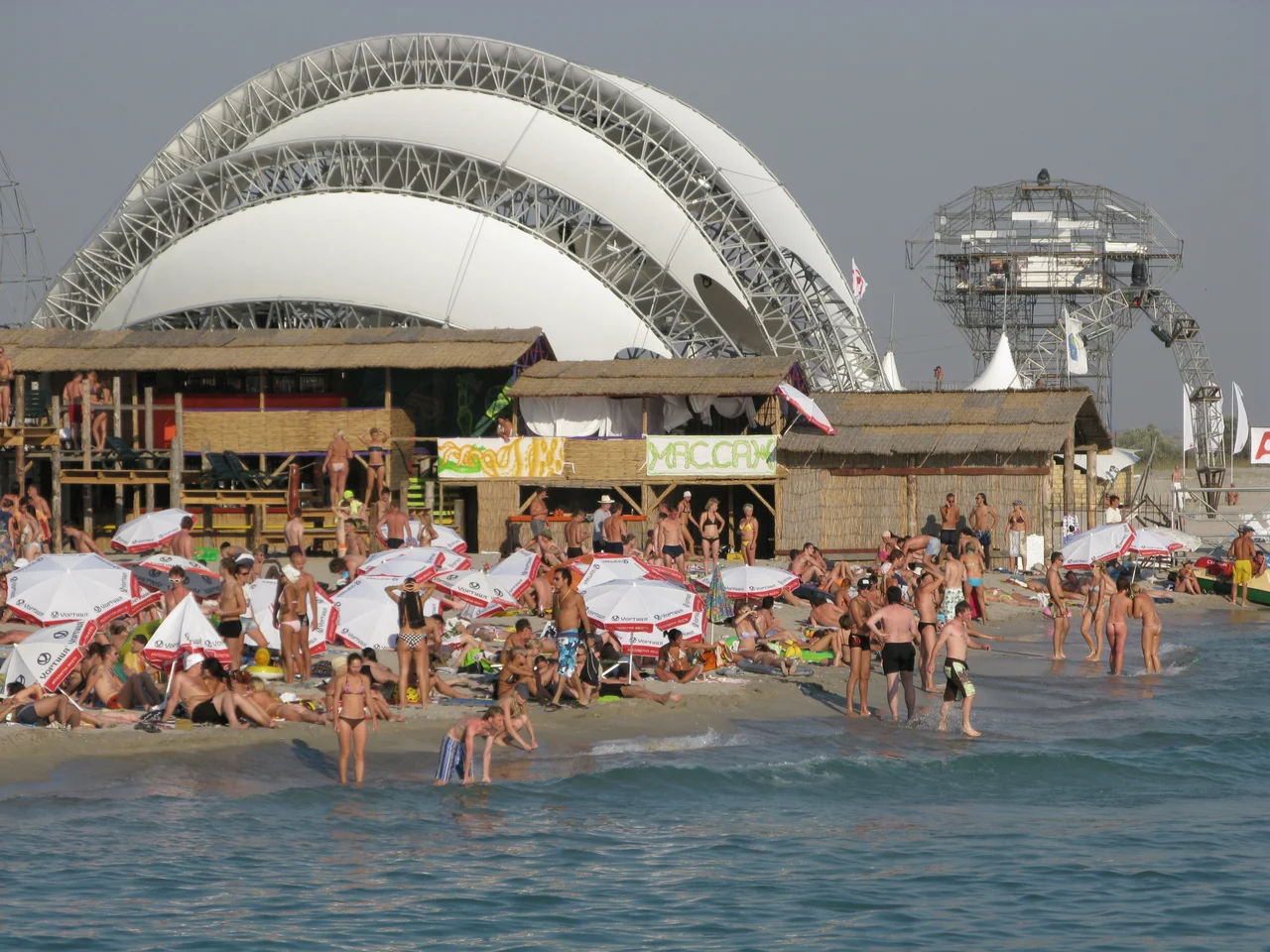

KaZantip
For several wild summers in the late 1990s, the biggest dance party on the Black Sea coast pulsed inside the turbine hall of a nuclear power station that was never switched on. The Crimean Atomic Energy Station, half-built and abandoned near Shchelkino, had a vast concrete cavern meant to house machinery that never arrived. Into that silence poured strobe lights, bass, and thousands of dancers. This was KaZantip, known simply as Z, and turning a would-be reactor into a nightclub was entirely in keeping with its logic. It was a festival that took the ordinary rules of the world and gleefully rewrote them.
From Windsurfers to a Republic
KaZantip did not set out to become an institution. It began around 1992 as something almost accidental: a loose gathering of windsurfers unwinding after long days of riding the Crimean waves, named for the nearby Kazantyp headland. Its founder, Nikita Marshunok, who styled himself Nikita I, eventually added a techno and trance party to celebrate the end of the surfing season, and that spark caught fire. The festival swelled into an international phenomenon that ran each summer until 2013, drawing roughly 100,000 visitors who called themselves paradiZers. It presented itself, tongue firmly in cheek, as a virtual republic, complete with its own mythology, its own holidays, and an entrance ticket that was, naturally, called a viZa.
The Rules of Republic Z
Everything about KaZantip came with its own playful grammar. There was a cult of orange fashion and yellow suitcases, a color scheme that turned the crowd into a single glowing organism. There was a spring holiday called the Mayovka, or Happiness Parade, held from late April into early May and devoted, in the festival's own words, to spring, friendship, and happiness. And there was the music, relentless and everywhere: at its peak, the republic ran more than 300 DJs across over 14 dance floors, spinning 24 hours a day on a stretch of land covering some 60,000 square meters. From 2001 the festival settled in the village of Popivka near Yevpatoria, transforming a quiet coastal town into a nonstop, sun-bleached carnival for two or three weeks every August.
A Party Always on the Move
KaZantip never stayed in one place for long. It took its name from the Kazantyp headland, near which it was staged during the atomic-hall years from 1995 to 1999. In 2000 it decamped to the settlement of Vesele, and from 2001 onward it found its longest home in the coastal town of Popivka, near Yevpatoria, where it would remain through its final Crimean seasons. Each move transformed an ordinary Black Sea town, for a few weeks each August, into the capital of an imaginary nation. Locals watched their quiet resort villages fill with tens of thousands of visitors in orange, dragging their yellow suitcases toward the dance floors. Wherever it landed, KaZantip carried its whole invented country with it, unpacking its viZas, its parades, and its round-the-clock music onto whatever stretch of sand would have it.
The Names on the Decks and the Long Goodbye
In its prime, KaZantip pulled in the biggest names in electronic music. The lineups read like a who's who of the global scene: Carl Cox, Armin van Buuren, Richie Hawtin, Ricardo Villalobos, and Josh Wink graced its floors, and the 2012 season alone brought Tiesto, Skrillex, Benny Benassi, and David Guetta to the Crimean sand. Then the world beyond the party intruded. After the annexation of Crimea by the Russian Federation in 2014, the festival left the peninsula for the first time in its history, relocating that year to Anaklia in Georgia. An attempt to stage it on an island off Cambodia in 2015 was cancelled at the last minute by local authorities. The republic had lost its homeland. But for two decades, on a headland by the Black Sea, KaZantip had proven that even an empty nuclear hall could be filled with something entirely, defiantly alive.
From the Air
The Popivka-era festival grounds sit near 45.2914 N, 33.0381 E on Crimea's western coast, close to Yevpatoria. From 2,000 to 3,500 feet the low, sandy coastline and the flat resort terrain around the village stand out against the Black Sea. Saky (Saki) airfield lies a short distance to the southeast.
Nearby Stories
- Saky 20 km away
- Battle of the Alma 28 km away
- Soviet Destroyer Otvazhny 31 km away
- Karkinit Bay 36 km away
- Swan Islands Nature Reserve 40 km away
- Zaliznyi Port 66 km away
- Racecourse of Achilles 104 km away
- Januarius MacGahan 372 km away