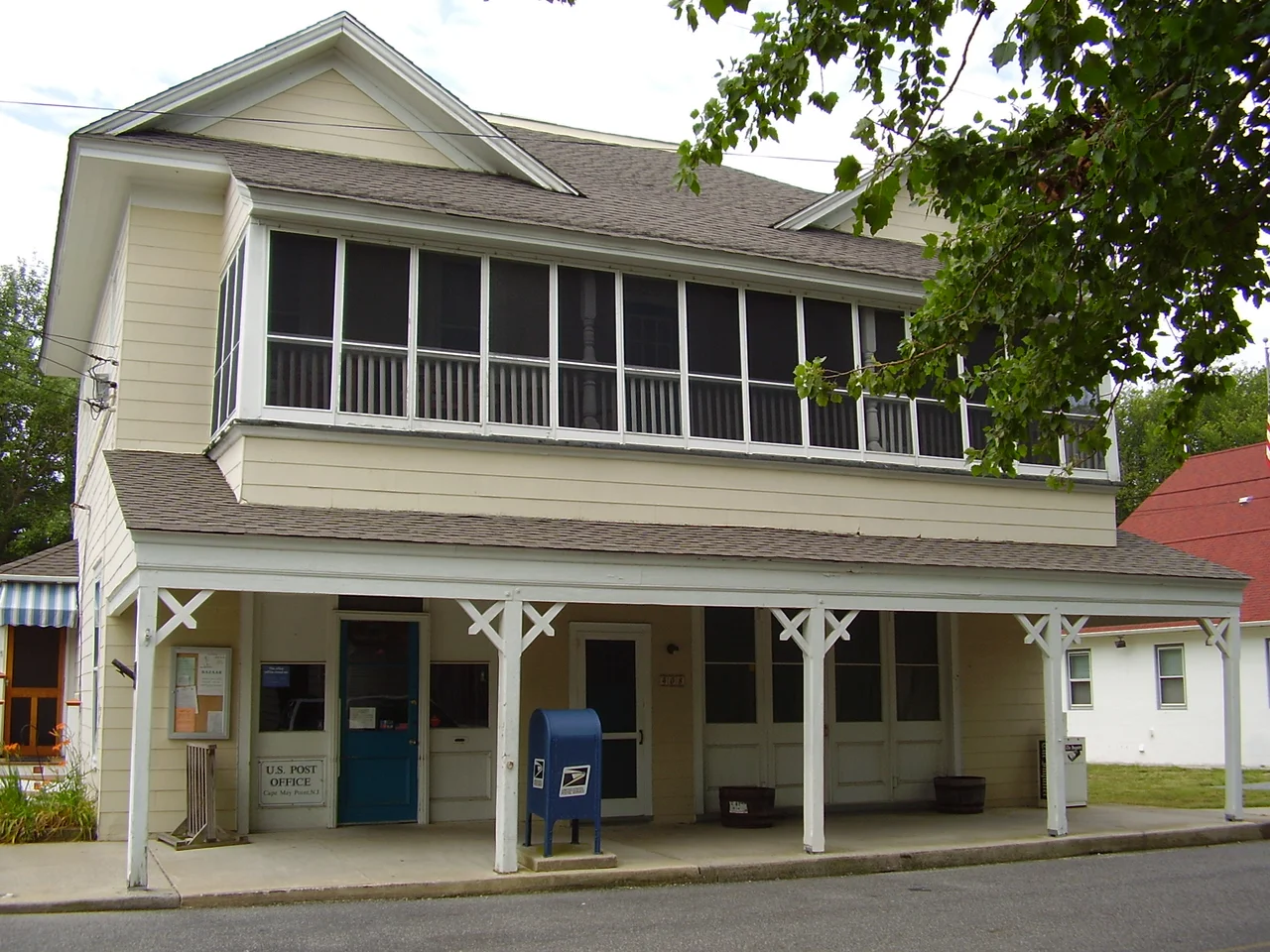

Cape May Point, New Jersey
President Benjamin Harrison spent his summers here, in a cottage that the wealthy Philadelphia retailer John Wanamaker and a circle of associates gifted to him in 1890. Cape May Point was that kind of place - small, exclusive, breeze-cooled, the sort of borough where a sitting president could quietly take the sea air while the country swirled along without him. More than a century later, the borough still holds onto that sense of pleasant insignificance. Roughly three hundred people live here at the southern tip of New Jersey, in a town with no state highways, no chain stores, and a one-room jail that may have set world records for the fewest inmates it ever held.
A President's Quiet Corner
The Harrison cottage was a political gift wrapped as a gesture of friendship. John Wanamaker, who built one of America's first department store empires in Philadelphia, served as Harrison's Postmaster General. When he and his associates handed the president the keys to a Cape May Point cottage in 1890, they gave him something rarer than money: a private place to be ordinary. Harrison was the 23rd president, and his single term in office stretched from 1889 to 1893. He came here to escape the Washington heat and the political weather. The cottage no longer functions as a presidential retreat, but its memory is one of those small details that explains how a borough of three hundred souls keeps producing outsized stories.
The Sisters by the Sea
The largest building in Cape May Point opened in 1889 as the Shoreham Hotel. When the hotel business failed, the property reinvented itself in 1898 as a home for elderly African Americans - documented in the language of its era as the Home for Aged and Infirm Colored People. In 1909, the Sisters of St. Joseph bought the U-shaped, 38,000-square-foot building for $9,000 and renamed it Saint Mary by-the-Sea. For more than a century, Catholic women came here on retreat, watching the Atlantic from porches that ran the length of the building. The COVID-19 pandemic ended that tradition. The sisters announced the retreat's closure in 2021, the latest chapter in a building that has spent its life serving people the wider world often forgot.
The Smallest Jail
When the borough incorporated in 1878, it built itself a one-room jail. Local historian Joe Jordan wrote that the building "may have held several world's records as the smallest jail, with the fewest inmates, and the shortest periods of incarceration." In other words, it probably served as the place where you slept off a bad evening before the constable let you wander home. The borough tried to sell the jail in 1927, got one unimpressive bid, and turned the building into fire department storage instead. In 1983, the whole structure was lifted and moved to Historic Cold Spring Village, where it sits today as a curiosity. It is hard to imagine a more honest monument to Cape May Point's character - small, peaceful, and gently embarrassed by its own infrastructure.
The Three-Town Pact
Cape May Point has rarely had the population to support a full government on its own. For decades it experimented with shared services and special arrangements. The borough used "special" police - ordinary residents pressed into law enforcement when needed - well into the modern era. In 1986 it contracted with West Cape May's police department, then ended that arrangement in 2001. The dissolution helped collapse the West Cape May force entirely. On January 1, 2002, all three municipalities - Cape May City, West Cape May, and Cape May Point - began sharing a single police department, the first such arrangement in New Jersey. People talked about doing it for twenty-five years before they actually did. That is also Cape May Point in a sentence.
A Bird's Map of America
Cape May Point sits at one of the most important migratory bird stopovers on the Atlantic coast. Hawks, songbirds, and butterflies funnel through the southern tip of New Jersey every fall, riding north winds down the peninsula until the open water of Delaware Bay forces them to pause. The borough's most celebrated ornithological connection is David Allen Sibley, who came to Cape May Point in 1980 to work as a hawk counter at the Cape May Bird Observatory. His Sibley Guide to Birds, first published in 2000, became the standard field guide for a generation of North American birders. He learned the silhouettes of warblers in a place where the warblers themselves stack up by the thousands. The wind off the cape is what makes this borough work, and the birds know it before anyone else does.
From the Air
Cape May Point sits at the extreme southern tip of New Jersey at 38.94 degrees north, 74.97 degrees west, where the Atlantic Ocean meets Delaware Bay. From a cruising altitude, the cape appears as a small, flat hook of land surrounded by water on three sides. The nearest airport is Cape May County Airport (KWWD), about six nautical miles north. Atlantic City International (KACY) lies roughly forty nautical miles northeast. Clear weather typically reveals the Cape May Lighthouse and the offshore wreck of the concrete ship SS Atlantus, half-submerged off Sunset Beach.
Nearby Stories
- A. J. Meerwald 4.6 km away
- Longport, New Jersey 13 km away
- Bethany Beach 15 km away
- Ocean Wind 1 19 km away
- Adkins Arboretum 30 km away
- Wicomico County, Maryland 34 km away
- USS General G. W. Goethals 47 km away
- The Brandywine Valley: Where Three Generations Painted America 75 km away