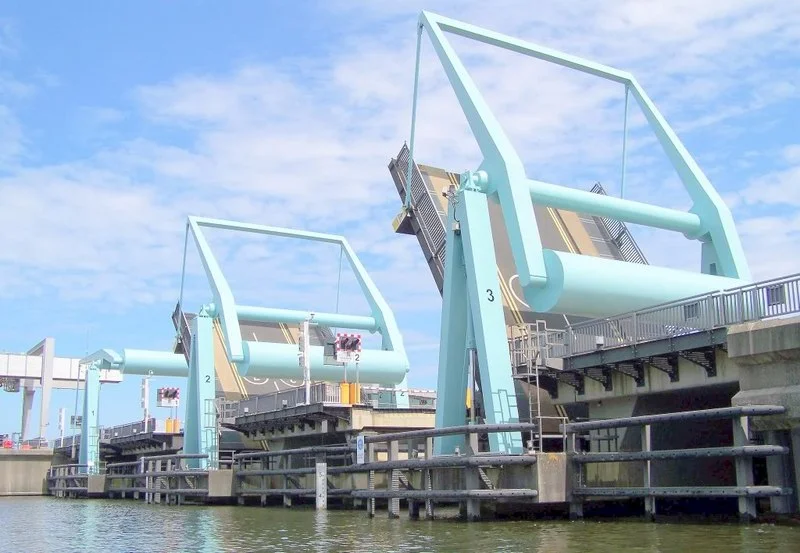

Cardiff Bay Barrage
In the early 1980s, the Welsh Secretary Nicholas Edwards visited the derelict Cardiff docklands and looked at the mudflats. Two hours either side of high water, Cardiff Bay was muddy mile of estuary. The rest of the time it was muddier mile of estuary. Edwards was an opera enthusiast. He had a vision: a vibrant waterfront with restaurants and homes and shops, and at its centre an opera house facing the water. The mudflats were not part of the vision. The solution came from a Welsh Office civil servant named Freddie Watson: build a dam across the bay, hold the rivers Taff and Ely behind it, and convert the tidal mudflats into a permanent 500-acre freshwater lake. It would cost £400 million. It would displace the birds. Margaret Thatcher tried to scrap it. Twenty years later, the Senedd stands on its shore.
The Vision
Cardiff in the early 1980s was a port without a port - the great coal trade gone, the docklands derelict, the buildings boarded up. The Cardiff Bay Development Corporation was established in 1987 to revive 1,100 acres of waterfront, modelled in part on Baltimore's Inner Harbor, where another rusting industrial port had been reborn as a tourist district. Edwards saw it work in Baltimore and wanted it for Cardiff. But Cardiff had a problem Baltimore did not: the Bristol Channel has the second-highest tidal range in the world. At low water the bay drained to a sticky brown plain. No waterfront cafe sells dinner overlooking mud. Freddie Watson's barrage proposal solved the aesthetic problem by creating a permanent freshwater lake from the impounded rivers. It also created several other problems.
The Opposition
Margaret Thatcher did not want the barrage. According to a later BBC investigation, the Prime Minister thought it was too expensive and the economic case too thin. Treasury officials agreed - they had been quietly questioning both the numbers and the methodology for years. In 1990 a parliamentary select committee voted 3 to 1 in favour of the scheme despite admitting they had been unable to examine all the economic details they wanted to see. Thatcher reportedly wanted to scrap the proposal until Nicholas Edwards threatened to resign over it, at which point she yielded. Opposition continued from many quarters. Rhodri Morgan, then Labour MP for Cardiff West and later First Minister of Wales, called the scheme too expensive. Environmental groups protested loudly: the intertidal mudflats were a vital feeding ground for migrating shorebirds. Local residents along the Taff feared groundwater would rise and flood their basements. The Cardiff Bay Barrage Act 1993 passed Parliament with provisions for compensation and for a new wetland habitat further east. Construction began in 1994.
Closing the Gates
Balfour Beatty and Costain built it in a joint venture between 1994 and 1999. The structure runs roughly a kilometre across the mouth of Cardiff Bay between Queen Alexandra Dock and Penarth Head. It contains three locks for maritime traffic (so boats can still get out to the Bristol Channel), a fish pass to let salmon reach their breeding grounds in the Taff, sluice gates to manage water levels, and oxygenation systems borrowed from the Swansea Barrage to keep the new freshwater lake from going stagnant. In November 1999, the sluice gates were closed at high tide, trapping seawater behind the barrage. Over the following weeks the salt was gradually flushed and replaced with freshwater from the rivers. A 200-hectare lake appeared where the mudflats had been. Cardiff Bay had a new shoreline.
The Royal Snub
A grand royal inauguration was planned for St David's Day 2000, with the Queen invited and Rhodri Morgan - a vociferous opponent of the whole project - expected to attend. It never happened. On 1 March 2000, the National Assembly of Wales announced there would be no ceremony. Instead the Cardiff Bay Development Corporation arranged a modest event in its final weeks before dissolution, with a former Lord Mayor and one supportive MP unveiling a plaque. Cardiff Council refused to host the plaque on its land, so the ceremony had to be held at the Penarth end on Vale of Glamorgan Council territory. A seven-foot bronze mermaid - the Development Corporation's logo, designed by Cardiff graphic artist Roger Fickling - was installed on the Penarth roundabout. After the CBDC was wound up on 31 March 2000, Cardiff Council quietly removed the original plaque and installed a new one in the middle of the barrage, with no mention of the Development Corporation. The mermaid stayed.
What the Birds Lost
The freshwater lake worked. Around it has grown the Wales Millennium Centre, the Senedd parliament building, restaurants, hotels, marinas, a watersports culture. The barrage has won engineering awards including the Institution of Civil Engineers Brunel Medal. The pedestrian and cycle route across the top finally opened in 2008, cutting two miles off the journey between Cardiff and Penarth. But the birds did not benefit. Studies published in 2006 confirmed what environmentalists had predicted: the loss of intertidal mudflats meant the shelduck and shorebirds that had wintered in the bay had nowhere to feed. Most could not settle elsewhere. Common redshanks that relocated to the nearby Rhymney estuary showed lower body weights and their annual survival rate dropped from 85% to 78%. Cardiff Bay became the first body of freshwater in Wales infested with zebra mussels - an invasive species that now requires every kayak and canoe leaving the bay to be washed down with bleach before going elsewhere. Toxic blue-green algae still appears in places. The new lake is alive, but it lives differently than the old mud did.
Standing on the Barrage
Walk across the barrage today and on one side you have the Bristol Channel - tidal, brown, the working sea. On the other side you have the freshwater bay - calm, dark, ringed by buildings that did not exist when Edwards first looked at the mudflats. Three bascule bridges over the locks. Sluice gates rising and falling under hydraulic control. A salmon fish pass. The Swiss artist Felice Varini painted three yellow ellipses across the locks and gates in 2007 - 3 Ellipses for 3 Locks - and professional climbers were hired to access the more difficult sections. The barrage was used as a special stage in the 2010 Wales Rally GB. From above, you see two different waters that used to be the same water, separated by a thin line of concrete that took five years to build and changed everything. It is, depending on whom you ask, either a masterpiece of urban regeneration or a monument to what gets lost when the mud is no longer the point.
From the Air
Located at 51.45°N, 3.16°W, spanning the mouth of Cardiff Bay between Queen Alexandra Dock and Penarth Head, on the north shore of the Bristol Channel. The kilometre-long barrage is clearly visible as a thin line separating the calm freshwater lake (Cardiff Bay) from the tidal Bristol Channel. Cardiff (EGFF) is approximately 5 miles west. Best viewed at 1,500-2,500 feet AGL with Cardiff city to the north, Penarth on the southwest side, and the Senedd / Wales Millennium Centre prominent at the bay's north end. On a clear day, Steep Holm and Flat Holm are visible offshore.
Nearby Stories
- Aberfan Disaster 1.3 km away
- Glastonbury 6.5 km away
- Quantock Hills 7.4 km away
- Tyntesfield 7.5 km away
- Tintern 9.2 km away
- The Mumbles Lifeboat Station 19 km away
- Carreg Cennen Castle 20 km away
- Appledore Lifeboat Station 26 km away