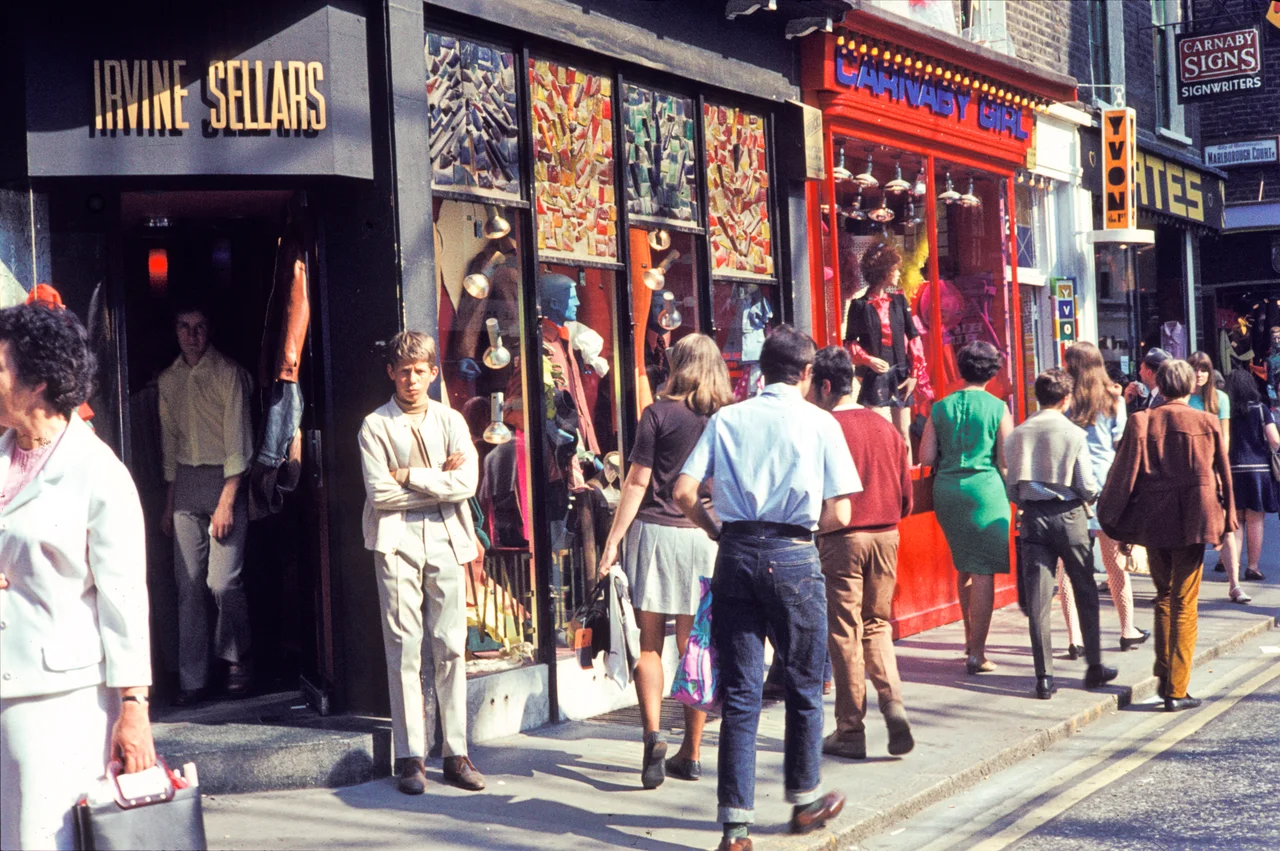

Carnaby Street
In the early 1950s Carnaby Street was a Soho backstreet you walked past, not down. "Rag trade sweat shops, locksmiths and tailors, and a Central Electricity Board depot practically took up one side of the street." That was the assessment of one observer; few would have argued. There was nothing here for tourists, nothing for fashion, and certainly nothing that the world would later associate with the word "swinging." Then in 1954 a male physique photographer named Bill Green opened a small shop called Vince in adjoining Newburgh Street, selling close-fitting clothes to the body-building community that congregated around the Marshall Street baths. Within a decade, that quiet beginning had turned this unremarkable lane into the most photographed shopping street on Earth.
The Doctor and the Pump
Before Carnaby Street became a fashion landmark, the neighbourhood made a different kind of history. In 1854, a cholera outbreak tore through the streets just to the west, killing hundreds in a matter of days. The local physician was John Snow. He started knocking on doors. He plotted every death on a topographical map of the area, building a picture of where the cases clustered. The pattern was unmistakable: nearly all of them lay within a few streets of a water pump on Broad Street - now called Broadwick Street, one of Carnaby Street's parallels. Snow could not yet prove that water carried the disease at the cellular level; that would come later. But he could see it. He persuaded the parish to remove the pump handle. The outbreak ended. Modern epidemiology starts, more or less, with that pump. A reconstruction now stands near the original site, a small pilgrimage spot for public health students. The Carnaby Street area was therefore already, in a quiet way, world-famous - just for entirely different reasons than its later notoriety.
John Stephen's Boutique Revolution
Bill Green's Vince had identified a market: young men who actually wanted to look at clothes. In 1957 the Glaswegian tailor John Stephen, briefly Vince's employee, opened his own shop in Beak Street. When it burned down, he moved around the corner and opened His Clothes at 5 Carnaby Street. Stephen had a genius for accelerated retail - rapidly changing window displays, loud music in the shops, an eye for what would photograph well. Mary Quant later said of him: "He made Carnaby Street. He was Carnaby Street. He invented a look for young men which was wildly exuberant, dashing and fun." The format spread fast. Gear, Mates and Ravel opened nearby. In 1966, Harry Fox and Henry Moss launched Lady Jane, the first women's boutique on the street - and triggered an early viral moment when they put live models in the window getting dressed, bringing Carnaby Street to a standstill. Round the corner in Kingly Street, Tommy Roberts opened Kleptomania; he later moved to Carnaby Street and went on to King's Road as Mr Freedom. The street was, briefly, the engine of an entire industry.
Time Magazine Notices
On 15 April 1966, Time magazine published a cover story titled London: The Swinging City, and Carnaby Street was at its centre. Mary Quant, Marion Foale and Sally Tuffin, Lord John, Merc, Take 6, and Irvine Sellars had all set up shop here. The Small Faces, The Who, and The Rolling Stones came to work at the Marquee Club around the corner in Wardour Street, to shop, and to be seen. The first Cranks restaurant opened at 22 Carnaby Street in 1961 - run by David and Kay Canter and Daphne Swann - and grew into one of the major influences on the spread of British vegetarianism in the decades that followed. Underground music bars like the Roaring Twenties appeared in the surrounding lanes. The Kinks wrote "Dedicated Follower of Fashion" in 1966, with the immortal line: "Everywhere the Carnabetian Army marches on, each one a dedicated follower of fashion." The American teen idol Peggy March recorded a 1969 album titled In der Carnaby Street, with a hit single of the same name. The street had stopped being a place. It had become a brand.
Pedestrianised, Then Tested
In October 1973 the Greater London Council pedestrianised Carnaby Street, restricting vehicle access between 11 a.m. and 8 p.m. A before-and-after comparison found a 30% increase in pedestrian traffic - confirmation that car-free streets could actually be busier than the alternative. But the energy that had defined the place was already shifting. John Stephen closed his last business in 1975. He had built a clothing empire in his early twenties, watched it expand into the world's most photographed retail strip, and saw it slowly become a tourist novelty zone full of Union Jack souvenirs. He died in 2004, aged seventy. The boutique trade that he founded in 1957 still survives in pockets along the street - many small fashion shops carry on the original DNA - but Carnaby Street today is owned by a single property company that brands and themes the area each season. The arches at either end are redecorated regularly: in 2018-19 the entrance arch carried Queen's logo to celebrate Bohemian Rhapsody and Freddie Mercury. The street still works the same trick it always worked, which is to be more about itself than about anything else.
The Earlier Layer
All of this sits on a far older grid. Carnaby Street derives its name from Karnaby House, built in 1683 to the east; the street itself appears in the ratebooks by 1687 and was almost completely built up by 1690. A market was developed in the 1820s, and in his 1845 novel Sybil, Benjamin Disraeli refers to "a carcase-butcher famous in Carnaby-market" - which is to say that the street had been a recognisable bit of London at least a century before fashion got involved. In 1934, Amy Ashwood Garvey and Sam Manning opened the Florence Mills Social Club at number 50, a jazz club named for the Harlem singer that became a gathering place for supporters of Pan-Africanism. Westminster City Council has installed two green plaques on the street: one at number 1, for John Stephen, who triggered the Mod revolution from this address; the other at 52/55, for the Small Faces and their manager Don Arden. The whole street is a layered palimpsest - market, sweatshop, plague map, mod heartland, tourist destination. People walking down it today rarely realise how much sits underneath their feet.
From the Air
Carnaby Street runs north-south through Soho in the City of Westminster at 51.513°N, 0.139°W, between Beak Street and Great Marlborough Street. From the air, the pedestrianised lane sits in the grid west of Regent Street and south of Oxford Street - look for the dense urban block bounded by Regent Street (east), Beak Street (south), Marshall Street (west), and Great Marlborough Street (north). Nearest airport for general aviation is London City (EGLC) about 8 nm east-southeast; London Heathrow (EGLL) is 12 nm west. This is central London Class A airspace; not flyable VFR at low altitude but visible context for any approach over the West End.
Nearby Stories
- Stevenage 5.7 km away
- Malling Abbey 5.7 km away
- 1952 Farnborough Airshow Crash 7.7 km away
- Ingatestone Hall 8.2 km away
- Hellfire Caves 9.1 km away
- The Carrington Event: The Solar Storm That Could Happen Again 9.8 km away
- Bletchley Park 16 km away
- Castle Hedingham 23 km away