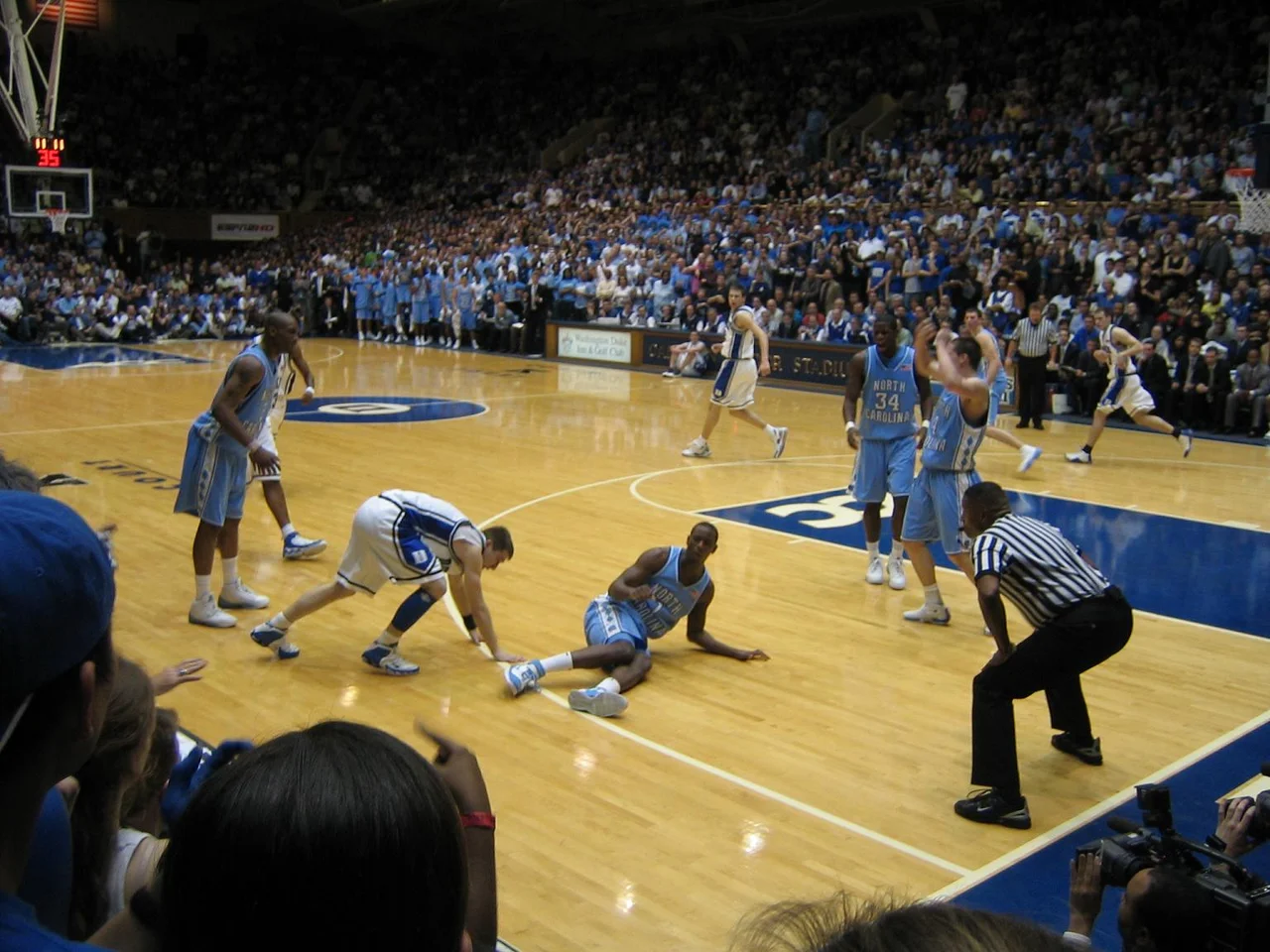

Carolina-Duke Rivalry
Ten miles of asphalt along US 15-501 separates the two campuses, eight miles as the crow flies, and in that small distance lives the loudest argument in American college basketball. The first game was January 24, 1920. The most recent meeting only sharpens the question that has carried more than a century: who owns Tobacco Road? Across 266 games, North Carolina leads Duke 146 to 120. Together the two programs have won eleven national championships since 1982, more than a quarter of all titles in the modern era. A US congressman once told an Associated Press reporter that if Duke played the Taliban, he would have to root for the Taliban. He was a Carolina graduate, and he was only half joking.
Public and Private, Eight Miles Apart
The rivalry's intensity sits on top of an older divide. Duke is private, founded as a Methodist and Quaker school in 1838 and rebuilt with tobacco money in the 1920s. North Carolina is public, chartered in 1789 as the first state university in the country. The student bodies look different. The funding structures differ. The cultures of Durham and Chapel Hill have their own gravity. Wedge in the fact that both basketball programs have been near the top of college sports for half a century, and the smallest games carry generations of accumulated meaning. Almost every year, at least one of these teams contends for a national title.
Heyman and the First Brawl
The modern rivalry has a specific origin. Art Heyman committed to play basketball for North Carolina, then changed his mind and went to Duke. In the 1959-60 season, a brawl broke out between the freshman teams involving Heyman and UNC's Dieter Krause. On February 4, 1961, Heyman and Carolina's Larry Brown started a varsity fight that ended in suspensions for both players. The grudge took root early. Two decades later, when ESPN and the rising network coverage of the ACC put the games on national television, the rivalry stopped being a local feud and became theater. Dean Smith and Mike Krzyzewski coached the cameras as much as the teams.
The Coaches
Dean Smith retired after the 1997 season holding what was then the record for most wins by a Division I men's head coach, 879. Krzyzewski passed him in December 2010, then passed his own mentor Bob Knight, then on January 25, 2015, became the first Division I men's coach to reach 1,000 wins. He retired in 2022 after a Final Four loss to North Carolina in his last game, finishing 50-48 against the Tar Heels across his career. Smith and Krzyzewski coached opposite each other for seventeen seasons. Roy Williams returned to Chapel Hill in 2003 and won three national titles. The names matter because in this rivalry, coaches become characters.
Eight Points in Seventeen Seconds
The games produced moments that fans still recite from memory. March 2, 1974, at Carmichael Auditorium: Duke led by eight with seventeen seconds left, and Carolina tied it before regulation ended, then won in overtime, 96-92. February 2, 2012, at the Dean Smith Center: Carolina led by ten with two minutes left. Austin Rivers hit a three-pointer at the buzzer to win it for Duke, 85-84, with his father, NBA coach Doc Rivers, watching from the stands. In 1991, the schools came within one game of meeting for the national championship in Indianapolis. Kansas upset Carolina in the semifinal, and Duke beat undefeated UNLV by two before winning the title against the same Kansas team. Krzyzewski later said he never wanted to see a Carolina-Duke championship game. The pain of losing it, he said, would have been unbearable.
Franklin Street and Burning Benches
Winning matters here in specific, traditional ways. At Duke, residential quads build benches each year in part so the students can burn them after a Carolina win, then rebuild and burn them again. At Carolina, a win sends thousands of students rushing onto Franklin Street in Chapel Hill, the commercial strip north of campus. Police block the street before tip-off in anticipation. Bonfires often involve Duke-branded gear as fuel. The Duke Chronicle prints a satirical edition called The Daily Tar Hole. The Daily Tar Heel runs an annual column titled "Insider's guide to hating Duke." Each side knows exactly how the other side will celebrate, and what they will say the morning after.
From the Air
The Dean E. Smith Center, home of UNC basketball, sits at roughly 35.90 N, 79.03 W in Chapel Hill. Cameron Indoor Stadium, home of Duke, lies about 8 miles northeast at 36.00 N, 78.94 W on Duke's West Campus near Duke Chapel. From altitude both campuses are easily picked out by the Gothic chapel tower on the Duke side and the bowl of Kenan Memorial Stadium on the Carolina side. Nearest airport: Raleigh-Durham International (KRDU).
Nearby Stories
- Orange County Speedway 3.7 km away
- Tobacco Road 8.7 km away
- Haw River 15 km away
- Johnston County, North Carolina 18 km away
- Soul City, North Carolina 25 km away
- Chinqua Penn Plantation 29 km away
- North Carolina Aviation Museum 40 km away
- Cherry Hill Plantation 45 km away