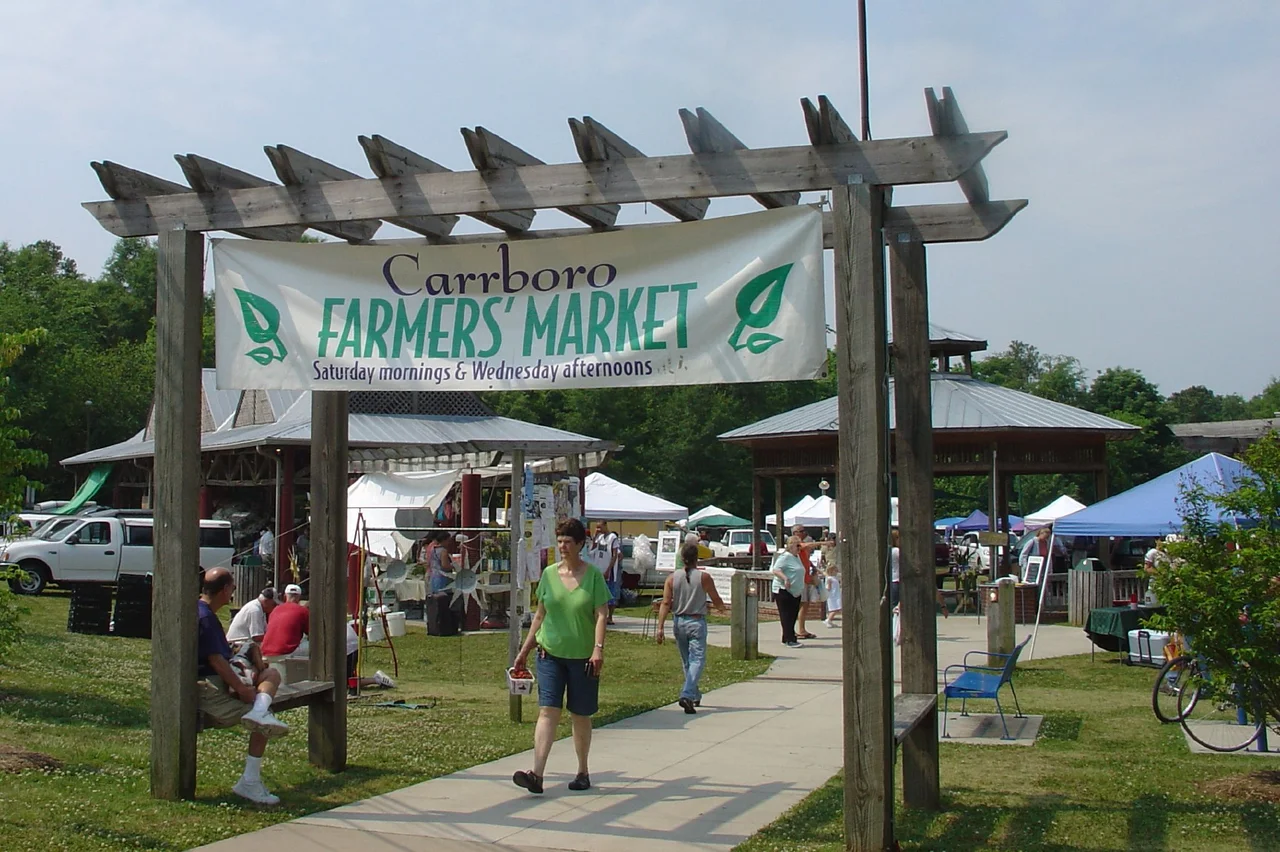

Carrboro, North Carolina
A sardonic reporter coined the nickname in 1970. A political-science graduate student named Nyle Frank had launched what he called the Invisible University in this small mill town just west of Chapel Hill, and announced he would have himself crowned its king. John Martin of the Chapel Hill Weekly looked at the announcement and said: I can see it now, the Paris of the Piedmont. The joke stuck. Carrboro has lived inside it ever since, a town of 21,295 that elects mayors who are openly gay, passes resolutions against the PATRIOT Act, and hosts a Pride Promenade led by a rainbow goat. It is also a town named for a Confederate veteran and white supremacist, a paradox the town has not fully resolved.
West End, Lloydville, Venable, Carrboro
The town has worn four names. The original 1882 settlement was West End, planted in a vacant field at the terminus of a rail spur built one mile from the University of North Carolina campus. State law required that distance, officially to protect student morals, less officially to keep students from leaving on weekends and spending their money elsewhere. In 1898 Thomas F. Lloyd built a steam-powered grist mill, the seed of the Alberta Cotton Mill, and for two years the town called itself Lloydville. Incorporation in 1911 produced Venable, after UNC president Francis Preston Venable. Two years after that came the name that stuck, honoring Durham industrialist Julian S. Carr, who had bought the mill and brought electric power to town.
The Namesake Problem
Julian Carr was a UNC alumnus, trustee, philanthropist, and the man who electrified Carrboro. He was also a Confederate veteran who defended the Ku Klux Klan, opposed Black suffrage, and endorsed the Lost Cause interpretation of the Civil War. At the 1913 dedication of the Silent Sam Confederate monument on UNC's campus, Carr delivered a speech that has become locally infamous, openly celebrating violence against a Black woman near the same spot. When a 2011 article in The Daily Tar Heel brought the speech back into public conversation, residents began asking whether the town should change its name. Former mayor Jim Porto formally proposed it in 2016. In 2017, the Board of Aldermen called for Silent Sam's removal. In 2019, the town installed a truth plaque acknowledging Carr's history. The name itself remains.
From Mill Town to Mall
The cotton mill carried Carrboro through generations. During World War II, Mill No. 7 produced munitions. Pacific Mills bought both Mills 4 and 7 after the war and ran them as Carrboro Woolen Mills until the mid-1960s, when the final activity was sorting and shipping BVD underwear. The textile industry left. The mill sat abandoned through the 1970s. In 1975 the owner planned to demolish it, but a community petition and fundraising drive saved the structure and turned it into Carr Mill Mall, now anchored by Weaver Street Market. Robert "Bob" Drakeford, elected in 1977 as the town's first Black mayor, recalled when Carrboro had been a sundown town where Black residents knew not to be out after dark. He won office in the same town that once kept his neighbors out.
The Paris of the Piedmont
What replaced textiles was something less easily categorized. In 1995, Carrboro became the first municipality in North Carolina to elect an openly gay mayor, Michael Nelson, and the first to grant domestic-partner benefits to same-sex couples. The Carrboro Farmers' Market opened in 1977 and still requires that everything sold come from within fifty miles. Cat's Cradle, the music venue on Main Street, has hosted Nirvana, Public Enemy, and Iggy Pop in its half-century run. The ArtsCenter brought Richard Thompson, k.d. lang, and Dr. John through town. In the early 1990s, Latino immigrants began moving in for construction and service work, and the Hispanic population grew by 936 percent between 1990 and 2003. The town adopted the Universal Declaration of Human Rights in 2009. Bon Appetit eventually called the broader Chapel Hill-Carrboro area America's foodiest small town.
Sister Cities and Rainbow Goats
Carrboro's sister cities include Saratov in Russia, San Jorge in Nicaragua, and two towns in Guanajuato, Mexico. Its annual Pride Promenade features the rainbow goat. The Carrboro Music Festival began in 1998 as a Fete de la Musique on the summer solstice, then moved to fall to escape the heat. Folk guitarist Elizabeth "Libba" Cotten, who wrote "Freight Train," lived here. The town is in Senate district 23, represented at the federal level by Valerie Foushee. Affordable housing has become the local crisis, as with neighboring Chapel Hill. The mill town that named itself after a man who defended the Klan now welcomes Burmese and Karen refugees through its Human Rights Center. The contradiction does not resolve. It simply lives in the same town.
From the Air
Carrboro sits at 35.91 N, 79.08 W, directly west of Chapel Hill in Orange County, North Carolina, at the western edge of the Research Triangle. From the air the town reads as a small grid of streets just outside the wooded UNC campus, identifiable by Carr Mill Mall's industrial roofline near downtown. Nearest airport: Raleigh-Durham International (KRDU) about 18 nautical miles east. Horace Williams Field (KIGX) is closer at about 2 miles, though it serves UNC primarily.
Nearby Stories
- Orange County Speedway 3.7 km away
- Tobacco Road 8.7 km away
- Haw River 15 km away
- Johnston County, North Carolina 18 km away
- Soul City, North Carolina 25 km away
- Chinqua Penn Plantation 29 km away
- North Carolina Aviation Museum 40 km away
- Cherry Hill Plantation 45 km away