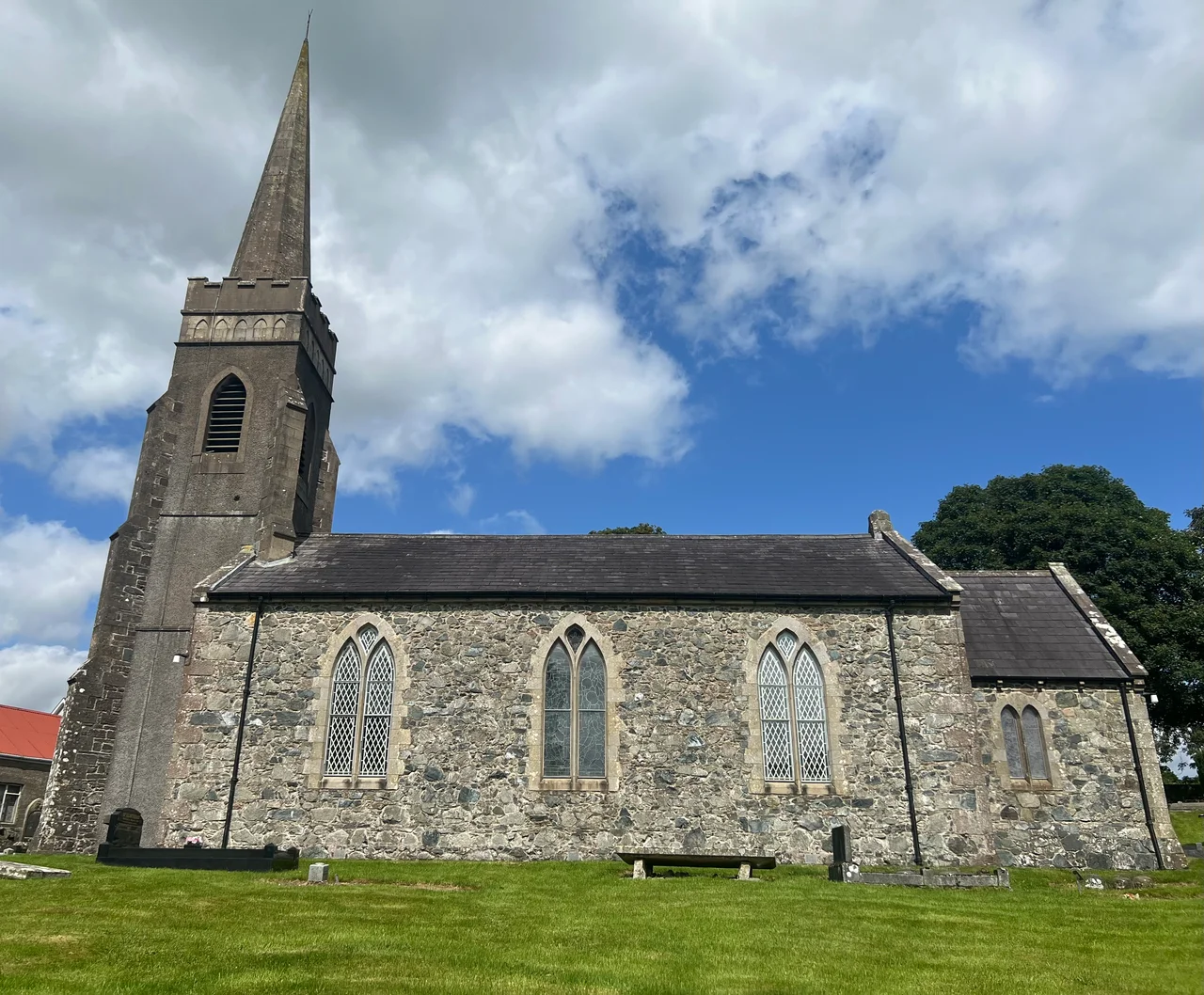

Carrickmore
On 18 April 1854, in the small Church of Ireland parish church of St Columbkille in Carrickmore, Samuel Cobane married Letitia. The marriage register would have been filed and forgotten in some Tyrone records office if not for what happened next. Twenty-one years later, in 1875, the couple left Inishatieve townland and emigrated - first to Canada, then to Washington state. Their fifth-generation descendant was Kurt Cobain, lead singer of Nirvana. A small plaque now marks the connection outside Patrician Hall in the centre of the village. It is one of the stranger threads to find in this tiny rocky hill town in County Tyrone, where Neolithic farmers were burying their dead five thousand years before the Cobane wedding and where political speeches from the steps of Quinns Corner have shaped Irish history for more than a century.
McGurk's Sanctuary
Carrickmore's older name is Termon Rock. Termon - tearmann in Irish - means a sanctuary, a place of refuge granted by the church. The McGurks were the coarbs, the hereditary lay custodians of the parish's church lands, and the parish name Termonmaguirk literally means 'McGurk's sanctuary.' The village sits on a rocky hill - the carraig mhór of its modern name - that has been continuously settled for thousands of years. The hill is studded with cairns, stone circles, standing stones, and ringforts. The Creggandevesky Court Tomb, four miles outside the village, was built between 5,000 and 6,000 years ago by Neolithic people who buried their dead inside ten-foot cairns. During excavations in 1979 and 1982, archaeologists recovered the remains of twenty-one individuals, pottery sherds, flint tools, and a necklace of 112 stone beads. The cairn faces Lough Mallon to the south-east, a tomb angled toward water older than memory.
Saints and Glassmakers
Saint Colmcille founded a monastery at Mullinalap in 550 AD, on a site that had been Celtic before him. Pilgrims came to the holy well there from across Ireland and Europe. A short distance away, Dunmisk Fort - excavated in the 1980s - turned out to be one of Early Christian Ireland's only known industrial sites for making glass, with evidence that both glass-making and glass-working took place inside the same monastic complex of more than four hundred graves. Then there is Relignaman - relig na mban, 'the women's graveyard' - a small sub-rectangular enclosure where local tradition says no living woman and no dead man should enter. It probably dates to the early Christian period, and is just far enough from St Colmcille's church that, locals say, the bell will not wake the dead. The High Cross beside the modern Catholic church stands twenty-four feet tall, carved with scenes from the lives of Irish saints and a depiction of Pope John Paul II placing a prayer in the Western Wall in Jerusalem during his pilgrimage in 2000.
Quinns Corner
On the corner of Main Street and Creggan Road stands an elevated platform that was once a hotel and later a public house, now derelict. Quinns Corner has been the speaking-spot for half the most famous figures in Irish nationalism: Michael Davitt, Roger Casement, Constance Markievicz, Éamon de Valera, Gerry Adams, Tomás Mac Giolla, Liam Kelly, and Bernadette Devlin all addressed crowds from it. On Easter Sunday 1916, sixty men mobilised at Carrickmore in anticipation of the Easter Rising in Dublin. Joseph McGarrity, a key Carrickmore-area figure in Clan na Gael, helped raise American money for the Rising; Patrick McCartan from the same area was another prominent Irish Republican Brotherhood figure. The garden of remembrance on the edge of the village holds the annual commemoration of 1916. For a place of 625 residents, Carrickmore has carried a remarkable amount of political weight.
The Tree of Fortune and the Nally Stand
There is an old tree beneath the Mullinalap monastic settlement that locals say covers a portal to the otherworld. The Fear Dubh - the dark man - is said to have once appeared there and offered mortals a betting game; win and your wishes were granted, lose and your soul was his. According to the story, the Tuatha Dé Danann led by Lugh banished the spirit by sealing the portal with the tree itself, and Lugh declared the place a tearmann. The Aos Sí, descendants of the Tuatha Dé Danann, are said to guard the tree still. A local brewery is named after it. On a more recent note, when Croke Park in Dublin was redeveloped, one of the original stands surrounding the pitch - the Nally Stand - was disassembled, transported to Carrickmore, and reassembled at the local GAA ground. Carrickmore St Colmcille's now plays Gaelic football beneath wooden benches that once watched Hill 16. There is also a small grass airfield run by the C-More Flying Club, where light aircraft from across Ireland and Britain land at the annual fun day. Pre-Christian neolithic tombs, an Easter Rising garden, a Nirvana plaque, and a portal to Mag Mell - all within a few square miles of Tyrone hillside.
From the Air
Coordinates 54.60°N, 7.05°W, on a raised rocky hilltop in central County Tyrone between Cookstown, Dungannon and Omagh. Carrickmore Airfield is a small grass strip on the edge of the village. From 3,000 feet AGL the village sits visibly on its hill with the Sperrin Mountains rising to the north. Nearest large airports are Belfast International (EGAA) about 35 nm east and City of Derry (EGAE) about 30 nm north. Watch for thermals off the Sperrins and the typical undulating Tyrone topography.
Nearby Stories
- Maghera 0.4 km away
- Altinaghree Castle 4.7 km away
- Pettigo 7.1 km away
- Coalisland Canal 7.7 km away
- Marble Arch Caves Global Geopark 8.3 km away
- Rockhill Barracks 10 km away
- County Monaghan 14 km away
- Kingsmill Massacre 19 km away