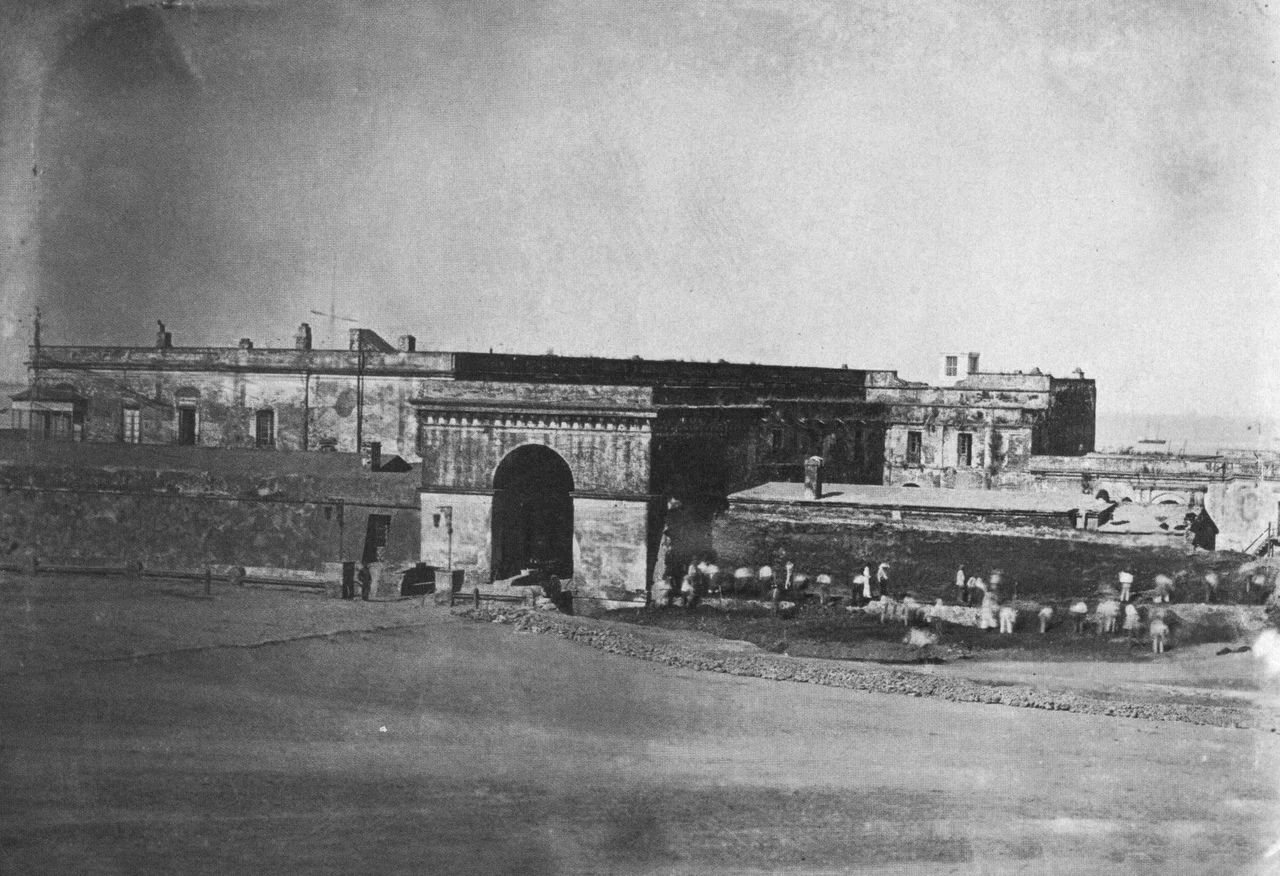

Casa Rosada
Why is the seat of Argentine power painted the color of a sunrise? The most enduring story holds that President Domingo Sarmiento ordered the building washed in pink in the 1860s as an act of political peacemaking, blending the red of the Federalists with the white of the Unitarians, the two factions whose rivalry had soaked the country in blood. A blunter legend says the original paint was simply mixed with cow's blood to fend off the river's humidity. Whichever is true, the result is unmistakable: the Casa Rosada, the Pink House, glowing at the eastern edge of the Plaza de Mayo, the most emblematic building in Buenos Aires and the working office of every Argentine president for more than a century and a half.
Built on a Fort and a Riverbank
The Casa Rosada stands where Argentina has always made its decisions. The Plaza de Mayo has been ringed by the country's most important institutions since the city's foundation in 1580, and this exact spot, once at the very shoreline of the Rio de la Plata, was first occupied by a fort built on the orders of the city's founder, Juan de Garay, in 1594. A masonry castle complete with turrets replaced it in 1713, making the site the nerve center of colonial rule. President Bernardino Rivadavia added a neoclassical portico in 1825. The fort came down in 1857 for a new customs house, and an old administrative annex that survived was pressed into service as the presidential offices in the 1860s. From a riverside fort to a customs house to a palace, the ground has been continuously occupied by power for more than four centuries.
The Balcony
No feature of the Casa Rosada carries more emotional weight than its balcony, the stage from which leaders have spoken directly to the crowds packing the plaza below. It is forever associated with Eva Peron, who addressed her descamisados, the shirtless ones, the working poor who adored her, from this railing. Her final appearance there came on May 1, 1952, when she was dying of cancer. To stand before the crowd at all she had to be given morphine for the metastases in her neck and ankle, and she told the assembled workers she wished to be a rainbow of love between the people and Peron. Within months she was dead, at thirty-three. The balcony made the bond between leader and crowd into something physical, a few meters of open air across which a nation's hopes and grief passed back and forth.
The Day the Sky Attacked
On June 16, 1955, the plaza that had so often held celebration became a killing ground. Around thirty aircraft of the Argentine Navy took off from Moron Air Base and bombed the Casa Rosada and the square before it, striking in waves through the afternoon in a coup attempt against President Juan Peron. The crowds gathered in the plaza had no warning. Estimates of the dead vary and remain contested to this day, but more than three hundred people are believed to have been killed and well over a thousand wounded, many of them civilians, workers, and children caught in the open. It was one of the deadliest acts of political violence in Argentine history, an aerial bombing of a nation's own capital and citizens. The scars it left, in the masonry and in the national memory, never fully healed.
A Hall of Busts, Endlessly Rearranged
Inside the palace, the Hall of Busts offers a quieter but no less revealing drama: marble heads of past presidents, perpetually reshuffled to suit whoever currently holds office. The arrangement is openly political. In 2006 President Nestor Kirchner ordered the removal of the busts of presidents who had seized power in coups. His widow and successor, Cristina Fernandez de Kirchner, broke the chronological order to place allies in places of honor. Mauricio Macri reordered them under the supervision of the national history academy; Alberto Fernandez restored Cristina's arrangement; Javier Milei added a bust of Carlos Menem and moved others away. Some presidents have no bust at all. In few buildings anywhere is the contest over a country's past staged so literally, in marble that gets carried from room to room each time the nation changes its mind about who deserves to be remembered.
From the Air
The Casa Rosada anchors the eastern end of the Plaza de Mayo in central Buenos Aires, at 34.6081 degrees south, 58.3703 degrees west. From the air it is one of the city's most identifiable landmarks: the distinctive pink facade and Italianate portico face west across the open rectangle of the plaza, with the riverfront district of Puerto Madero and the Rio de la Plata just behind it to the east. Trace the ceremonial Avenida de Mayo running west from the plaza to find the green-domed Congress building roughly a kilometer away, a reliable orientation axis. The palace lies about 4 km south of Aeroparque Jorge Newbery (ICAO SABE) on the riverfront, the closest airport, with Ministro Pistarini (Ezeiza) International Airport (ICAO SAEZ) some 30 km to the southwest. The city sits essentially at sea level on the estuary's western bank; the pink walls are best appreciated at low altitude in clear daylight.
Nearby Stories
- Ezeiza Massacre 1.9 km away
- Luján, Buenos Aires 5.1 km away
- Curutchet House 13 km away
- Colonia del Sacramento 17 km away
- Martín García Island 28 km away
- Atucha Nuclear Power Plant 37 km away
- Lobos 43 km away
- Cry of Asencio 87 km away