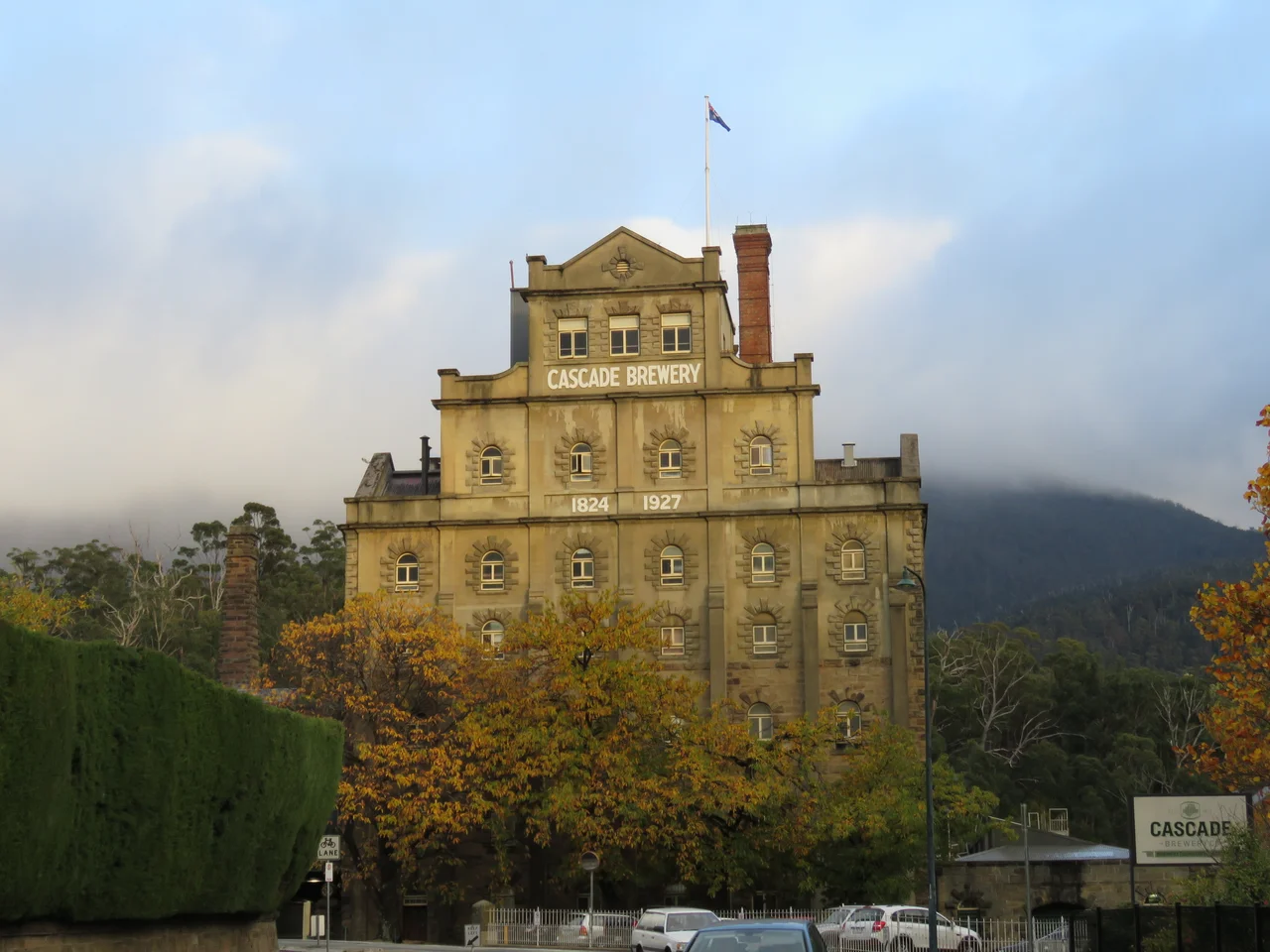

Cascade Brewery
The idea arrived in a prison cell. Peter Degraves, an undischarged bankrupt locked in the old Hobart Gaol, knew that the land his partnership owned at the foot of the mountain had something money could not buy: cold, clear water tumbling down from kunanyi in a cascade that never stopped. When he walked free in 1832, he turned that water into beer. Nearly two centuries later, the Cascade Brewery still stands beside the Hobart Rivulet, its tall Georgian sandstone facade glowing against the green slopes of South Hobart, the oldest continuously operating brewery in Australia.
An Officer, a Bankrupt, and a Sawmill
The Cascade story begins not with beer but with timber. Hugh Macintosh, a retired East India Company officer, sailed from England in 1824 aboard his ship the Hope, bringing along his business partner Degraves. Together they founded Macintosh and Degraves Sawmills, milling the forests above the rivulet from 1825. But Degraves carried trouble with him: debts from England caught up, and he spent years in custody. For a long time the popular history credited Degraves alone as the founder. Research by historian Greg Jefferys, completed in 2011, told a quieter truth: Macintosh was the major partner who paid the partnership's debts and kept the enterprise alive, and Degraves rewrote the record in his own favour after Macintosh died in 1834.
Water From the Mountain
What made the site extraordinary was its setting. Pure meltwater and spring water drained off Mount Wellington straight past the works, and good water is the first ingredient of good beer. The brewery sold its first product in December 1832, and beer soon joined timber as a Cascade export. When the Victorian gold rush erupted across Bass Strait in the 1850s, thirsty diggers and booming towns created enormous demand for both, and Degraves shipped his barrels and his boards to the mainland. The brewery grew into a Hobart institution, its name eventually lending itself even to a local football club and a sporting trophy, the Cascade Cup.
The Thylacine on the Label
Look closely at a Cascade bottle and you will meet a ghost. Since 1987 the label has carried a nineteenth-century illustration of the thylacine, the Tasmanian tiger, drawn by Henry Constantine Richter for John Gould's monumental work The Mammals of Australia. The last known wild thylacine was taken in Tasmania in the 1930s, and the species was declared extinct, which makes its striped silhouette on a living brand quietly poignant. The brewery leans into its Tasmanian roots in other ways too: Cascade is rare among Australian breweries in running its own maltings, turning locally grown barley into malt for its mainstream beers.
Fire and Survival
On 7 February 1967, catastrophe swept down from the hills. The bushfires that devastated south-east Tasmania that day killed 62 people and razed thousands of buildings, and the brewery was nearly destroyed. The fire gutted the structure, yet the response was almost defiant: rebuilding began at once, and beer was flowing again within roughly three months. The surviving sandstone walls, now listed on the Tasmanian Heritage Register, still wear the scale and confidence of colonial Georgian architecture. Today the grounds welcome visitors for guided tours and a garden that frames the old facade against the mountain, a working brewery that doubles as a window onto Hobart's founding decades.
More Than Beer
Cascade has never been only a brewery. Over the years the site grew into a small empire of Tasmanian drinks, bottling apple juice, blackcurrant syrup, cordials, and a long line of sparkling mixers alongside its lagers and stouts; that non-alcoholic side of the business was sold to Coca-Cola Amatil in 2013. The beer brands carry their own folklore among Tasmanians, from the green-labelled Pale Ale to the blue-labelled Lager with its cult following among university students, and an annual First Harvest ale brewed each year from the fresh, unkilned flowers of the first Tasmanian hop crop. To drink a Cascade in Hobart is to taste something local in the most literal sense: barley, hops, and mountain water from the island itself.
From the Air
Cascade Brewery sits at 42.90 degrees south, 147.29 degrees east, in South Hobart at the foot of kunanyi / Mount Wellington (1,271 m). From the air the tall pale Georgian brewery building is a distinctive landmark on the Hobart Rivulet, with the Organ Pipes cliffs rising directly behind it to the west. The nearest major airport is Hobart International Airport (YMHB), about 17 km east-southeast across the Derwent estuary; Cambridge Aerodrome (YCBG) lies nearby. Recommended viewing altitude is 2,000 to 4,000 ft AGL, but note that Mount Wellington's summit and notoriously violent downslope winds demand caution on the western approach; clear, calm mornings give the best light on the sandstone.
Nearby Stories
- Mount Field National Park 6.7 km away
- Bruny Island 19 km away
- Eaglehawk Neck 22 km away
- Maria Island 36 km away
- Lake Pedder 38 km away
- Van Diemen's Land 80 km away
- 2003 Fiordland Earthquake 1547 km away
- Chatham Islands 2954 km away