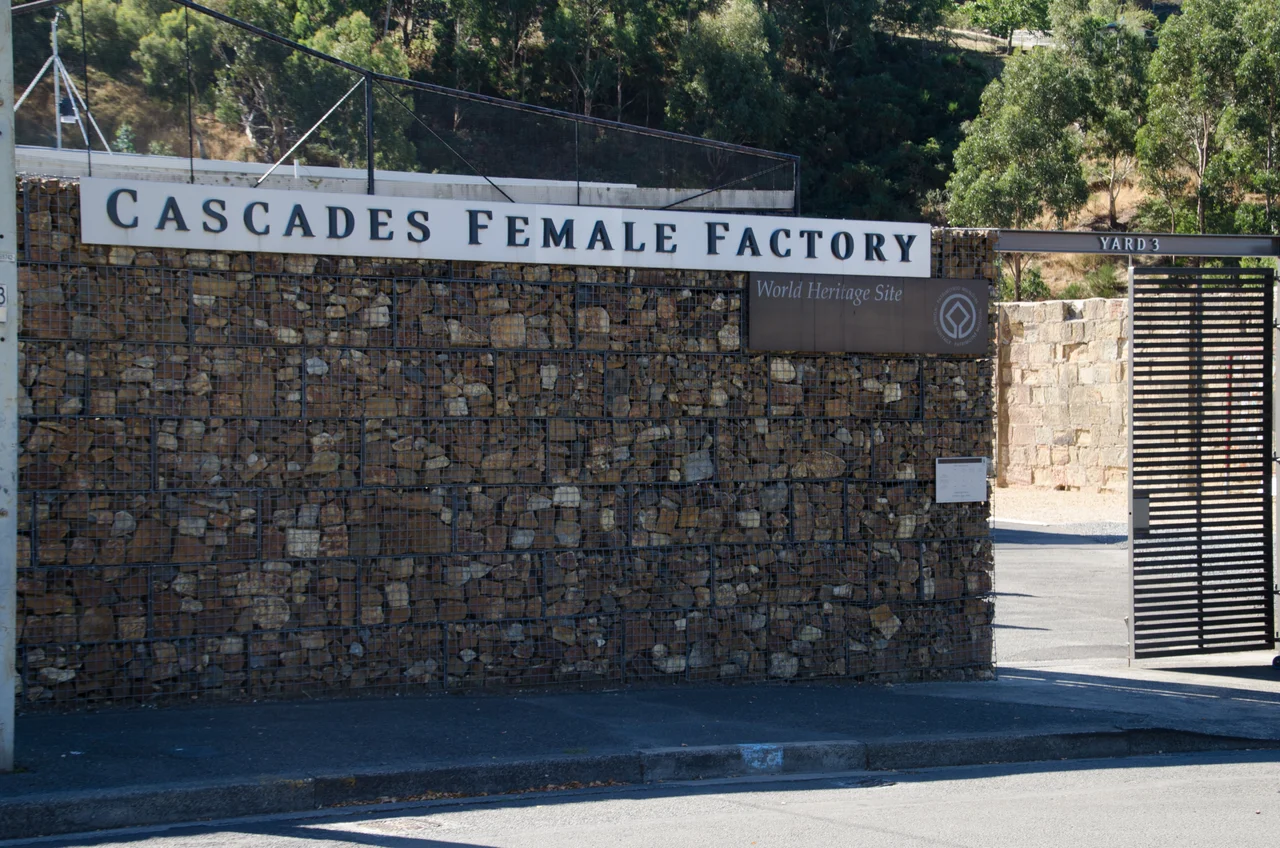

Cascades Female Factory
Walk a few hundred metres up the rivulet from the Cascade Brewery and the mood changes. Here the high sandstone walls enclose not a working business but a memory of suffering. Between 1828 and 1856, the Cascades Female Factory held convict women transported to Van Diemen's Land, far from England and entirely at the mercy of the system that had sent them. The walls that remain enclose mostly empty yards now, but they hold the stories of the women who lived here, and of the children who, far too often, did not live long at all.
Sent to the Bottom of the World
More than half of all convict women transported to Australia were sent to Tasmania, and most passed through this place. Their crimes were usually small, the kind that poverty makes: theft, vagrancy, the offences of women with no safety net. Authorities built the factory in 1828 specifically to remove them from Hobart, fearing their supposed immorality would corrupt the town. The reasoning reveals how these women were seen, not as people who had been failed, but as a contagion to be contained. They came in their thousands, assigned out as servants, returned for punishment, and confined again when they had nowhere else to go.
A House Built on Swamp
The choice of ground was almost cruel in its carelessness. The factory sat in a narrow, sunless valley on damp, swampy land where cold air pooled and water never fully drained. Overcrowding made it worse, and so did the thin food, the inadequate clothing, and the poor sanitation. Disease spread easily. The death rate inside the walls ran at more than one in four, far higher than in the Hobart district outside. Unlike many prisons, where the strongest men were worked hardest, here it was the women and the smallest children who suffered most, and not chiefly from the lash but from the conditions themselves.
The Nurseries
The hardest truth of Cascades lies in its nurseries. Many children were born within these walls, and the system pulled infants from their mothers and weaned them early into rooms where sickness was constant. The infant mortality rate reached roughly sixty-five per cent. Historians have since compiled a list of the children known to have died in the nurseries at Cascades and its associated sites between 1829 and 1856; it runs to 1,148 names. Each name was a baby whose mother carried her own grief out through the gate, if she lived to leave at all. To read that list is to understand that the cost of transportation was paid first by the youngest and most defenceless people in the colony.
Hands That Made Things
It would be a mistake to remember these women only as victims. They were workers, mothers, and makers, and they carried skills across the world with them. The factory was a place of labour: washing, sewing, carding wool, the unending tasks the colony extracted from them. Out of that enforced industry came objects of real beauty and defiance. The most famous is associated with the convict ship Rajah, whose women stitched an extraordinary patchwork coverlet during the long voyage out, the Rajah Quilt, now treasured as one of Australia's great textile artefacts. An interpretation of it is displayed at the site. In every careful seam there is evidence of something the system could not take: the dignity of people who kept making, kept caring for one another, and kept hold of who they were.
Keeping Their Memory
What survives today is partial: three of the five original yards, sandstone walls, a single cottage, fragments of the lives once crowded inside. Yet incompleteness is part of the power. The Cascades Female Factory is the only female factory in Australia whose remains still convey what these institutions were, and in July 2010 it was inscribed on the UNESCO World Heritage List as one of eleven Australian Convict Sites. In 2022 a new History and Interpretation Centre opened to tell the women's stories with the care they were denied in life. A sculpture, From the Shadows, stands outside the gate. The work refuses to let these women remain anonymous, and that, finally, is the point of the place: to give them back their names, and their humanity.
From the Air
The Cascades Female Factory Historic Site lies at 42.89 degrees south, 147.30 degrees east, in South Hobart, tucked into a valley at the base of kunanyi / Mount Wellington and only a short distance upstream from the Cascade Brewery, with which it is easily confused from the air. Look for the enclosed sandstone yards on the valley floor. The nearest major airport is Hobart International Airport (YMHB), roughly 17 km east-southeast across the Derwent estuary; Cambridge Aerodrome (YCBG) is also nearby. Recommended viewing altitude is 2,000 to 3,500 ft AGL. The site sits in mountain shadow for part of the day, so late morning offers the clearest light into the deep, narrow valley.
Nearby Stories
- Mount Field National Park 6.7 km away
- Bruny Island 19 km away
- Eaglehawk Neck 22 km away
- Maria Island 36 km away
- Lake Pedder 38 km away
- Van Diemen's Land 80 km away
- 2003 Fiordland Earthquake 1547 km away
- Chatham Islands 2954 km away